Every gym owner reaches the same fork in the road while building a budget. A full commercial strength line quoted at ₹18 lakh new can often be assembled second-hand for ₹7 lakh, and that gap is hard to ignore when rent, interiors and staffing are all competing for the same capital. The market for used gym equipment India buyers can access has grown quickly, fed by gym closures, franchise upgrades and hotel refits. Some used gym equipment India sellers offer genuinely excellent value. A significant share of it is somebody else’s problem being passed along at a discount. This guide sets out exactly when second-hand is the smarter commercial decision, when it quietly destroys margin, and how to tell the two apart before money changes hands.
Understanding the Used Gym Equipment India Market
The used gym equipment India market does not draw from one place, and where a machine comes from tells you most of what you need to know about its condition.
Where Second-Hand Stock Actually Comes From
Four sources dominate the used gym equipment India supply chain, and they are not equal.
Closed gyms. The largest single source of used gym equipment India listings. A gym that shut after eighteen months usually releases lightly used equipment, and the seller is often distressed, which means real bargaining room. A gym that ran for eight years before closing has equipment at the end of its service life regardless of how it looks.
Upgrade sell-offs. Established chains replacing a strength line on a planned cycle. This is the tier of the used gym equipment India market worth waiting for. This is generally the best stock available: maintained on a schedule, with service records, sold because of a brand refresh rather than a fault.
Hotel and corporate refits. Frequently the best value in the entire used gym equipment India market. Hotel gym machines often see a fraction of the usage of a commercial floor while being maintained under an annual contract.
Import clearances and refurbishers. Container loads of ex-commercial equipment from Europe, the Gulf or the United States, repainted and resold. Quality varies enormously across this part of the used gym equipment India supply, and machines are typically at a much later stage of life than the paint suggests.
Why Prices Vary So Widely
Two apparently identical chest presses can be quoted ₹35,000 apart in the used gym equipment India market. The variance comes from build class, remaining life, spare-part availability and whether anyone will service the unit afterwards. An imported machine with no Indian service network may be cheap because the seller knows a broken cable ends its working life. A domestically manufactured machine costs more second-hand precisely because parts remain available and any competent technician can repair it.
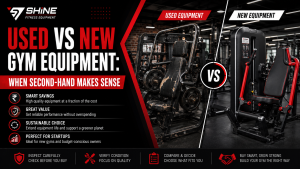
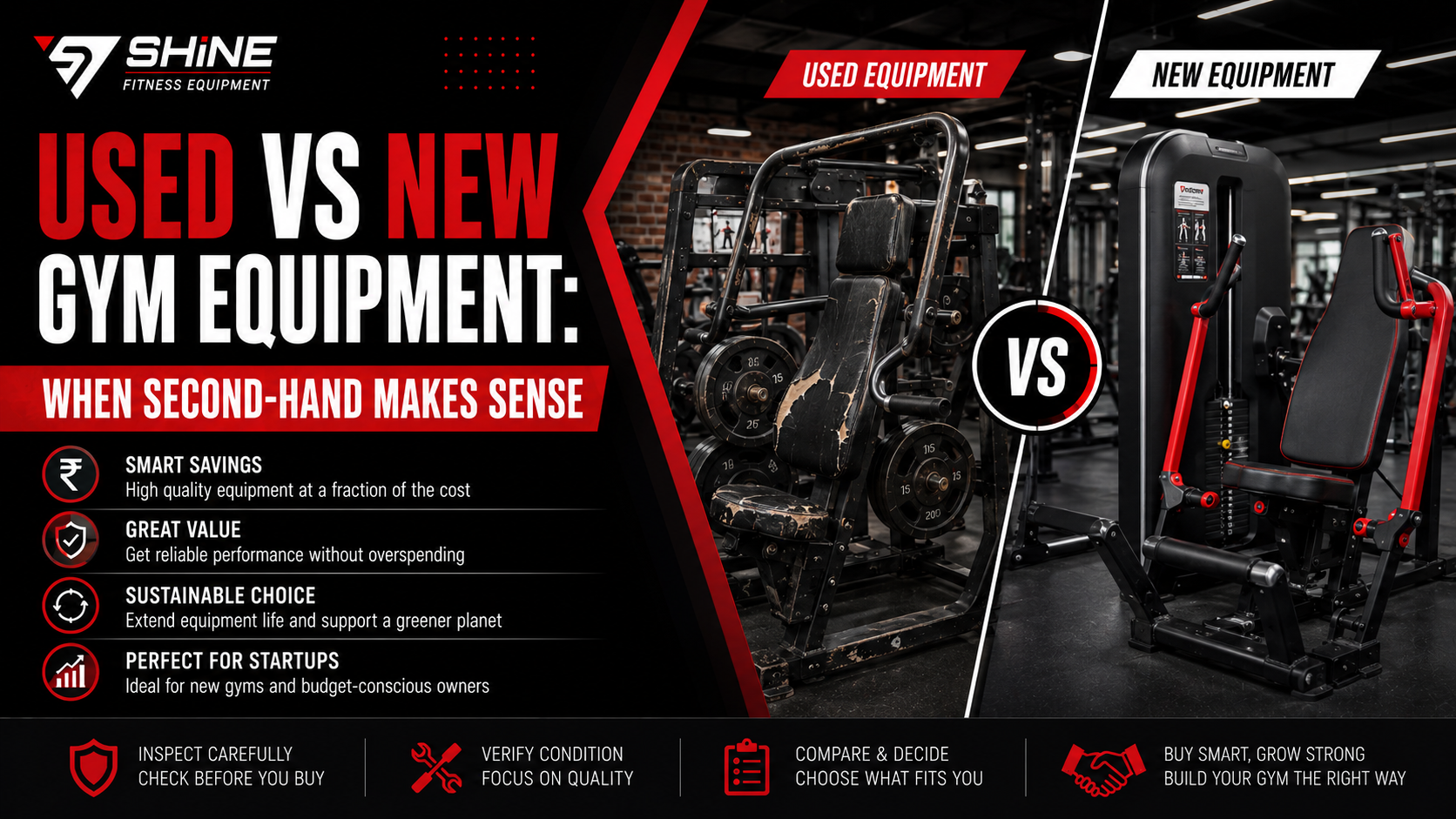
Used vs New Gym Equipment: The Honest Comparison
| Factor | Used equipment | New equipment |
| Upfront cost | 35–60% of new price | Full price |
| Warranty | Rarely any; occasionally 3–6 months | 1–10 years by component |
| Expected remaining life | 3–7 years, highly variable | 10–15 years commercial |
| Spare parts | Uncertain, model dependent | Guaranteed by manufacturer |
| Customization | None; take what exists | Colour, upholstery, branding, layout |
| Delivery timeline | Immediate | 3–8 weeks manufacturing |
| Finance and leasing | Difficult to arrange | Widely available |
| Depreciation claim | Limited, on purchase value | Full, on invoice value |
| Hidden cost risk | High | Low |
| Resale value later | Very low | Moderate |
The table exposes the real trade-off behind every used gym equipment India decision. Second-hand buying converts a capital problem into an operating risk. You save cash today and accept unpredictable downtime, no warranty recourse and a shorter runway before replacement. Whether that trade is sensible depends entirely on your business model, not on the discount percentage.
When Buying Used Gym Equipment India Makes Real Sense
Buying used gym equipment India stock is a genuinely smart decision in a defined set of circumstances:
- You are testing an unproven location. If you are unsure a neighborhood will support a gym, spending ₹7 lakh instead of ₹18 lakh to validate demand is disciplined, not cheap. Buy used, prove the model, reinvest from revenue.
- You need free weights, racks and benches. Plates, dumbbells, barbells, squat racks and benches have almost no wear mechanism. A ten-year-old rack with sound welds is functionally equivalent to a new one, and this is where second-hand delivers its cleanest saving.
- The seller is a chain doing a planned upgrade. Documented maintenance, known usage history and machines still in current production, which means spares stay available.
- You are filling a small studio or PT space. A facility running twenty sessions a day places nowhere near the load of a 400-member gym, so remaining life stretches much further.
- You can buy an entire floor from one closure. Buying thirty matched machines from a single source gives real negotiating leverage and a visually coherent floor, which a piecemeal collection never achieves.
- You have a technician on call. If you already have a reliable partner for gym equipment repair, the main risk of second-hand ownership is substantially reduced.
When Second-Hand Quietly Destroys Margin
The opposite cases are just as clear, and they are where most used gym equipment India purchases go wrong:
- High-membership commercial floors. A machine serving 300 members a day is a revenue asset. Every day a station is out of service costs member goodwill that no discount recovers.
- Motorized cardio. Treadmill motors, controllers and running decks are consumables. A used treadmill at 40% of new price may have consumed 70% of its deck and belt life, and a replacement motor controller can cost more than a new entry-level machine.
- Anything with electronics you cannot source. Consoles, sensors and control boards from discontinued models are frequently unobtainable at any price. The frame stays perfect while the machine becomes unusable.
- Premium positioning. If you charge ₹3,000 a month, worn upholstery and mismatched paint undermine the price you are asking members to pay. Perceived quality is part of the product.
- Anywhere finance matters. Lenders and lessors rarely fund second-hand fitness equipment, so you pay in cash exactly when cash is scarcest.
What Holds Value and What Does Not
Not all categories age the same way, and this distinction matters more in the used gym equipment India market than the overall discount does.
| Category | Ages well? | Buy used? | Reason |
| Olympic plates and dumbbells | Excellent | Yes | Effectively no wear mechanism |
| Racks, half racks, rigs | Excellent | Yes | Inspect welds, then buy confidently |
| Benches | Very good | Yes | Upholstery is cheap to replace |
| Plate-loaded machines | Good | Usually yes | Few consumables, simple bearings |
| Selectorized machines | Moderate | With inspection | Cables, bushings and guide rods wear |
| Cable crossovers, functional trainers | Moderate | With inspection | Cable and pulley condition is critical |
| Treadmills | Poor | Rarely | Motor, deck, belt and board all consume life |
| Ellipticals and bikes | Poor | Rarely | Bearings and electronics fail together |
The pattern is consistent: the simpler the machine, the safer the second-hand purchase. Buying used plate loaded machines and racks while buying cardio new is the split that most experienced operators eventually settle on, because it captures the majority of the saving while removing the majority of the risk.
The Inspection Checklist Before You Pay
Never buy used gym equipment India stock unseen, and never buy from photographs alone. Inspect in person, under load, with the machine’s own weight stack:
- Welds. Look at every joint, especially where uprights meet the base. Cracked or reworked welds mean walk away, no matter the price.
- Frame straightness. Sight along uprights. A bent frame from a drop or bad transport can never be corrected economically.
- Guide rods. Run a bare hand along them. Scoring, pitting or rust means the machine ran misaligned and the bushings are already worn.
- Cables. Flex each cable and check at the ferrules and first pulley. Any broken strand, kink or flattening requires immediate replacement.
- Pulleys. Spin each by hand. Noise, wobble or resistance indicates failed bearings.
- Weight stack. Cycle through every plate. The pin must engage cleanly and the stack must travel smoothly without knocking.
- Bushings and bearings. Move each arm through its full range. Play, clicking or grinding is a repair cost you are inheriting.
- Upholstery and grips. Cosmetic, and useful leverage in negotiation, but budget ₹1,500 to ₹4,000 per pad for reupholstery.
- Rust. Surface rust on paint is manageable. Rust at weld joints or inside tubing is structural and terminal.
- Model currency. Confirm the model is still in production somewhere, or that a supplier stocks compatible cables, bushings and pulleys.
- Provenance. Ask where it ran, for how long, and whether service records exist. A seller who cannot answer is telling you something.
- Complete parts. Check pins, adjustment knobs, safety catches, foot plates and handles. Missing small parts on a discontinued model are surprisingly hard to replace.
Running the Actual Numbers
Discount percentage is the wrong way to judge used gym equipment India offers. Cost per usable year is the right one. Consider a ten-station selectorized circuit:
Used route. Purchase ₹6,50,000. Reupholstery and cables at commissioning, ₹85,000. Transport and installation, ₹60,000. Expected repairs across five years at roughly ₹40,000 a year, ₹2,00,000. Total five-year outlay ₹9,95,000, with the equipment likely due for replacement at that point. Cost per year across five years: ₹1,99,000.
New route. Purchase ₹15,50,000 including installation and warranty. Repairs in years one to five are largely warranty-covered, so budget ₹60,000. Total ₹16,10,000, with roughly eight years of life still remaining and a realistic thirteen-year horizon. Cost per year across thirteen years: ₹1,23,800.
The used option costs approximately 38% less to acquire and roughly 60% more per year of service. That gap narrows sharply if you buy racks and free weights rather than selectorized machines, and it widens further if you buy cardio. This is why the category-by-category split matters far more than a blanket decision either way. Before committing, compare against current commercial gym equipment price levels from a factory-direct manufacturer, because the new-price assumption most buyers carry in their heads is usually based on imported brands rather than domestic ones.
The Middle Path Most Operators Miss
The used gym equipment India question is rarely all-or-nothing, and the strongest floors are usually hybrids:
- Buy free weights, racks and benches used, capturing 50–60% savings on items that barely wear
- Buy strength equipment with cables and moving parts new, where warranty and spare-part access genuinely matter
- Buy cardio new or on a rental contract, so consumable wear stays the supplier’s problem
- Standardize on one manufacturer for new purchases so spares, service and future additions stay simple
Buying factory-direct changes the maths considerably against used gym equipment India pricing. Domestic pricing frequently sits closer to refurbished imported equipment than most buyers expect, while including warranty, installation and ongoing spare-part access. Several operators who set out to buy second-hand end up buying new domestic once they compare properly. It is worth checking against local suppliers in your city, whether that means gym equipment suppliers in Mumbai or a manufacturer shipping direct from Gujarat.
Get a real comparison before you commit. Shine Fitness has manufactured commercial gym equipment in Ahmedabad since 2007, supplying factory-direct with warranty, installation and long-term spare-part support. Send us the used equipment list you are considering and we will quote the equivalent new line so you can compare cost per usable year rather than sticker price. Request a quotation.
Paperwork and Practical Cautions
Used gym equipment India transactions are frequently informal, which creates avoidable exposure:
- Get a proper invoice with GST where the seller is registered. Without it you cannot claim depreciation correctly.
- Confirm ownership, particularly where equipment was leased or financed. Machines with outstanding finance can legally be reclaimed.
- Check import documentation on ex-import stock. If duty was never properly paid when the equipment entered the country, the liability can follow the goods, which is worth understanding alongside the normal rules to import gym equipment in India.
- Ask about any remaining warranty. Manufacturer warranties are almost never transferable, but confirm rather than assume.
- Budget for transport and reinstallation at ₹1,500 to ₹4,000 per machine depending on distance and access, and remember that no gym equipment warranty protects you against damage during a move you organized yourself.
Conclusion
Used gym equipment India stock is neither a shortcut nor a trap. It is a tool with a narrow, well-defined use case. Second-hand works when you are testing a location, when you are buying simple mechanical items with no consumable parts, when you can inspect properly in person, and when you have a technician who can keep the floor running. It fails when the machine is complex, when the electronics are unsupported, when your membership volume is high, or when you are asking members to pay premium rates for a visibly tired floor.
The most reliable way to approach used gym equipment India options is to stop asking what percentage you will save and start asking what each machine will cost per year of dependable service. Judged on that measure, free weights and racks are usually a clear yes, plate-loaded machines are often worth it, selectorized machines depend entirely on inspection, and cardio is almost always a false economy. Split your purchase along those lines, compare seriously against factory-direct new pricing, and you will build a stronger floor for the same money than either approach delivers on its own.
Frequently Asked Questions
Is buying used gym equipment India stock worth it for a new commercial gym?
It is worth it selectively rather than wholesale. For free weights, racks, benches and plate-loaded machines, second-hand typically saves 40 to 60% with very little added risk. For selectorized machines it depends entirely on cable, bushing and guide-rod condition. For motorized cardio it is usually a false economy, because the components that consume life are precisely the expensive ones to replace.
How much should used gym equipment India stock cost compared with new?
As a broad guide, expect to pay 50 to 60% of new price for equipment under three years old in good condition, 35 to 45% for machines three to six years old, and 20 to 30% for anything older or of uncertain provenance. If a seller is asking more than 60% of new price, factory-direct new equipment with a warranty is almost always the better purchase.
Where can I buy reliable used gym equipment India sellers trust?
The most dependable used gym equipment India sources are gyms doing planned upgrades, hotel and corporate refits, and established refurbishers who provide a short warranty. Classified marketplaces carry the widest selection and the highest risk, since there is no inspection, no recourse and often no genuine ownership history. Wherever you buy, inspect in person under load before paying.
What are the biggest risks with used gym equipment India buyers face?
Three risks account for most losses: unobtainable spare parts on discontinued models, structural damage hidden under fresh paint, and equipment that was already at the end of its service life when sold. All three are largely avoidable through a physical inspection focused on welds, guide rods, cables and model currency rather than on cosmetic appearance.
Can used gym equipment India stock be refurbished to near-new condition?
Mechanically, often yes. Cables, bushings, pulleys, upholstery and paint can all be renewed for roughly ₹15,000 to ₹40,000 per station. What cannot be restored economically is a bent or cracked frame, a worn guide rod, or an obsolete electronic console. Refurbishment makes sound machines look and feel new, but it cannot reverse structural fatigue.
Should I buy used cardio machines for a small studio?
Only with clear expectations. Cardio is the weakest category in the used gym equipment India market. A used treadmill in a low-traffic studio may serve well for two to three years, but treat it as a consumable purchase rather than a capital asset, and confirm before buying that the motor controller, deck and belt for that model are still available in India. For anything busier than a small studio, new or rented cardio is the more predictable choice.
Is it better to buy used gym equipment India stock or new from an Indian manufacturer?
Compare the two properly before deciding, because most buyers anchor to imported-brand pricing. Factory-direct Indian manufacturing often lands within 20 to 30% of good refurbished stock while including warranty, installation, spare-part access and the ability to specify colours and layout. For a commercial floor intended to run for a decade, that gap usually closes on cost per usable year. For a home gym setup or a trial location, second-hand remains the sharper use of capital.