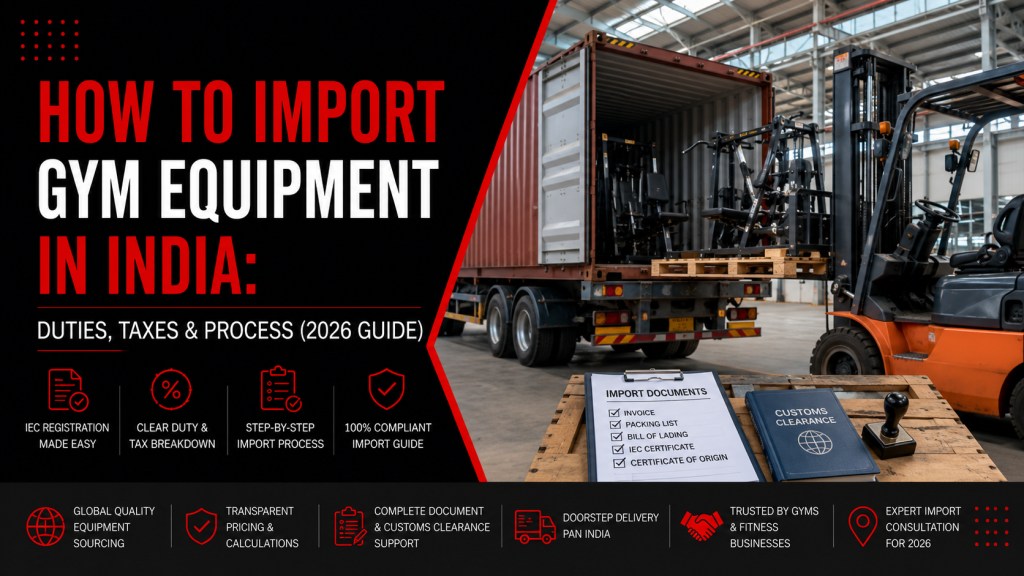
If you are planning to import gym equipment in India for a new commercial gym, a franchise rollout, or a specialized training studio, the sourcing decision usually comes down to two paths: bring in machines from an overseas factory, or buy from an established Indian manufacturer. This guide focuses on the first path. It breaks down exactly what it takes to import gym equipment in India in 2026 the IEC registration, the correct HSN classification, the customs duty and GST you will actually pay, and the paperwork customs officers expect at the port. By the end, you will also see where importing genuinely makes sense, and where it quietly costs first-time buyers far more than they expected once freight, duty, and delays are added up.
Why Businesses Choose to Import Gym Equipment
Not everyone who wants to import gym equipment in India actually needs to look overseas. Indian manufacturing has matured significantly over the last decade, and a lot of the "imported" equipment sold in India is now made locally to the same specification. Still, there are legitimate reasons buyers go down the import route:
- Sourcing a specific international brand that a franchise agreement or trainer certification requires
- Buying niche cardio or biomechanics equipment that isn't yet manufactured in India at scale
- Comparing landed cost against local pricing before finalizing a large multi-location order
- Bringing in equipment as part of a larger machinery or interiors shipment for a new facility
- Testing a new product category before committing to a bulk domestic order
If your reason falls into one of the first two categories, importing can make sense. If it's really about price, it is worth running the numbers first - once duty, GST, freight, insurance, and after-sales logistics are added, imported equipment is frequently not cheaper than sourcing from a gym equipment manufacturer in India, and you lose the ability to walk into a factory and inspect the build quality yourself.
Step 1: Get Your Import Export Code (IEC)
Before you can legally import gym equipment in India, your business needs an Import Export Code (IEC) issued by the Directorate General of Foreign Trade (DGFT). This is a one-time, lifetime registration tied to your firm's PAN, and without it, customs will not clear your shipment and your bank cannot process the outward foreign exchange payment to your supplier.
The IEC application is filed entirely online through the DGFT portal and is usually processed within a few working days once your documents are verified.
Documents You Need for IEC Registration
- PAN card of the business or proprietor
- Business registration proof (GST certificate, incorporation certificate, or partnership deed)
- Cancelled cheque or bank certificate for a current account in the firm's name
- Address proof of the registered business premises
- A valid mobile number and email ID linked to Aadhaar for e-KYC verification
Once issued, remember that every IEC holder is required to confirm and update their IEC details electronically each year between April and June, even if nothing has changed, or the code can become inactive.
Step 2: Classify Your Equipment with the Correct HSN Code
Every product that crosses an Indian port needs an HSN (Harmonized System of Nomenclature) code, and this single number decides your customs duty rate, your GST rate, and whether any additional compliance applies. Most gym and fitness machines fall under Chapter 95, specifically heading 9506, which covers "articles and equipment for general physical exercise." Getting the HSN code for gym equipment wrong is one of the most common and expensive mistakes first-time importers make, since an incorrect classification can trigger reassessment, penalties, or a demand notice months after clearance.
| HSN Code | Typical Equipment | Approx. Basic Customs Duty* |
| 9506 91 90 | General physical exercise equipment (multi-gyms, benches, racks) | ~10% |
| 9506 69 90 | Other sports and fitness articles, select gym accessories | ~20% |
| 9019 20 90 | Powered fitness/therapy apparatus with electronic components | ~7.5% |
*Duty rates are revised in the Union Budget and through periodic CBIC notifications, so always confirm the current rate on the official customs tariff before you place an order or sign a purchase agreement.
A good customs house agent (CHA) or your freight forwarder can help confirm the exact eight-digit code for each item in your shipment, since a single container often mixes multiple HSN codes, for example, a manual leg press and a motorized treadmill in the same order will usually fall under different headings.
Step 3: Work Out the Duties and Taxes You Will Actually Pay
This is the step most first-time buyers underestimate when they import gym equipment in India. Landed cost is not just the supplier's invoice value plus shipping - it is the invoice value plus freight and insurance (which together form the Assessable Value), plus three layers of government levies:
- Basic Customs Duty (BCD): charged on the Assessable Value, at the rate tied to your HSN code (commonly 7.5-20% for fitness equipment)
- Social Welfare Surcharge (SWS): charged at 10% of the BCD amount, not the assessable value
- IGST: Integrated GST, charged at 18% on gym equipment under HSN 9506, calculated on the Assessable Value plus BCD plus SWS combined
Here is what that looks like on a real order. Say you import commercial gym equipment with an Assessable Value (CIF) of ₹10,00,000:
| Component | Rate | Amount (₹) |
| Assessable Value (CIF) | - | 10,00,000 |
| Basic Customs Duty (BCD) | 10% | 1,00,000 |
| Social Welfare Surcharge | 10% of BCD | 10,000 |
| IGST | 18% on (AV+BCD+SWS) | 1,99,800 |
| Total duty & tax payable | - | 3,09,800 |
| Total landed cost | - | 13,09,800 |
That is roughly 31% added on top of your supplier invoice, before you have even paid for local transport, installation, or CHA charges. There is one silver lining for registered businesses: unlike BCD and SWS, the IGST paid at the port can usually be claimed back as Input Tax Credit if your business is GST-registered and the equipment is used for taxable business purposes which meaningfully changes the real cost of the import for a commercial buyer compared to an individual importing for personal use.
Step 4: Documents Required for Customs Clearance
Once your shipment is on the water or in the air, your customs house agent will need a complete, consistent document set to file the entry. Missing or mismatched paperwork is the single biggest cause of port delays and demurrage charges.
- Commercial invoice showing item-wise description, quantity, and value
- Detailed packing list matching the invoice line by line
- Bill of Lading (sea freight) or Airway Bill (air freight)
- Import Export Code (IEC) certificate
- GST registration certificate (GSTIN)
- Certificate of Origin, where a preferential duty rate is being claimed
- Insurance certificate for the shipment
- Any product-specific compliance certificate requested by customs (see the next section)
Step 5: Filing the Bill of Entry and Clearing Customs
With documents in hand, your CHA files the Bill of Entry electronically through ICEGATE, India's customs gateway. This declaration lists the goods, their HSN classification, and the declared value, and it can be filed in advance (a "prior" Bill of Entry) once the vessel schedule is confirmed, so duty assessment can begin before the ship even docks.
Customs then assesses the declaration, and shipments are either cleared on the basis of the paperwork alone or flagged for physical examination new importers and high-value gym equipment shipments are somewhat more likely to be checked, simply because the profile is less familiar to the system. Once the assessing officer is satisfied and duty is paid, an "Out of Charge" order is issued, and the cargo can be moved out of the port to your facility. For a compliant, well-documented shipment, this entire process typically takes two to four working days at a major port, though it can stretch longer during examinations or if a query is raised on valuation.
Compliance and Safety Checks Before You Import
Beyond customs paperwork, a few compliance points are worth checking before you commit to a purchase order:
- Ask the supplier for ISO 9001 or equivalent manufacturing quality certification
- For any equipment with a motor, battery, or electronic display, confirm it is rated for Indian voltage (230V, 50Hz) and plug standards
- Check whether BIS registration applies to the specific electronic component (some powered fitness accessories fall under compulsory registration schemes)
- Request pre-shipment inspection photos or a third-party inspection report before the container is sealed
- Confirm warranty terms are honored in India, not only at the country of manufacture, imported machines with no local service partner can be expensive to repair
Common Mistakes First-Time Importers Make
- Under-declaring the invoice value to reduce duty this is a serious offence and routinely detected during valuation checks
- Assuming the same HSN code applies to every item in a mixed shipment of cardio, strength, and accessory equipment
- Booking sea freight without factoring in port handling, CFS storage, and last-mile transport for oversized, heavy machines
- Skipping a pre-shipment inspection and discovering damage or spec mismatches only after customs clearance
- Not confirming whether the IGST paid can actually be claimed as Input Tax Credit before assuming it as a "recoverable" cost
Import vs. Buying from a Gym Equipment Manufacturer in India
Before you commit budget and time to an international order, it is worth comparing the two paths side by side, since the decision to import gym equipment in India only pays off in specific situations. Many gym owners start out planning to import, then switch after seeing the real cost and timeline difference against sourcing from a commercial gym equipment manufacturer already operating in India.
| Factor | Importing Equipment | Buying from an Indian Manufacturer |
| Typical lead time | 6-12 weeks (production + shipping + clearance) | 1-4 weeks, often from ready stock |
| Landed cost impact | +25-35% in duty, GST, freight, and CHA fees | GST only (18%), no customs layer |
| Quality inspection | Photos or third-party report only | Factory visit and physical inspection possible |
| After-sales service | Depends on local distributor, if any | Direct manufacturer support and spares |
| Customization | Limited, tied to supplier's standard range | Often available directly with the manufacturer |
| Currency and freight risk | Exposed to exchange rate and shipping delays | None |
For buyers who simply need reliable, durable strength equipment, benches, and plate-loaded machines without the wait, sourcing locally is usually the faster and financially safer route. It is also worth browsing what is already available to buy gym equipment online in India before finalizing an overseas order, since domestic catalogues have expanded considerably over the past few years.
If your business genuinely needs to import - say, for a specific franchise-mandated brand it still helps to request a comparative quote from a domestic gym equipment manufacturer in India first, purely as a cost and lead-time benchmark. It is common to find that a plate loaded gym equipment range or a full multi-station setup manufactured domestically matches import specifications at a fraction of the landed cost and delivery time. Reputable gym equipment suppliers in India can usually turn around a written quotation within a day or two, which makes the comparison easy before you commit foreign currency to an overseas order.
If you would rather skip the customs paperwork altogether, get in touch with our team for a same-week quote on strength equipment, benches, and plate-loaded machines manufactured and stocked in India.
Conclusion
Importing gym equipment in India is entirely doable, and for certain brands and product categories it is the only option. But it is not a light undertaking - IEC registration, correct HSN classification, customs duty, SWS, IGST, and a full clearance document set all have to line up correctly, and a single mistake in valuation or classification can hold up a container for weeks. Before you sign an international purchase order, run the full landed-cost math, factor in realistic lead times, and get at least one comparative quote from an Indian manufacturer. For a lot of buyers, that comparison alone ends up settling the decision.
FAQs
1. Is an Import Export Code (IEC) mandatory to import gym equipment in India?
Yes, for any commercial import. An IEC from DGFT is required before customs will clear your shipment, and your bank will also ask for it before releasing payment to an overseas supplier.
2. What is the HSN code for gym equipment in India?
Most gym and fitness machines fall under heading 9506, with the exact eight-digit code (commonly 9506 91 90 or 9506 69 90) depending on the specific product. Powered equipment with electronic components sometimes falls under a different heading, so always confirm with your CHA before shipping.
3. How much is customs duty on imported gym equipment?
Basic Customs Duty typically ranges from around 7.5% to 20% depending on the HSN code, plus a 10% Social Welfare Surcharge on that duty amount, plus 18% IGST calculated on the combined value. Total duty and tax usually adds roughly 25-35% on top of the invoice value.
4. Can I claim back the GST paid on imported gym equipment?
If your business is GST-registered and the equipment is used for taxable business purposes, the IGST paid at import can generally be claimed as Input Tax Credit. Basic Customs Duty and the Social Welfare Surcharge, however, are not recoverable.
5. How long does it take to import gym equipment into India?
Realistically, budget 6 to 12 weeks end to end: production time at the supplier's factory, ocean or air transit, and customs clearance. Clearance itself usually takes 2 to 4 working days once the shipment lands, assuming the paperwork is complete and consistent.
6. Do I need BIS certification to import gym equipment?
It depends on the product. Purely mechanical equipment (benches, racks, plate-loaded machines) generally does not require BIS registration, but powered equipment with electronic or battery components may fall under compulsory registration requirements, so it is worth checking against the current BIS list before you order.
7. Is it cheaper to import gym equipment or buy from an Indian manufacturer?
For most standard strength and cardio equipment, buying domestically works out cheaper once duty, IGST, freight, insurance, and CHA charges are added to an import order, and delivery is far faster. Importing tends to make financial sense only for specific brands or specialized equipment that isn't manufactured in India.