The gym setup cost in India ranges from ₹12 lakh for a compact strength studio to ₹2.3 crore for a full commercial club. That spread is wide because It is never a single figure. It is the sum of five distinct expenditure heads, each of which behaves differently as floor area increases.A guide quantifies the gym setup cost in India by facility size, by equipment category and by ownership model, using current pricing from domestic manufacturers rather than imported premium lines. Every figure assumes commercial-grade machines sourced directly from a gym equipment manufacturer at factory rates.
Gym Setup Cost in India at a Glance
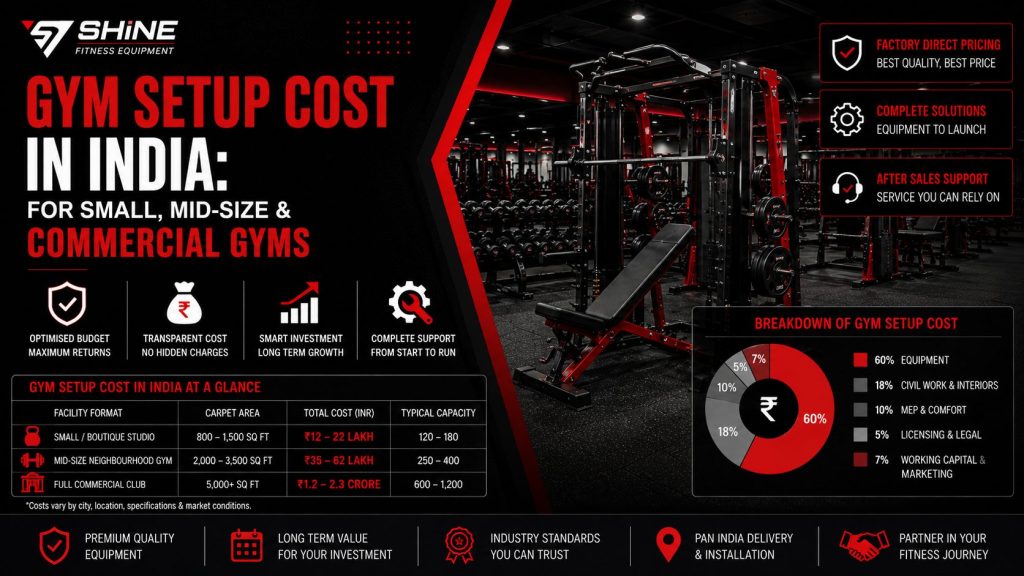
Before the detail, the headline numbers. The table below summarises the total gym setup cost in India across the three formats that dominate the market.
| Facility Format | Carpet Area | Total Gym Setup Cost in India | Typical Member Capacity |
| Small / boutique studio | 800-1,500 sq ft | ₹12-22 lakh | 120-180 |
| Mid-size neighbourhood gym | 2,000-3,500 sq ft | ₹35-62 lakh | 250-400 |
| Full commercial club | 5,000+ sq ft | ₹1.2-2.3 crore | 600-1,200 |
These bands assume a tier-2 city cost base. Tier-1 metros raise the gym setup cost in India by 25-40% on rent, civil work and salaries, while leaving the equipment line largely unchanged.
Factors That Determine Gym Setup Cost in India
Two facilities of identical square footage in the same city can differ by 60% in total outlay. The variance rarely originates in the machines themselves. It originates in three decisions taken before any equipment is ordered.
Location and Lease Structure
Rent establishes the floor beneath the gym setup cost in India. A ground-floor unit with lift access and parking in a tier-1 suburb commands ₹80,000-₹2,00,000 monthly, while comparable carpet area in a tier-2 city runs ₹30,000-₹75,000. Most landlords require six months’ deposit, which is capital held idle from commencement.
Ceiling height and floor loading impose further constraints. Cable stations and functional rigs require 9.5-10 feet of clear height, and upper-floor premises frequently cannot accept the point loading of a fully plated leg press without reinforcement, adding ₹1.5-4 lakh to the gym setup cost that no initial budget anticipated.
Equipment Sourcing
Sourcing is where the widest variance in gym setup cost occurs. Purchasing directly from the factory eliminates two to three distributor margins on every machine. Imported selectorized lines cost two to three times comparable Indian-manufactured commercial equipment, for a durability differential that seldom justifies the premium in a 200-400 member facility.
Consolidating the order with one supplier compounds the saving. A single-vendor package typically reduces the equipment component of the gym setup cost in India by 15-25% against assembling the same floor from multiple dealers, and consolidates warranty and service into one point of accountability. The factory-direct pricing guide sets out how a manufacturer quotation is normally structured.
Fit-Out Specification
Glass partitions, false ceilings and imported flooring can double the interiors line without adding a single member. Ambitious fit-out inflates the gym setup cost in India faster than any other discretionary head, and it is the head with the weakest correlation to retention. Members renew because the equipment functions and the floor is clean.
The Five Cost Heads Within Gym Setup Cost in India
Every budget line ultimately belongs to one of five categories, and It is simply their sum. Whatever the scale of the project, the total gym setup cost resolves into five heads. The proportions matter more than the absolute figure.
- Equipment 55-65%. Strength machines, plate-loaded stations, benches, racks, free weights and cardio. The largest single component of gym setup cost in India, and the one worth optimising rather than cutting.
- Civil work and interiors 15-20%. Flooring, mirrors, painting, partitioning, changing rooms, reception and washrooms.
- MEP and comfort 8-12%. Electricals, air conditioning or industrial ventilation, lighting, sound and water supply.
- Licensing, legal and insurance 3-5%. Trade licence, GST registration, fire NOC, public liability cover and shop and establishment registration.
- Working capital and pre-launch marketing 8-12%. Three to six months of salaries and rent, signage, launch campaign and management software. Underfunding this head closes more gyms in year one than any equipment decision.
Gym Setup Cost in India by Facility Size
| Cost Head | Small Studio (800-1,500 sq ft) | Mid-Size Gym (2,000-3,500 sq ft) | Commercial Club (5,000+ sq ft) |
| Strength & plate-loaded equipment | ₹5-8 lakh | ₹14-22 lakh | ₹40-70 lakh |
| Cardio equipment | ₹1.5-3 lakh | ₹6-12 lakh | ₹25-50 lakh |
| Free weights & storage | ₹1-2 lakh | ₹3-5 lakh | ₹8-15 lakh |
| Flooring & interiors | ₹1.5-3 lakh | ₹4-8 lakh | ₹15-35 lakh |
| Electricals, AC & lighting | ₹1-2 lakh | ₹3-6 lakh | ₹12-25 lakh |
| Licences, legal & insurance | ₹40,000-80,000 | ₹80,000-₹1.5 lakh | ₹2-5 lakh |
| Working capital (3 months) | ₹1.5-3 lakh | ₹4-8 lakh | ₹15-30 lakh |
| Indicative total | ₹12-22 lakh | ₹35-62 lakh | ₹1.2-2.3 crore |
Small Studio Gym Setup Cost in India
The small-format studio is the fastest-growing segment in the country, and the most efficient version of it is strength-led. Cardio carries the highest capital cost per square foot and depreciates fastest, so a studio that directs 70% of its equipment budget toward plate loaded gym equipment and benches returns more than one buying treadmills it cannot fill.
A viable equipment configuration at this gym setup cost in India comprises one lat pulldown, one chest press machine, one shoulder press, a combination leg station, a cable crossover, four benches, a half rack, dumbbells to 40 kg and three cardio units. That specification holds the small studio gym setup cost in India within the ₹12-22 lakh band.
Mid-Size Gym Setup Cost in India
This format is the most consistently profitable in the market. At 2,000-3,500 sq ft, parallel strength circuits become possible and member throughput ceases to bottleneck at peak hours. The equipment mix widens to include leg extension, leg curl, adductor, calf, pec fly and rear delt stations, plus a free-weight zone built around an Olympic bench line and multiple racks.
Allocate ₹14-22 lakh to strength, ₹6-12 lakh to cardio and ₹4-8 lakh to working capital. A facility at this scale charging ₹1,500-₹2,500 monthly with 250 members recovers its gym setup cost in India between month 14 and month 22.
Commercial Club Gym Setup Cost in India
At club scale the drivers shift from equipment toward experience: air conditioning across large volumes, premium changing rooms, group exercise studios and a front-of-house team. Equipment remains the largest single line but falls to 45-55% of the total gym setup cost in India rather than 65%.
Clubs also require duplicate stations, since one chest press serving 600 members produces queues that register directly in the renewal rate. Plan two to three units of every high-traffic station. Factory-direct strength equipment sourcing therefore matters most at this scale, where a 20% saving on a ₹60 lakh order returns ₹12 lakh to interiors or marketing.
Gym Equipment Price List: Category-Wise Rates
A gym equipment price list is best read as bands rather than fixed figures, because Indian commercial machines are priced on steel gauge, upholstery grade, bearing quality and finish.
| Equipment | Indicative Price Band | Principal Cost Driver |
| Chest press / shoulder press (plate loaded) | ₹45,000 to ₹90,000 | Converging versus fixed-path arms |
| Lat pulldown machine | ₹40,000 to ₹85,000 | Stack weight and pulley quality |
| Cable cross over machine | ₹80,000 to ₹1,80,000 | Dual stack and adjustable columns |
| 45° leg press machine | ₹75,000 to ₹1,50,000 | Carriage bearing type |
| Leg press with hack squat combo | ₹1,10,000 to ₹2,20,000 | Replaces two separate stations |
| Smith machine / power cage | ₹70,000 to ₹1,60,000 | Linear bearings versus bushings |
| Olympic bench (flat/incline/decline) | ₹12,000 to ₹30,000 each | Frame gauge and pad density |
| Dumbbell set (2.5-50 kg, rubber) | ₹2.5 to ₹5 lakh | Priced per kilogram |
| Commercial treadmill | ₹1.5 to ₹4 lakh | Motor rating and deck cushioning |
| Rubber gym flooring | ₹110 to ₹280 per sq ft | Thickness and density |
Two qualifications apply when converting any gym equipment price list into a budget. Plates and dumbbells are priced per kilogram, so cost scales linearly with the weight stocked. Freight and installation are frequently quoted separately and add 3-6% to the equipment portion of the gym setup cost in India. Always request a landed, installed figure before comparing quotations.
How to Start a Gym Business in India
Owners researching how to start a gym business in India generally want a checklist. Sequence matters more than the list itself, because two of these steps become irreversible once capital is committed.
- Validate the catchment. Count competing facilities within two kilometres and establish prevailing membership rates. A market supporting ₹1,200 memberships will not sustain a ₹3,000 concept irrespective of equipment quality.
- Complete the structural survey before signing. Confirm ceiling height, floor loading, sanctioned power, water availability and parking. Retrofitting these inflates the gym setup cost in India substantially; relocating costs more.
- Finalise the equipment layout before civil work. Flooring thickness, socket positions and mirror placement all follow the machine plan. Reversing that order guarantees rework.
- Process licensing in parallel. Registrations run on independent timelines and total ₹40,000 to ₹2 lakh.
- Pre-sell for six to eight weeks. Facilities launching with 60-100 founding members reach breakeven materially earlier. Regional supplier directories for Delhi NCR and Mumbai can help align delivery to the pre-sale calendar.
Gym Franchise Setup Cost Compared With an Independent Build
The gym franchise setup cost in India runs 40-70% above an equivalent independent build. Three heads account for the difference: a one-time brand fee, mandated equipment and interior specifications, and an ongoing royalty.
| Factor | Independent Gym | Franchise Gym |
| Upfront capital (2,500 sq ft) | ₹35-62 lakh | ₹60 lakh to ₹1.1 crore |
| One-time brand fee | None | ₹5-25 lakh |
| Ongoing royalty | None | 6-10% of revenue |
| Equipment sourcing freedom | Unrestricted | Approved vendors only |
| Typical breakeven | 14-24 months | 24-36 months |
| Brand recognition at launch | Built from zero | Immediate |
The distinction is strategic. A franchise suits operators entering a competitive metro catchment without prior experience. An independent build suits operators who know their catchment and want margin control. Because approved-vendor lists remove negotiating latitude, the gym franchise setup cost is least flexible precisely where an independent owner saves most.
Recurring Costs After Launch
The gym setup cost in India is only half the financial picture. For a 2,500 sq ft facility, plan monthly operating expenditure of ₹2.5-3.2 lakh: rent ₹60,000-₹1.2 lakh, salaries ₹90,000-₹1.5 lakh, electricity ₹25,000-₹60,000, housekeeping ₹15,000-₹25,000, marketing ₹20,000-₹40,000 and equipment maintenance ₹8,000-₹15,000.
Maintenance is the line most frequently underestimated when owners model the gym setup cost. Cables, upholstery and bearings are consumables in commercial use. Provisioning for them keeps machines earning; neglecting them converts a ₹3,000 cable replacement into a ₹40,000 rebuild.
How to Reduce Gym Setup Cost in India Without Compromising Quality
- Buy direct from the manufacturer. Removing distributor margins is the single largest controllable reduction in gym setup cost, typically 20-30% on the equipment head.
- Phase cardio. Treadmills carry the highest capital cost and fastest depreciation. Add them from operating cash flow once demand is demonstrated.
- Moderate the interiors specification. Redirect discretionary fit-out budget toward machine quality.
- Protect working capital. A facility opening with fewer machines and six months of runway is more resilient than one opening fully equipped with two weeks of cash.
- Never phase infrastructure. Flooring, electricals and air conditioning must be completed before opening, since retrofitting requires closing the floor.
Approached this way, the gym setup cost in India becomes an investment with a measurable payback period rather than a figure to be recovered on hope. To price a complete floor plan against your own square footage, contact the Shine Fitness team or review the full product range.
Frequently Asked Questions
What is the minimum budget required to open a small gym?
A functional 800-1,200 sq ft facility can be established for ₹12-22 lakh in a tier-2 or tier-3 city, covering commercial strength machines, a free-weight section, basic cardio, rubber flooring, mirrors, licensing and three months of working capital. Falling below ₹10 lakh generally means compromising either equipment gauge or operating runway, and both compromises surface within the first year.
How much of the total budget should equipment absorb?
Equipment represents 55-65% of total investment in small and mid-size facilities and 45-55% in large clubs. For a 2,000-2,500 sq ft gym, allocate ₹18-30 lakh: ₹14-22 lakh for strength and plate-loaded machines, ₹6-12 lakh for cardio, and ₹3-5 lakh for dumbbells, plates and storage.
How long does a new gym take to recover its investment?
A well-located independent facility generally breaks even in 14-24 months, while franchise formats require 24-36 months owing to the higher capital base and ongoing royalty. As a working model, 250 members paying ₹1,800 monthly generate ₹4.5 lakh against ₹2.5-3.2 lakh in operating expenditure. Retention influences profitability considerably more than acquisition.
Does imported equipment justify its price premium?
For the substantial majority of Indian facilities, no. Domestically manufactured commercial machines cost 50-65% less, spare parts arrive within days rather than months, and service engineers are locally available. The build-quality differential on plate-loaded and strength equipment has narrowed considerably over the past decade, leaving imported lines relevant mainly to premium clubs whose positioning depends on a specific brand appearing on the floor.
Which licences are required to operate a gym?
Shop and establishment registration, a municipal trade licence, GST registration above the turnover threshold, a fire safety NOC and public liability insurance. Certain municipalities additionally require a health trade licence and music licensing for played audio. Total expenditure falls between ₹40,000 and ₹2 lakh depending on city and facility size.
Can a gym be opened in phases to reduce upfront investment?
Yes, and it is frequently the most prudent approach. Open with compound stations serving the widest membership chest press, lat pulldown, shoulder press, a leg station, a cable crossover, benches and a rack then add isolation machines and additional cardio from operating cash flow across months 6-18. Flooring, electricals and air conditioning should never be phased, since retrofitting them requires closing the floor and forfeiting revenue.