Walk onto any commercial gym floor at seven in the evening and the free weight area tells you everything about how well the facility is run. Dumbbells parked on benches, pairs separated across the room, a 20kg sitting alone on the floor where somebody left it this is rarely a discipline problem. It is a storage problem. A gym dumbbell stand is the single piece of equipment that decides whether your free weight zone stays organised or descends into chaos by mid-evening, and it is consistently the most undervalued item on an equipment quotation.
What Is a Gym Dumbbell Stand?
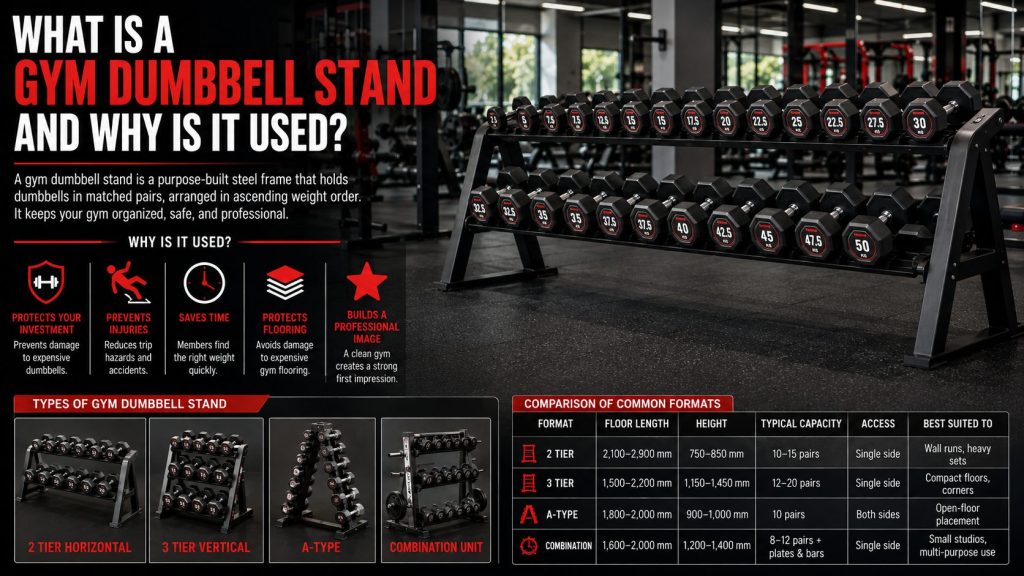
A gym dumbbell stand is a purpose-built steel frame that holds dumbbells in matched pairs, arranged in ascending weight order across one or more tiers. Each dumbbell rests in a shaped cradle usually called a saddle that supports the handle or the head of the weight and prevents it from rolling.
That description undersells the engineering involved. A full commercial set running from 2.5kg to 50kg in pairs weighs somewhere between 1,000kg and 1,300kg. That entire load is carried by a handful of welded joints and transferred through four to six contact points on the floor. A frame that looks adequate in a showroom behaves very differently when it has carried a tonne of steel through three years of members dropping weights back into place rather than setting them down.
The Main Components
- Frame and uprights the load-bearing structure, typically 50x50mm or larger mild steel sections
- Tier rails horizontal members that carry the saddles and transfer load into the uprights
- Saddles or cradles shaped seats, usually with rubber or polymer inserts, that hold each dumbbell
- Levelling feet adjustable pads that stop rocking on uneven flooring
- Protective finish pre-treatment and powder coating that resists rust at the weld seams
Why Is a Dumbbell Stand Used? Five Practical Reasons
The purpose goes well beyond tidiness. Each of these has a direct commercial consequence for a gym owner.
- It protects a substantial investment. A commercial dumbbell set represents ₹1.5-4 lakh depending on specification. Dumbbells left on the floor get chipped, scratched and dented, and mismatched pairs quickly become unsellable and unusable.
- It prevents injuries. Loose dumbbells on a gym floor are the most common trip hazard in any facility, and the one most likely to generate a liability claim.
- It reduces member friction. When weights are stored in sequence, a member finds the pair they want in seconds. When they are scattered, every set begins with a search.
- It protects your flooring. Rubber flooring costs ₹150-450 per square foot. Repeated dumbbell impact on unprotected areas damages it far faster than normal foot traffic.
- It signals standards. Prospective members walking through on a trial visit judge a facility in the first ninety seconds, and a disorganised free weight area is the fastest way to lose a sale.
Types of Gym Dumbbell Stand
There is no universal gym dumbbell stand format. The right choice depends on your floor shape, your set size and where the storage will sit.
Two-Tier Horizontal
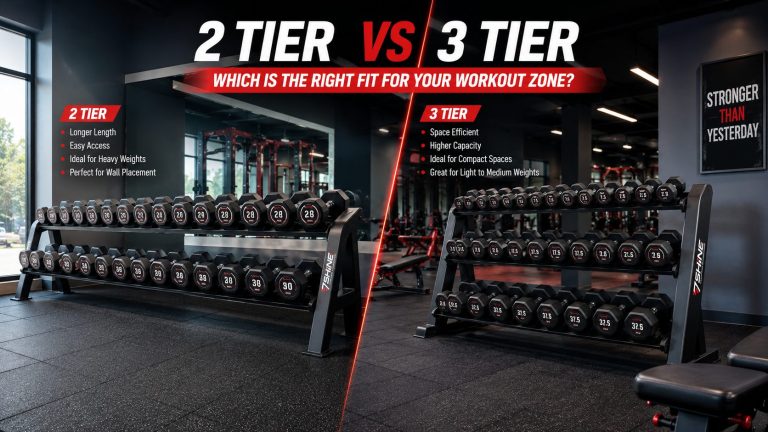
Pairs are arranged across two levels on a long frame, with the lower tier near the floor and the upper at roughly hip height. Retrieval ergonomics are excellent throughout, which makes this format the safest option for heavy sets. It requires an uninterrupted wall run of 2.1 to 2.9 metres.
Three-Tier Vertical
A dumbbell stand 3 tier configuration stacks the same capacity across three levels, cutting the required floor length by roughly a third while raising overall height to between 1,150mm and 1,450mm. A dumbbell stand 3 tier layout is the practical answer for compact studios, though heavy pairs must be assigned to the lower tiers since retrieving a 40kg dumbbell from chest height is an injury risk.
A-Type
This dumbbell holder format angles saddles outward from a central spine, allowing access from both sides. This format suits open-floor placement where the stand sits away from a wall and members approach from either direction.
Combination and Multi-Purpose Units
A combined dumbbell holder that also carries weight plates and barbells consolidates storage into one footprint. This is efficient in tight spaces, though it concentrates a considerable amount of traffic in a single area.
Comparison of Common Formats
| Format | Floor Length | Height | Typical Capacity | Access | Best Suited To |
| 2 Tier | 2,100-2,900 mm | 750-850 mm | 10-15 pairs | Single side | Wall runs, heavy sets |
| 3 Tier | 1,500-2,200 mm | 1,150-1,450 mm | 12-20 pairs | Single side | Compact floors, corners |
| A-Type | 1,800-2,000 mm | 900-1,000 mm | 10 pairs | Both sides | Open-floor placement |
| Combination | 1,600-2,000 mm | 1,200-1,400 mm | 8-12 pairs + plates | Single side | Small studios, home gyms |
| Vertical / Compact | 600-900 mm | 1,200-1,500 mm | 5-8 pairs | Single side | Personal training rooms |
Choosing the Right Gym Dumbbell Stand Size and Capacity
Sizing begins with the set you own, not the space you have available.
Count your pairs and identify your heaviest dumbbell. Measure the widest handle-to-handle span in the set almost always the top weight because every saddle must accommodate that span with clearance, or the heavy end of your set will not seat properly.
Two specifications matter beyond overall dimensions. The first is saddle pitch, meaning centre-to-centre spacing between adjacent cradles, typically 190-230mm on commercial units. Tight pitch looks efficient on a drawing and causes knuckles to collide during retrieval. The second is rated load capacity, which should carry a clear margin above your actual set weight rather than matching it exactly.
One further consideration: buy for the set you will own in two years. Facilities that open with pairs to 30kg almost always extend to 40kg or 50kg within a couple of seasons, and by then the storage is full. Specifying two or three spare positions costs very little at the point of purchase.
Build Quality: What Separates a Decade From Two Years
A gym dumbbell stand looks like the simplest product on a gym floor, which is exactly why cost gets quietly removed from it. These are the specifications worth confirming in writing before you order:
- Frame section and gauge. Commercial-duty units use 50x50mm sections or larger at 2mm minimum wall thickness. Lighter tubing bows visibly under a full load inside a year.
- Weld continuity at tier junctions. These joints carry the entire load. Continuous welds are required; tack welds fatigue and fail.
- Saddle construction and inserts. On any dumbbell holder, formed steel saddles with rubber or high-density polymer inserts protect the chrome on your dumbbells and the finish on the frame simultaneously.
- Levelling feet with rubber pads. Rocking on an uneven floor is the most common cause of long-term weld fatigue, and adjustable feet eliminate it.
- Multi-stage pre-treatment before powder coating. Phosphating prevents rust creeping out from weld seams, which is the most frequent cosmetic failure in humid and coastal cities.
A useful shortcut when comparing two quotations: ask for the weight of the unit itself. Machine weight is the honest proxy for how much steel is inside a frame, and it cannot be argued with the way a specification sheet sometimes can.
Placement and Clearance Planning
The footprint of a gym dumbbell stand is not its true space requirement. Members need working room in front of it, and this is where most layout mistakes occur.
- Allow a minimum of 1,200mm of clear floor in front of the unit for retrieval and return, extending to 1,500mm where the set runs above 30kg.
- Maintain a 900mm circulation lane behind that working zone so passing traffic does not collide with someone handling a heavy pair.
- Position storage within four to five metres of your benches. Longer carries are the direct cause of dumbbells being abandoned mid-floor.
- Avoid placing a stand directly opposite mirrors, where the lifting zone and the mirror-checking zone overlap and create congestion.
- For three-tier units, verify ceiling and lighting clearance, particularly in basement facilities with low soffits or exposed ducting.
Commercial Versus Home Use
The requirements diverge more than most buyers expect. A commercial gym dumbbell stand is engineered for a full set, continuous daily use and rough handling by hundreds of members who did not pay for the equipment. A home unit typically holds five to eight pairs, sees a fraction of the load cycles, and is handled carefully by its owner.
Buying a light-duty unit for a commercial floor is a false economy that usually reveals itself within eighteen months. Buying a full commercial-duty frame for a home gym is rarely wasted, however, since the price gap is modest and the unit will outlast the house it sits in.
Maintenance and Longevity
A well-built gym dumbbell stand needs very little maintenance, but it does need something.
Check the tightness of bolted connections every quarter, particularly on the tier rails. Inspect saddle inserts twice a year and replace any that have hardened or split, since a worn insert lets steel contact steel and damages both the dumbbell and the frame. Confirm the levelling feet remain in contact with the floor a stand that rocks even slightly is loading its welds in a way they were not designed for.
Wipe down the frame regularly. Sweat is corrosive, and it collects at exactly the points where the finish is most vulnerable.
Conclusion
A gym dumbbell stand is not a storage accessory. It is the piece of equipment that protects a several-lakh investment in dumbbells, removes the most common trip hazard on any floor, keeps your free weight zone usable during peak hours, and tells every prospective member what standard of facility they have walked into.
The specifications that matter are not visible in a catalogue photograph. Frame section and gauge, weld continuity at the tier junctions, saddle design and pre-treatment quality determine whether a unit carries over a tonne of steel safely for a decade or starts flexing within a year. Measure your set, measure your wall, plan proper clearance, and buy for the capacity you will need in two years rather than the one you need today.
Shine Fitness manufactures two-tier, three-tier, A-type and combination units in commercial-duty specification, and can build to your bay width where a standard size does not suit the floor. Share your layout and dumbbell set details, and our team will recommend the right configuration and capacity for your space.
Frequently Asked Questions
What is a gym dumbbell stand used for?
It stores dumbbells in matched pairs in ascending weight order, protecting the weights and the flooring while removing trip hazards. It also keeps the free weight zone organised so members locate pairs quickly during peak hours.
How much weight can a commercial dumbbell stand hold?
Commercial-duty units are generally rated between 800kg and 1,500kg depending on tier count and frame section. Always confirm the rated capacity exceeds your full set weight with a clear margin.
What is the difference between a 2 tier and a dumbbell stand 3 tier unit?
A two-tier design is longer and lower, giving better retrieval ergonomics for heavy pairs. A three-tier design stores the same capacity in roughly a third less floor length but places the top tier above comfortable lifting height.
How much space does a gym dumbbell stand need?
Allow the unit’s own footprint plus 1,200-1,500mm of clear working space in front of it. Add a 900mm circulation lane behind that zone so passing traffic does not interfere.
Where should heavy dumbbells be placed on the stand?
Always on the lowest tier. Retrieving a 40kg pair from chest height or above is a significant shoulder and lower-back injury risk.
Can a dumbbell stand be customised to my floor plan?
A manufacturer that fabricates in-house can adjust length, tier count and saddle pitch to suit a specific bay width. Suppliers working only from stocked variants generally cannot.
Is a commercial-grade stand necessary for a home gym?
Not strictly, but the price difference is modest and commercial frames handle heavier sets with a far greater safety margin. For sets above 30kg, commercial-duty construction is worth the small premium.