
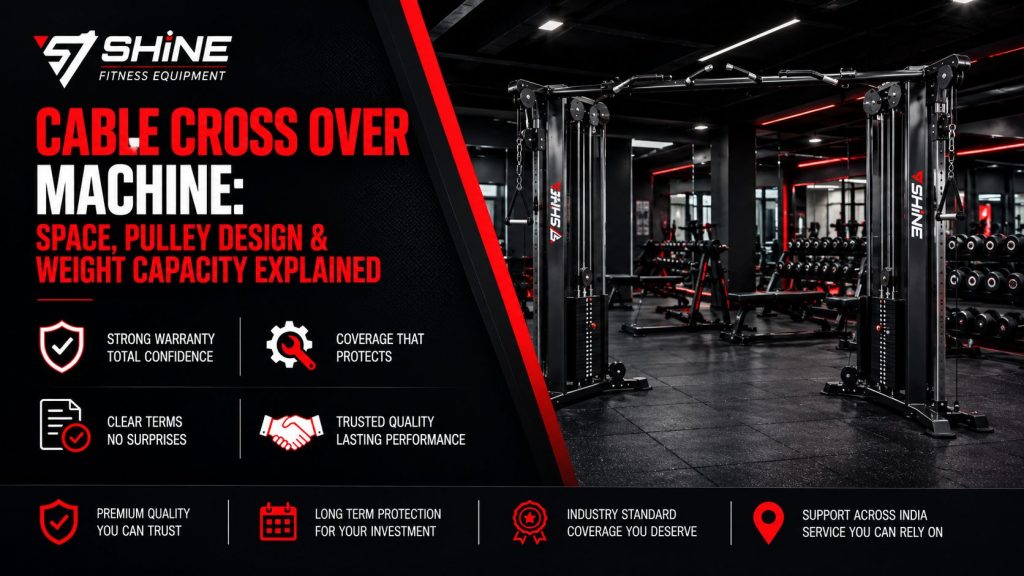
Every station on a commercial gym floor, the crossover generates the widest gap between what buyers expect and what they receive. Two units can carry identical descriptions dual stack, adjustable pulleys, commercial grade and still differ by ₹1 lakh in price and by a decade in service life. The difference lives in three specifications that rarely appear prominently in a catalogue: the floor and ceiling envelope the frame actually needs, the pulley ratio and bearing quality that determine how it feels, and the real usable resistance behind the number printed on the stack. Understanding those three before you buy a cable cross over machine is the difference between a station members gravitate toward and an expensive frame nobody enjoys using.Why This Station Earns Its Floor Space
Before the specifications, the business case. A cable cross over machine is the most versatile single frame in a gym. From two adjustable pulley columns a member can perform chest flyes at three angles, triceps pushdowns, cable curls, face pulls, lateral raises, woodchops, rows, pull-throughs and single-arm presses comfortably forty distinct exercises from one station.
That versatility means the station stays occupied. In most Indian gyms it ranks in the top three by utilisation, alongside the chest press and the lat pulldown. It also serves every ability level, which matters because few gyms can afford equipment that only 20% of members enjoy.
The catch is that it demands more planning than any other station. It is wide, it needs headroom, and it requires a clear working corridor on both sides that cannot be shared with anything else.
Space Planning: Floor and Ceiling You Actually Need
Width, Depth and the Working Corridor
A full dual-column cable cross over machine typically measures 11-13 feet between the outer faces of the towers, with a base depth of 3.5-4.5 feet. That is the machine. It is not the space requirement.
Crossover movements are performed standing in the middle with both arms sweeping through a wide arc, and members frequently step forward into a split stance. Allow at least 3 feet of clear working space in front of each column and a minimum of 8 feet of unobstructed depth from the frame face outward. In practice, budget a footprint of roughly 14 ft × 9 ft around 125 sq ft as a dedicated zone.
This is the single most common planning error. Owners measure the frame, allocate 50 sq ft, then discover members cannot complete a full fly without hitting a dumbbell rack.
Ceiling Height and Overhead Clearance
Most commercial frames stand 7.5-8.5 feet tall. High-pulley positions place the cable exit near the top of the frame, and members pulling from that position need the cable to run clear.
Plan for a minimum clear ceiling of 9 feet, and 9.5-10 feet if your unit includes an integrated pull-up bar. Check for obstructions specifically: ducting, sprinkler heads, ceiling fans and light fittings sit lower than the slab and are frequently the actual constraint. Measure to the lowest obstruction over the intended footprint, not to the ceiling.
If you cannot clear 9 feet, a single cable pulley machine with a lower profile is the sensible alternative. You lose the two-handed crossover movement but retain most of the exercise range.
Pulley Design: The Detail That Decides How It Feels
Understanding the 2:1 and 1:1 Ratio
This specification confuses more buyers than any other, and it directly determines whether your 100 kg stack delivers 100 kg or 50 kg.
A 1:1 ratio means resistance at the handle equals the weight selected. Pin 60 kg and you pull 60 kg. The cable travels the same distance the stack does.
A 2:1 ratio routes the cable through an additional pulley so the stack rises half as far as the handle travels. This halves the resistance pin 100 kg and you feel 50 kg but doubles available cable travel and produces a noticeably lighter, smoother feel with finer effective increments.
Neither is superior; they suit different purposes. A 2:1 ratio is standard on a cable cross over machine because the long cable travel it provides is exactly what wide fly movements need. But it means a 100 kg stack gives 50 kg of usable resistance per side, which is entirely adequate for flyes and lateral work and insufficient for heavy rows or pulldowns.
Always ask the ratio explicitly. A supplier quoting 200 kg total capacity on a 2:1 build is describing 50 kg of usable resistance per hand.
Fixed vs Adjustable Pulley Columns
A fixed-pulley cable cross over machine offers one high and one low position per column. They are cheaper, simpler and have fewer failure points.
Adjustable columns run the pulley carriage on a vertical track with 12-20 lockable positions from floor to full height. This transforms the station’s exercise range: mid-height flyes, face pulls at eye level, rows at hip height, and every angle in between. For a commercial floor, adjustable is worth the premium it is the difference between a chest station and a full-body station.
Check the adjustment mechanism specifically. A spring-loaded pin the user operates one-handed while holding a handle is right. A mechanism requiring two hands and a shoulder means members will not adjust it and will default to whatever position it was left in.
Pulley Diameter, Bearings and Cable Specification
- Pulley diameter: 100-115 mm on the main pulleys. Smaller pulleys force a tighter cable bend radius, which accelerates internal wire fatigue and produces a harsher feel under load.
- Bearing type: sealed ball bearings on every pulley, not bushings. Bushings run acceptably for a year, then develop the drag and squeak members complain about first.
- Pulley material: glass-filled nylon or machined aluminium. Plain injection-moulded plastic wears an oval groove within two years, which chews cables.
- Cable specification: 5-6 mm galvanised steel wire rope with a nylon coating. Below 5 mm, replacement intervals shorten sharply under commercial traffic.
- Cable terminations: swaged and thimbled ends, not clamped. Clamped terminations are the most common failure point on budget frames.
- Guide rods: chrome-plated, 25 mm minimum, with linear bearings or long-wearing bushes on the weight carriage.
Weight Capacity: Reading the Number Correctly
Indian manufacturers quote stack capacity in several ways, and comparing across quotes requires care.
| Quoted Spec | What It Usually Means | Usable Resistance Per Hand |
| “100 kg” | Per stack, 2:1 ratio | ~50 kg |
| “100 kg” | Per stack, 1:1 ratio | ~100 kg |
| “200 kg total” | Two 100 kg stacks, 2:1 | ~50 kg |
| “250 kg each stack” | Per stack, ratio unstated | Ask before comparing |
For a commercial gym, aim for 90-110 kg per stack at 2:1 on a chest-focused build. If the unit will also serve heavy rowing and pulldown work, either specify 1:1 on those positions or budget for a dedicated lat pull down machine alongside it.
Also check the plate increment. Stacks in 5 kg steps are common but coarse for isolation work, where a member may need a 2.5 kg progression. Units supplied with add-on 2.5 kg selector weights solve this cheaply, and members appreciate it more than owners expect.
Comparing Cable Station Formats
| Factor | Full Dual-Column Crossover | Single Cable Station | Functional Trainer |
| Footprint with clearance | ~125 sq ft | ~45 sq ft | ~70 sq ft |
| Minimum ceiling height | 9 to 9.5 ft | 8 ft | 8.5 to 9 ft |
| Two-handed crossover movement | Yes | No | Limited by column spacing |
| Exercise range | Very wide | Moderate | Very wide |
| India price band | ₹80,000 to ₹1,80,000 | ₹35,000 to ₹75,000 | ₹90,000 to ₹2,00,000 |
| Best suited to | Gyms above 2,000 sq ft | Studios, tight floors | Mixed-use and functional zones |
A single cable cross over machine one column with an adjustable pulley is the practical answer for studios under 1,500 sq ft. It delivers pushdowns, curls, single-arm flyes, face pulls and rows in roughly a third of the space. What it cannot do is the bilateral sweeping fly that gives the full station its name. Where the floor allows, a functional trainer sits between the two, and a compact functional trainer narrows the footprint further for smaller premises.
Cable Cross over Machine Price in India: What Drives the Number
Buyers researching cable cross over machine price india find quotations ranging from ₹55,000 to well past ₹2 lakh for what look like similar frames. Five variables explain almost all of that spread.
- Stack weight and quantity. Steel is priced by weight. Two 110 kg stacks cost meaningfully more than two 70 kg stacks before any other difference is considered.
- Adjustable versus fixed columns. The vertical carriage, track and locking mechanism add ₹20,000-₹40,000 per column.
- Bearing and pulley quality. Sealed bearings with machined aluminium pulleys against bushings with moulded plastic is typically a ₹15,000-₹30,000 difference and the single largest determinant of service life.
- Frame gauge. 60-75 mm section at 2.5-3 mm wall versus lighter tube changes both cost and how stable the station feels under a heavy pushdown.
- Attachments and extras. Integrated pull-up bar, arm pulleys, a full handle set and a storage rack can add ₹10,000-₹35,000. A crossover with arm pulley sits at the upper end of the band for exactly this reason.
Freight and installation are frequently quoted separately and can add 3-6% on a single large frame. Ask for a landed, installed figure before comparing quotations, and confirm what the warranty covers on cables and bearings specifically, because those are the parts that actually fail.
Installation and Floor Fixing
Most commercial cable cross over machine frames are freestanding and rely on stack weight for stability, but freestanding does not mean unanchored. Check three things at installation:
- Levelling. An out-of-level frame makes the carriage bind and wears guide rods unevenly. Shim the base before final tightening.
- Anchoring. Units with integrated pull-up bars should be bolted to the slab. Chin-up loading applies a tipping moment the stacks alone do not counter.
- Flooring. Place the frame on 15-20 mm rubber rather than directly on tile. Rubber absorbs the impact when a member drops a stack and prevents the base from walking over time.
Maintenance That Actually Matters
A cable cross over machine has more consumable parts than any other strength machine, and a simple routine prevents almost every failure owners encounter.
Weekly: wipe guide rods and check that cables run centrally in their grooves.
Monthly: inspect the full cable length for broken strands, flattening or kinking, particularly at swaged terminations and where the cable enters a pulley. Apply a light film of silicone lubricant to guide rods never grease, which collects dust and turns abrasive.
Quarterly: check pulley bearings for play by spinning each wheel by hand, verify the locking pins engage cleanly at every position, and torque frame bolts.
Every 18-30 months: replace cables under commercial traffic. This is a consumable, not a defect. A pre-emptive replacement costs ₹2,500-₹5,000 per cable; a snapped cable costs a member’s confidence and potentially an injury claim. Sourcing from a domestic strength equipment manufacturer means those spares arrive in days rather than the months an imported line can take.
Matching the Station to Your Facility
Under 1,500 sq ft: a single cable cross over machine or compact functional trainer. The full frame simply consumes too large a share of your floor.
1,500-3,000 sq ft: one full dual-column cable cross over machine with adjustable columns and 90-110 kg stacks. This is the sweet spot where the station’s versatility genuinely earns its 125 sq ft.
Above 3,000 sq ft: the full unit plus one or two single-column stations positioned elsewhere on the floor. Splitting cable capacity across the room reduces peak-hour congestion better than adding a second large frame in the same zone.
To size a cable cross over machine against your ceiling height and floor plan, contact the Shine Fitness team or browse the complete range of commercial machines manufactured for Indian gym floors.
Frequently Asked Questions
What is the cable cross over machine price in India?
Commercial-grade dual-column units run ₹80,000 to ₹1,80,000 factory-direct, with attachment-heavy builds reaching ₹2 lakh. Single-column stations sit at ₹35,000-₹75,000. Stack weight, adjustable versus fixed columns, bearing quality and frame gauge account for nearly all of the variation between two similar-looking quotations.
How much space does a cable cross over machine need?
The frame measures 11-13 ft wide with a 3.5-4.5 ft base depth, but the usable requirement is larger. Budget roughly 14 ft × 9 ft about 125 sq ft including working corridors on both sides, plus a minimum clear ceiling of 9 feet, or 9.5-10 feet with an integrated pull-up bar.
Is a single cable cross over machine worth buying instead?
For studios under 1,500 sq ft, yes. A single-column unit delivers most of the exercise range in about 45 sq ft and at half the price. The one thing it cannot replicate is the bilateral sweeping fly across the midline. If chest work is central to your programming and the floor allows, the full frame is worth the space.
What does a 2:1 pulley ratio mean for usable weight?
It halves resistance at the handle while doubling cable travel. A 100 kg stack at 2:1 delivers roughly 50 kg per hand. This is standard on crossovers because fly movements need the long travel, but it means the headline capacity figure is not the weight a member actually feels. Always confirm the ratio before comparing two quotations.
How often do cables need replacing?
Every 18-30 months under commercial traffic, sooner in humid coastal locations. Inspect monthly for broken strands, flattening and corrosion at the swaged ends. Replacing pre-emptively costs ₹2,500-₹5,000 per cable and is far cheaper than the consequences of a failure mid-set.
Fixed or adjustable pulley columns for a commercial gym?
Adjustable, in almost every case. Fixed columns limit the station to high and low positions, which covers flyes and pushdowns but little else. Adjustable carriages with 12-20 lockable heights turn the same frame into a full-body station, and the incremental cost is recovered quickly through higher utilisation.