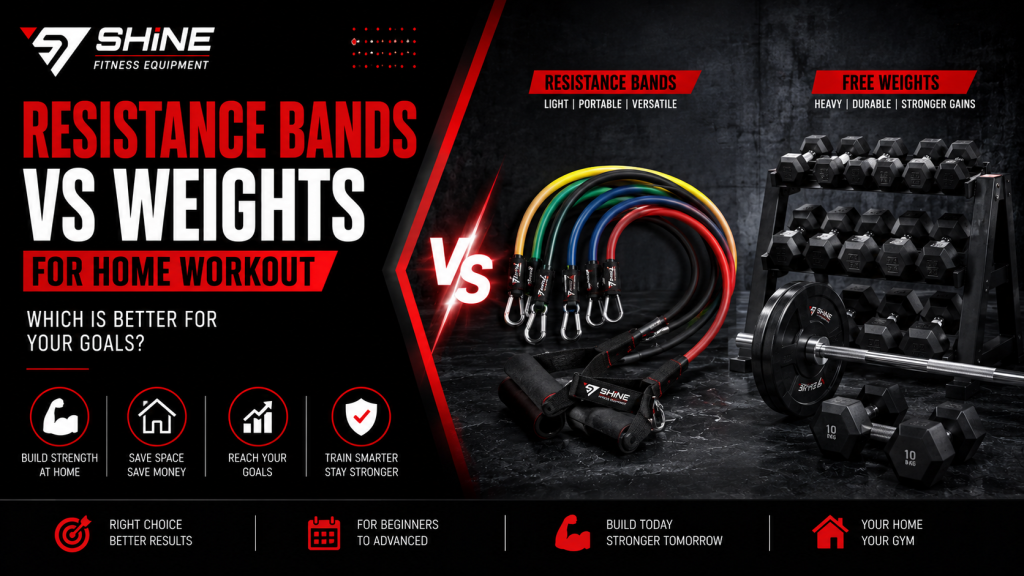
Setting up a home workout space always brings up the same debate - should you invest in resistance bands or a traditional set of weights? The resistance bands vs weights discussion has become louder over the past few years as more Indians move away from crowded gyms and build compact training corners at home. Both tools can help you build strength, but they behave very differently under load, occupy different amounts of space, and cost very different amounts of money. This guide breaks down the resistance bands vs weights question in plain language so you can pick the right setup for your goals, your budget, and your living space.
Whether you are a beginner working out three days a week or an intermediate lifter chasing serious muscle, the choice you make today will shape your progress for the next several years. Let us walk through both options honestly, look at the science, compare cost and durability, and end with a clear recommendation.
Understanding Resistance Bands and Free Weights
Before we jump into the resistance bands vs weights comparison, it helps to understand what each tool actually does to your muscles. Resistance bands are elastic loops or tubes made from layered latex. As you stretch them, tension increases - this is called variable resistance. Free weights, on the other hand, provide constant resistance based on gravity. A 20 kg dumbbell weighs 20 kg at the top of a curl and at the bottom.
How Resistance Bands Work
Bands are lightweight, portable, and offer resistance that grows as the band stretches. This makes them excellent for warm-ups, mobility work, and finishing sets. They are also joint-friendly, which is why physiotherapists often start rehab patients on bands.
How Free Weights Work
Free weights include dumbbells, barbells, kettlebells, and weight plates. They rely on gravity, so your muscles must control the load through the full range of motion. This is why serious lifters still prefer a well-built weight bench for home gym along with dumbbells for pressing movements. Free weights also recruit stabilizer muscles that bands often bypass.
Resistance Bands vs Weights: Head-to-Head Comparison
The resistance bands vs weights comparison usually comes down to five things: strength gains, cost, space, safety, and versatility. Here is how each option performs on those parameters.
| Factor | Resistance Bands | Free Weights |
| Starting Cost (INR) | ₹800 - ₹3,500 | ₹4,000 - ₹40,000+ |
| Space Required | Minimal - fits in a drawer | Moderate to large |
| Muscle Building | Good for beginners & toning | Superior for hypertrophy |
| Joint Impact | Low - very joint friendly | Moderate - form dependent |
| Progression | Limited past a point | Unlimited with plates |
| Portability | Excellent - travel friendly | Poor - fixed setup |
Which Builds More Muscle: Bands or Weights?
Multiple studies published in the Journal of Strength and Conditioning Research show that when volume and intensity are matched, both bands and free weights produce similar strength gains in beginners and intermediates. However, once you cross the intermediate stage, free weights pull ahead clearly. The reason is simple - you can load a barbell with 100 kg, 150 kg, or 200 kg, but heavy bands top out and become awkward to handle. This is where investing in muscle building equipment like plate-loaded machines or barbells becomes the smart move for anyone serious about long-term progress.
For pure muscle building, free weights win the resistance bands vs weights debate for one core reason - progressive overload. Muscles grow when you keep giving them more work over time. Free weights let you add 2.5 kg, 5 kg, or 10 kg plates whenever you are ready. Bands force you to switch to a heavier band, which changes the tension curve and often feels inconsistent.
When Bands Actually Outperform Weights
Bands are not just a beginner tool. Advanced lifters use them for:
- Accommodating resistance - attaching bands to a barbell to increase load at lockout
- Warm-up and activation before heavy compound lifts
- Rehab after shoulder, knee, or elbow injuries
- Explosive speed work where dropping a weight would be dangerous
- Travel workouts when you cannot access a gym
Cost Analysis: Resistance Bands vs Weights in India
On paper, bands look like a steal. A quality band set costs under ₹3,000, while a beginner dumbbells for home workout set with a bench can easily cross ₹15,000. But here is the honest math - bands wear out. Even premium latex bands snap or lose tension after 12 to 24 months of regular use. A cast-iron dumbbell you buy today will still work in 2045. Over a five-year window, weights become the cheaper option per session.
Hidden Costs to Consider
The resistance bands vs weights price gap narrows once you factor in accessories. Bands often need door anchors, ankle straps, and handles. Weights need a rack, a bench, and possibly flooring to protect your tiles. Plan for the full setup, not just the primary tool.
Choosing the Right Tool for Your Goals
The honest answer to the resistance bands vs weights question is that most serious home gym owners end up using both. Here is a quick decision framework based on your primary goal. If you are new to strength training at home, bands are a low-risk entry point that teach you movement patterns without intimidation.
Pick Resistance Bands If You…
- Live in a compact apartment with limited storage space
- Travel frequently and want to train on the road
- Are recovering from an injury or just starting out
- Have a budget under ₹5,000 for your entire setup
- Focus on toning, mobility, and general fitness rather than mass
Pick Free Weights If You…
- Want to build serious muscle mass and strength
- Have dedicated space of at least 4×6 feet
- Plan to train seriously for years and want equipment that lasts
- Enjoy tracking numbers and chasing progressive overload
- Prefer the feel and mental engagement of holding real iron
The Smart Approach: Combining Both
Instead of treating the resistance bands vs weights choice as either-or, consider a hybrid setup. Use free weights for your main compound lifts and bands for warm-ups, finishers, and accessory work. This is exactly how most commercial gyms structure their equipment layout. A modest home setup with adjustable dumbbells, a bench, and a good band set gives you the flexibility of both worlds for well under ₹25,000.
The resistance training benefits of combining tools include better joint health, more variety, and the ability to train even when you are short on time or stuck in a hotel room. Bands make an excellent complement rather than a full replacement for iron.
Ready to Build Your Home Gym?
Whether you decide on bands, weights, or both, quality matters. At Shine Fitness, we manufacture commercial-grade dumbbells, benches, and plate-loaded equipment right here in India - trusted by gyms, studios, and home users across the country. Browse our full range on the gym equipment India catalogue, or contact our team to design a home gym setup that fits your goals and your space.
Conclusion
The resistance bands vs weights debate does not have a universal winner. Bands are cheaper, more portable, and gentler on joints - perfect for beginners, travellers, and rehab. Free weights offer superior muscle building, unlimited progression, and long-term value - the right pick for anyone serious about strength. Most well-rounded home lifters eventually own both. Start with whichever suits your current goal, and add the other as your training matures. What matters most is that you actually train consistently - the tool is just a means to that end.
Frequently Asked Questions (FAQ)
1. Are resistance bands as effective as weights for building muscle?
For beginners and intermediate lifters, resistance bands can produce comparable strength gains when training volume is matched. However, once you become advanced, free weights allow better progressive overload and are more effective for continued muscle growth.
2. What is cheaper long-term - bands or weights?
Bands cost less upfront but need replacement every one to two years. Weights cost more initially but last a lifetime, making them cheaper on a cost-per-year basis over five or more years of consistent use.
3. Can I do a full-body workout with only resistance bands?
Yes. A good band set with anchors, handles, and ankle straps can train every major muscle group. However, heavy leg movements like squats and deadlifts are more effective with barbells and plates.
4. Which is safer for beginners?
Resistance bands are generally safer for absolute beginners because they cannot fall on you, and they force controlled movement. Free weights are safe too, but require you to learn proper form and use a spotter or safety pins for heavy lifts.
5. How much space do I need for a home gym with weights?
A minimum of 4×6 feet works for a bench and dumbbells. Add a barbell and rack, and you will want 6×8 feet with at least 8 feet of ceiling height for overhead pressing.
6. Do resistance bands wear out or break?
Yes. Latex bands degrade with heat, sunlight, and stretching over time. Expect 12 to 24 months of life from quality bands with regular use. Store them in a cool, dry place away from direct sun to maximize life.
7. Can I combine bands with weights in the same workout?
Absolutely and many advanced lifters do exactly this. Bands can be looped onto barbells for accommodating resistance, used as warm-up tools, or added to dumbbell exercises to increase tension at the top of the movement.