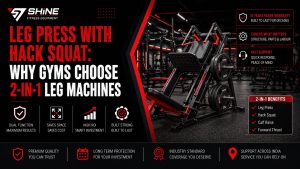
A leg press hack squat machine is one of the few pieces of strength equipment that earns its floor space twice over. In a single welded frame, it delivers two of the most productive lower-body movements in resistance training the angled leg press and the guided hack squat without asking a gym owner to buy, install and maintain two separate stations. For commercial gyms working with finite square footage and members who expect a full leg workout without queuing, the leg press hack squat machine has quietly become a default inclusion rather than an optional extra.
What Is a Leg Press Hack Squat Machine?
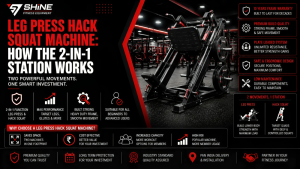
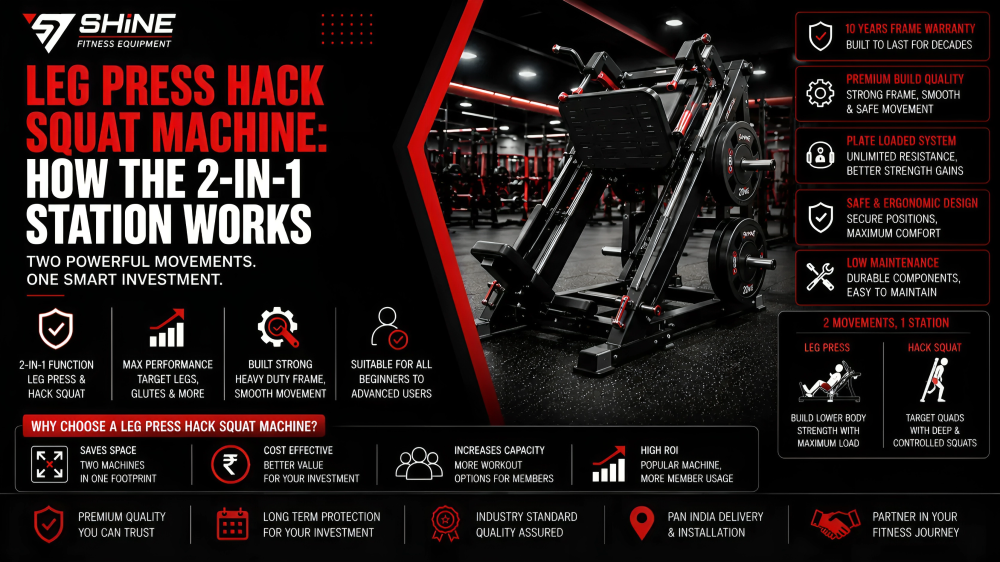
A leg press hack squat machine is a plate-loaded lower-body station built around a single carriage that travels along a fixed pair of inclined rails, usually set between 40 and 45 degrees. The carriage carries the load. What changes between exercises is the user’s orientation relative to that carriage. Sit on the lower back pad and press upward against the footplate and you are performing a leg press. Stand on the footplate, place your shoulders under the yoke pads and drive upward and you are performing a hack squat. The frame, rails, bearings and weight horns are shared; only the contact surfaces differ.
Because both movements share the same rail geometry, the combination is marketed as a 2 in 1 leg machine or a combo squat press. Terminology varies, but the engineering intent is consistent: consolidate the leg press and hack squat into one footprint while preserving the strength curve and safety characteristics of each.
How the 2-in-1 Station Works
The mechanics determine who the machine suits, how it should be coached, and what wears out first.
The Leg Press Position
In the leg press configuration, the user is seated or semi-reclined with the spine supported against a backrest. The load travels away from the body along the rails as the knees and hips extend. Because the torso is braced, spinal compression is minimal and the lifter can handle substantially heavier loads than in a free squat. This is why the press half of a leg press hack squat machine is typically the most used station in a commercial gym: accessible to beginners, tolerant of poor mobility, scalable to advanced lifters.
The Hack Squat Position
Flip the orientation and the same carriage becomes a guided squat. The user stands on the footplate with the back against an angled pad and shoulders under the yoke. The pattern resembles a barbell back squat, but the rails absorb the balance demand. Guidance from the National Strength and Conditioning Association indicates that machine-guided squat variations let lifters reach mechanical failure with lower stabiliser fatigue useful for hypertrophy and for rehabilitation settings requiring controlled loading.
The Shared Sled and Rail System
The component that determines the quality of a leg press and hack squat combination is the carriage assembly, and it is where most buyers under-specify. Cheap units use nylon bushings that develop play within a year of commercial use. Premium units run sealed linear bearings on chrome-plated rails, producing a glide that stays smooth under 400 kg or more. Safety catches, adjustable stop positions and base stoppers matter equally, because both movements place the user underneath the load.
Leg Press and Hack Squat: Key Mechanical Differences
Members often ask which position they should use. The answer is both, for different reasons. The table below sets out the distinctions a trainer should be able to explain on the floor.
| Parameter | Leg Press Position | Hack Squat Position |
| Body orientation | Seated / semi-reclined | Standing, back against angled pad |
| Primary emphasis | Quadriceps, glutes, adductors | Quadriceps, with strong vastus medialis load |
| Spinal loading | Very low | Low to moderate (axial through shoulders) |
| Typical load handled | Highest of any leg machine | Roughly 50-70% of leg press load |
| Range of motion driver | Hip and knee flexion depth | Ankle dorsiflexion and knee travel |
| Suitability for beginners | Excellent | Moderate — requires coaching |
| Carryover to barbell squat | Moderate | High |
Most coaches use the leg press for heavy compound volume and the hack squat position for depth-focused quadriceps work later in the session. Because the transition takes under a minute, supersets between the two are practical.
Why Commercial Gyms Choose a 2 in 1 Leg Machine
The commercial case for a 2 in 1 leg machine rests on four measurable factors rather than on preference.
- Floor efficiency. Two standalone stations typically consume 9 to 11 square metres once safety clearance is included. A single combo squat press covers the same programming in roughly 5 to 6 square metres.
- Capital efficiency. Buying one frame, one carriage and one set of weight horns is materially cheaper than buying two complete machines of equivalent gauge.
- Throughput. During peak evening hours, a leg press hack squat machine lets two members share a station in alternating sets rather than occupying two machines and two lanes of walkway.
- Maintenance simplicity. One rail system, one set of bearings and one grease schedule instead of two reduces service time and spare-part inventory.
The trade-off is genuine and should be acknowledged: at very high occupancy, one station cannot serve two members simultaneously the way two separate machines can. Gyms above roughly 400 active members per floor often install a leg press hack squat machine alongside a dedicated press rather than instead of one.
Build Standards That Separate Commercial from Light-Commercial
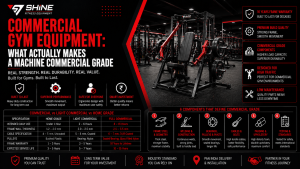
Two machines can look identical in a photograph and differ by a factor of three in service life. When evaluating any hack squat leg press machine, the following points are non-negotiable.
- Frame steel: minimum 3 mm wall thickness on 75 x 75 mm or larger box section. Anything thinner belongs in a home gym.
- Weld quality: continuous MIG welds at all load-bearing joints, not stitch welds. Gussets at the rail-to-base junction.
- Rail and bearing system: hardened, chrome-plated guide rods with sealed linear bearings; nylon bushings are a light-commercial compromise.
- Load rating: a genuine commercial leg press hack squat machine should carry a tested rating of 400 kg or above, with the rating stated in writing.
- Safety architecture: multi-position rotating safety catches, secondary base stoppers, and non-slip diamond-plate footplate.
- Finish: electrostatic powder coating over a phosphated surface, plus double-stitched vinyl over high-density foam on all contact pads.
Standards such as ISO 20957 for stationary training equipment define test loads and stability criteria for class S commercial use. Asking which class a hack squat leg press machine is certified to separates serious manufacturers from assemblers.
Space Planning and Installation
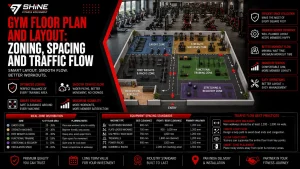
A 2 in 1 leg machine needs more clearance than its footprint suggests. Allow at least 900 mm behind the seat for entry and exit, 750 mm on the loading side for plate handling, and clear sightlines for floor staff. A weight tree should sit within two steps of the weight horns, otherwise plates migrate onto the floor and become a trip hazard.
Flooring matters as much as clearance. A leg press hack squat machine transmits significant point load through four base pads. Rubber tiles of 15 mm or greater, laid over a level screed, prevent both floor damage and frame rocking. In multi-storey facilities, confirm the slab loading allowance with the building engineer before positioning a fully loaded combo squat press near the middle of a span. A fully loaded leg press hack squat machine can exceed 700 kg in total mass.
Coaching the Movement Correctly
Lower-body machine incidents cluster around two behaviours: excessive range at the bottom of the press, and knee valgus under load in the squat position. Guidance from the American College of Sports Medicine reinforces that controlled tempo and full but not forced range are the primary risk controls. The following coaching points should appear on the instruction placard of any leg press hack squat machine.
- Set the footplate position so the knees track over the second toe throughout the movement, never collapsing inward.
- Lower under control to the point where the pelvis begins to tilt, then reverse do not chase depth by rounding the lower back.
- Keep the entire foot in contact with the plate; heel lift shifts load onto the patellar tendon.
- Engage the safety catches before dismounting, every repetition set, without exception.
- Load and unload plates symmetrically to avoid twisting the carriage on its rails.
Planning your strength floor? Shine Fitness manufactures commercial-grade leg press and hack squat stations built on 3 mm box-section frames, sealed linear bearings and 400 kg-plus tested load ratings. Share your floor dimensions with our team at shinefitness.in and we will send a spacing plan, specification sheet and delivered price for your facility.
Maintenance Schedule
The schedule below reflects standard practice for a leg press hack squat machine in high-traffic Indian commercial gyms.
| Interval | Task | Why It Matters |
| Weekly | Wipe rails, inspect pad stitching | Prevents abrasive build-up on bearing surfaces |
| Monthly | Lubricate guide rods with light machine oil | Maintains glide, reduces bearing wear |
| Quarterly | Torque-check all frame and rail fasteners | Vibration loosening is the main cause of frame rock |
| Half-yearly | Inspect welds, safety catches and stoppers | Safety-critical components fail progressively |
| Annually | Replace worn bushings, re-upholster contact pads | Restores feel and protects resale value |
Conclusion
A leg press hack squat machine consolidates two proven lower-body movements into one frame without diluting either, provided the frame, rails and safety systems are engineered to commercial standard. The decision comes down to three questions: how much floor area is genuinely available, how many members will use the station during peak hours, and whether the supplier can evidence the load rating and steel specification in writing. Answer those honestly and the purchase becomes straightforward.
Shine Fitness manufactures commercial strength equipment for Indian gyms, hotels, corporate facilities and sports academies, with a focus on heavy-gauge fabrication and serviceable component design. Our combined leg stations are built, finished and load-tested in-house, backed by spare-part availability and on-site installation. If you are specifying a leg press hack squat machine for a new build or an equipment refresh, our team will compare configurations against your actual floor plan rather than a brochure. Visit shinefitness.in to begin.
Frequently Asked Questions
Is a leg press hack squat machine as effective as separate machines?
Yes, provided the rail geometry and pad positions are correctly engineered. The resistance profile of each movement is set by the rail angle and user orientation, both preserved in a well-built combined unit. The only real loss is simultaneous use by two members.
How much floor space does a combined leg station need?
Plan for a footprint of approximately 2.1 x 1.5 metres, plus 900 mm of entry clearance behind the seat and 750 mm on the loading side. Total allocation is typically 5 to 6 square metres including walkways.
What weight capacity should a commercial unit have?
A minimum tested rating of 400 kg is appropriate for commercial use, and 500 kg is preferable in gyms with a strong powerlifting or bodybuilding membership. Always ask for the rating in writing rather than accepting a verbal figure.
Can beginners use a hack squat leg press machine safely?
Yes. The guided rails remove the balance demand that makes free-weight squatting difficult for new members. Beginners should start in the seated press position, learn foot placement and tempo, then progress to the standing position under supervision.
What is the difference between a combo squat press and a standalone leg press?
A standalone leg press offers only the seated pressing position. A combo squat press adds a standing hack squat orientation on the same carriage, giving greater quadriceps emphasis and better carryover to barbell squatting.
How often does the machine need servicing?
Monthly lubrication of the guide rods and a quarterly fastener torque check suffice in most facilities. Welds, safety catches and stoppers should be inspected every six months; contact pads typically need re-upholstering annually in high-traffic gyms.
Does Shine Fitness provide installation and after-sales support?
Yes. Shine Fitness supplies commercial equipment with on-site installation, floor-layout guidance, spare-part availability and service support across India. Enquiries can be raised directly through shinefitness.in.