The phrase commercial gym equipment appears on almost every manufacturer’s website, yet it carries no legally protected meaning in India or in most other markets. A machine can be described as commercial because it is heavy, because it is expensive, or simply because the seller says so. For a gym owner committing lakhs of rupees to a floor that must survive a decade of continuous use, that ambiguity is expensive. This article sets out the measurable criteria that separate genuine commercial grade machines from equipment that merely looks the part.
Everything below is verifiable before a purchase order for commercial gym equipment is signed. Steel gauge can be measured, welds can be inspected, cables carry printed specifications and load ratings can be demanded in writing. A supplier unwilling to provide those numbers has answered the question already.
Why the Commercial Classification Exists
Classification of commercial gym equipment originated as a duty-cycle concept borrowed from industrial machinery. A home treadmill is engineered for perhaps one hour of use per day; a health-club treadmill may run twelve. The same logic applies across resistance equipment, where the governing variable is cycles rather than hours how many repetitions the bearings, cables and welds will absorb before failure.
International standards give this structure. ISO 20957, the governing standard for stationary training equipment, defines accuracy and safety classes, with class S denoting studio and commercial use and class H denoting home use. Class S equipment must withstand higher test loads, tighter stability tolerances and stricter entrapment criteria. Where a manufacturer of commercial gym equipment can evidence class S conformity, the buyer has an objective reference rather than a marketing adjective.
Commercial vs Light Commercial vs Home Grade
The middle tier causes most of the confusion in the commercial gym equipment market. Light commercial equipment is engineered for facilities with low concurrent usage apartment complexes, hotels, small corporate gyms and is frequently sold into full commercial settings where it fails early. Understanding commercial vs light commercial specification is therefore the single most valuable exercise a first-time buyer can undertake.
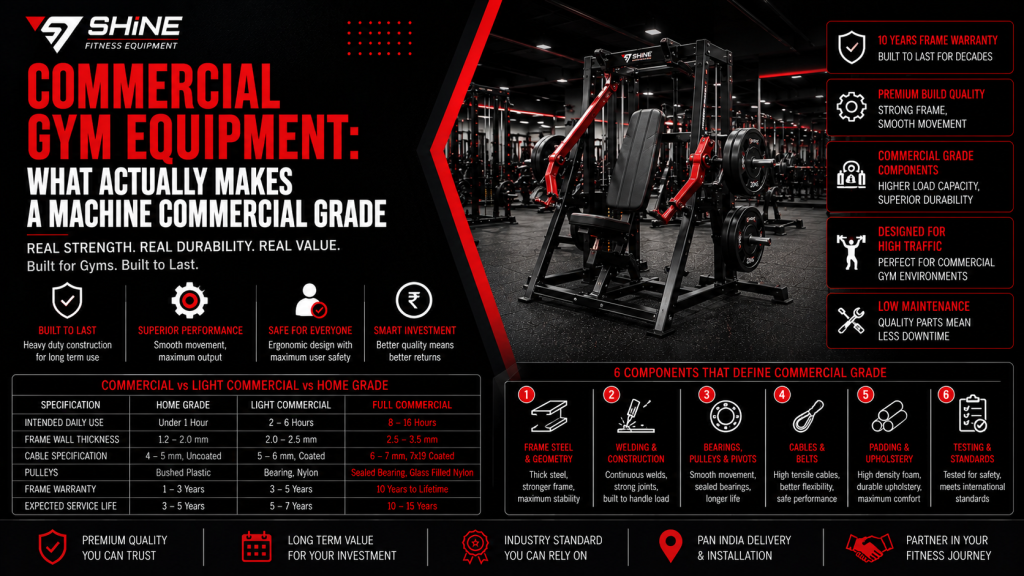
| Specification | Home Grade | Light Commercial | Full Commercial |
| Intended daily use | Under 1 hour | 2 to 6 hours | 8 to 16 hours |
| Frame wall thickness | 1.2 to 2.0 mm | 2.0 to 2.5 mm | 2.5 to 3.5 mm |
| Frame section size | 40 to 50 mm | 50 to 60 mm | 60 to 100 mm |
| Cable specification | 4 to 5 mm, uncoated | 5 to 6 mm coated | 6 to 7 mm, 7×19 coated |
| Pulleys | Bushed plastic | Bearing, nylon | Sealed bearing, glass-filled nylon |
| Typical frame warranty | 1 to 3 years | 3 to 5 years | 10 years to lifetime |
| Expected service life | 3 to 5 years | 5 to 7 years | 10 to 15 years |
The commercial vs light commercial decision is not always resolved in favour of the heavier option. A twenty-unit residential facility with eight daily users does not need class S fabrication and should not pay for it. The error lies in applying light commercial specification to a paid-membership gym running peak-hour queues, where the cost of premature failure includes lost members as well as replacement equipment.
The Six Components That Define Commercial Grade
Any gym machine build standard worth the name addresses six subsystems, and together they define whether a unit qualifies as commercial gym equipment. Each can be inspected during a factory visit or verified from a specification sheet.
1. Frame Steel and Section Geometry
Every category of commercial gym equipment starts with the frame. Commercial resistance stations use rectangular or square box section of 60 x 60 mm upward, with wall thickness of 2.5 mm on upper-body units and 3 mm or more on leg equipment. Section size matters as much as thickness: a 3 mm wall on a 40 mm section is still structurally inferior to a 2.5 mm wall on an 80 mm section, because stiffness scales with the cube of depth.
2. Welding and Joint Construction
Continuous MIG welds at every load-bearing joint are the standard for commercial gym equipment. Stitch welding short intermittent beads is a cost reduction that concentrates stress at each bead terminus and initiates fatigue cracking. Gussets should reinforce every high-moment junction, particularly where uprights meet the base and where weight horns cantilever from the frame.
3. Bearings, Pivots and Pulleys
Sealed ball bearings at every pivot point are what allow commercial grade machines to feel identical in year eight to year one. Bronze or nylon bushings, common in lower tiers, develop measurable play within twelve to eighteen months of heavy use. Pulleys should be glass-filled nylon over sealed bearings, sized so that the cable bend radius does not exceed the manufacturer’s minimum.
4. Cable and Load Path
Cable is the most common failure point in selectorised stations. The specification to demand is 7 x 19 construction aircraft-grade steel with a nylon outer coating, minimum 6 mm diameter, with a breaking strain of at least seven times the maximum working load. Swaged end fittings should be factory-pressed, not crimped on site.
5. Upholstery and Contact Surfaces
Pads are consumables, but their construction determines how quickly they become one. Commercial specification means high-density closed-cell foam bonded to a plywood or steel backing plate, covered in double-stitched marine-grade vinyl. Critically, pads should be individually replaceable equipment that requires a full seat assembly to be replaced because the vinyl has split is poorly designed.
6. Finish and Corrosion Protection
Electrostatic powder coating applied over a phosphated or zinc-primed surface resists the sweat, humidity and cleaning chemicals that define a gym environment. Wet paint finishes chip at contact points within months. In coastal cities, corrosion protection is not cosmetic it determines whether a frame is sound at year ten.
How to Verify a Supplier’s Claims
Specification sheets are written by marketing departments. The following verification steps consistently separate manufacturers from assemblers rebadging imported frames.
- Request the steel test certificate for the specific section used, not a generic mill certificate.
- Measure wall thickness with a vernier caliper at a cut end or through a bolt hole during a factory visit.
- Ask for a written load rating per station, signed, rather than a range quoted verbally.
- Inspect welds on a finished unit continuous beads, no undercut, no visible porosity, ground smooth at contact points.
- Check warranty segmentation frame, moving parts and upholstery should carry separate written terms.
- Confirm spare-part availability in years five to ten, with a published parts list and lead time.
The last point is routinely overlooked and routinely decisive. Heavy duty gym equipment that cannot be repaired in year six becomes scrap regardless of how well it was built. Manufacturers that stock and ship pads, cables, pulleys and pins for discontinued models are demonstrating something a brochure cannot.
Comparing suppliers? Shine Fitness manufactures commercial gym equipment in-house 3 mm box-section frames, continuous MIG welds, sealed bearings and 7 x 19 coated cable as standard, with written load ratings on every station. Send your requirement to shinefitness.in and our team will provide full specification sheets and a factory-visit invitation so you can verify the build yourself.
Cost of Ownership: Where the Real Difference Appears
Purchase price is the least informative number in a commercial gym equipment decision. The comparison that matters is total cost across the expected life of the floor, including replacement, downtime and lost membership revenue.
| Cost Factor | Light Commercial Station | Full Commercial Station |
| Initial purchase | Lower by 30 to 40% | Baseline |
| Replacement cycle | 5 to 7 years | 10 to 15 years |
| Annual maintenance | Higher, bushings, cables | Lower, sealed components |
| Downtime per year | Higher | Minimal with scheduled service |
| Resale value at year 5 | Low | Moderate to good |
| 10-year total cost | Typically higher | Typically lower |
A light commercial station purchased at 35 per cent less but replaced twice within the period of one commercial unit’s service life is not a saving. Facilities that have run both tiers consistently report that the cost gap closes by year four and inverts by year six.
Matching Equipment Tier to Facility Type
Specification of commercial gym equipment should follow usage, not aspiration. The guidance below reflects standard practice across Indian facilities.
- Paid-membership commercial gyms: heavy duty gym equipment throughout; this is non-negotiable on leg and cable stations.
- Hotel and residential facilities: light commercial is generally appropriate, with full commercial on the two or three highest-use stations.
- Corporate gyms: light to full commercial depending on headcount; over 200 employees, specify full commercial.
- Sports academies and rehabilitation centres: full commercial, with additional attention to adjustment range and range limiters.
- Studio and boutique formats: full commercial on fewer, better-chosen stations rather than a wide light commercial floor.
Compliance and Safety Considerations
Beyond durability, the commercial classification carries safety obligations. Entrapment gaps, pinch points, guard coverage on weight stacks and stability under off-centre loading are all specified in class S testing. Facility operators should also confirm that circulation and access around equipment meets recognised accessible design guidance, and that instruction placards are fitted to every station.
General exercise-safety principles published by the American College of Sports Medicine reinforce a point buyers often miss: equipment that adjusts easily and fits a wide range of body sizes is used more correctly and produces fewer incidents. Adjustment range is a safety specification, not a convenience feature.
Conclusion
Commercial gym equipment is defined by measurable engineering, not by price or appearance. Frame gauge, weld continuity, bearing type, cable construction, upholstery design and finish quality together determine whether a station survives ten years of commercial duty or fails in five. Every one of those attributes can be verified before a purchase order is signed, and any credible manufacturer will welcome the scrutiny.
Shine Fitness manufactures commercial gym equipment for gyms, hotels, corporate facilities, sports academies and residential clubs across India. Our machines are fabricated in-house on heavy box-section steel with continuous welds, sealed bearing pivots and commercial-grade cable, then load-tested before dispatch and supported with on-site installation, scheduled service and long-term spare-part availability. If you are evaluating a gym machine build standard against competing quotations, our team will provide the specification detail required to make a genuine comparison. Visit shinefitness.in to request a quotation or a factory visit.
Frequently Asked Questions
What defines commercial gym equipment?
Commercial gym equipment is engineered for eight to sixteen hours of daily use, typically built on 2.5 to 3.5 mm box-section steel with continuous welds, sealed bearings, coated aircraft-grade cable and a ten-year or lifetime frame warranty. Conformity to ISO 20957 class S provides objective confirmation.
What is the difference between commercial and light commercial equipment?
The commercial vs light commercial distinction is one of duty cycle and construction. Light commercial suits two to six hours of daily use with lighter frames and bushed pivots; full commercial is built for continuous use with heavier steel and sealed bearings, and lasts roughly twice as long.
How long should commercial grade machines last?
Ten to fifteen years on frames is the reasonable expectation, with cables, pulleys, pins and upholstery treated as consumables replaced every two to four years depending on traffic volume.
Is heavy duty gym equipment always the right choice?
Not always. A low-occupancy residential or hotel facility can be served appropriately by light commercial specification. The heavier tier becomes essential once a facility charges membership and experiences peak-hour queueing.
What steel thickness should I specify?
A minimum of 2.5 mm wall thickness on upper-body stations and 3 mm on leg equipment, on sections of 60 mm or larger. Verify by measurement rather than accepting a quoted figure.
How can I check a gym machine build standard before buying?
Request steel test certificates, measure wall thickness directly, inspect welds on a finished unit, obtain written load ratings, review segmented warranty terms and confirm spare-part availability for years five to ten.
Does Shine Fitness manufacture its own equipment?
Yes. Shine Fitness fabricates, finishes and load-tests its equipment in-house in India, and supports it with installation, servicing and spare parts. Full specification sheets are available on request through shinefitness.in.