Selecting gym machines for a commercial facility is a capital decision, not a shopping exercise. Every station occupies floor area that must generate membership value, and every unit carries a maintenance obligation for the next decade. Yet most equipment lists circulating online are either home-gym checklists dressed up as commercial guidance, or manufacturer catalogues with no explanation of why a station belongs on the floor. This article corrects that by setting out a structured list of gym machines organised by muscle group and by training function, with the specification notes a gym owner actually needs.
How Commercial Gym Machines Are Categorised
Before reviewing any strength station list, it helps to understand the three engineering categories that manufacturers use, because they determine price, footprint and who the equipment suits.
| Category | Resistance Method | Best Suited To | Typical Footprint |
| Selectorised | Weight stack with pin selection | Beginners, circuits, high-traffic floors | 2.0 to 3.5 sq m |
| Plate-loaded | Olympic plates on horns, converging arms | Intermediate to advanced lifters | 2.5 to 5.0 sq m |
| Cable / functional | Adjustable pulleys, single or dual stack | Mixed-ability, sports and rehab work | 4.0 to 9.0 sq m |
| Cardio | Motorised or self-powered | All member segments | 1.8 to 2.5 sq m |
Selectorised units dominate in mainstream fitness clubs because they are fast to adjust and forgiving of poor technique. Plate-loaded units dominate in strength-focused gyms because the movement feels closer to free weights and the resistance curve is often superior. Most successful facilities run a deliberate blend of both rather than committing entirely to one.
Chest and Shoulder Pressing Stations
Pressing movements anchor the upper-body section of any commercial gym machine list. These are the stations members gravitate towards first, so they should be positioned where they can be supervised and where queueing will not block a walkway.
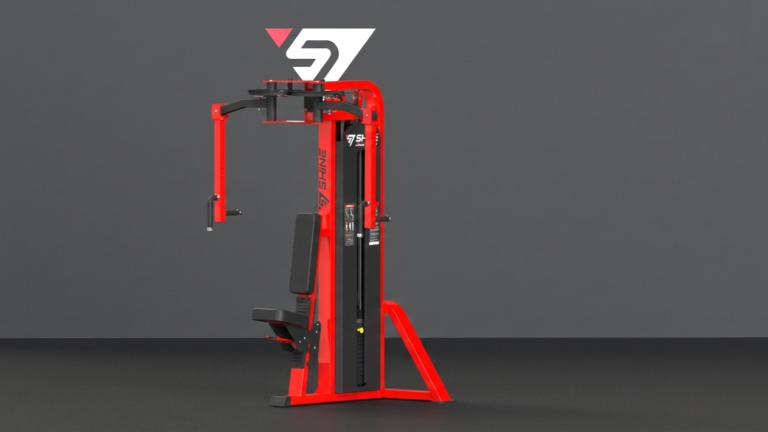
The core pressing group of gym machines comprises the chest press, incline chest press, decline chest press, pec deck or butterfly, shoulder press and lateral raise machine. A well-specified floor carries at least four of these six. Selectorised chest presses are typically installed near the entrance to the strength zone, while plate-loaded incline and decline units sit deeper in the floor where advanced members train.
Specification note: converging arm paths matter more than stack weight on pressing stations. A converging chest press mimics the natural adduction of the humerus and produces better peak contraction than a straight-line press at the same load.
Back and Pulling Stations
Pulling equipment is chronically under-specified in Indian commercial gyms, which creates postural imbalance across a membership base that already spends long hours seated. Any serious list of gym machines should carry pulling stations at close to parity with pressing stations.
Essential units here include the lat pulldown, seated row, high row, low row, T-bar row, pullover machine and assisted pull-up and dip station. The assisted pull-up unit deserves particular attention: it converts a movement most new members cannot perform into one they can progress on, which measurably improves retention in the first ninety days.
Leg and Lower-Body Stations
Lower-body gym machines carry the highest loads and therefore demands the heaviest fabrication. This section of the equipment specification should never be value-engineered.
- 45-degree leg press the highest-throughput leg station in most facilities; specify a minimum 400 kg tested rating.
- Hack squat or combined leg press hack squat unit adds a standing, quadriceps-dominant pattern in a compact footprint.
- Leg extension and seated leg curl isolation for the quadriceps and hamstrings; check for adjustable range limiters.
- Lying or standing leg curl recruits the hamstrings differently from the seated variant and is worth carrying alongside it.
- Hip thrust machine and glute kickback now core equipment rather than optional, driven by strong demand among female members.
- Standing and seated calf raise the seated variant loads the soleus, the standing variant the gastrocnemius; carry both where space allows.
- Abductor and adductor machine valuable for hip stability and widely used in rehabilitation programming.
A note on sequencing: leg stations generate the longest rest intervals, so they need wider walkways than upper-body equipment. Plan 1,000 mm of circulation around leg machines against 750 mm elsewhere.
Cable and Functional Training Systems
Cable equipment has moved from peripheral to central over the past decade. A dual adjustable pulley or functional trainer can substitute for a dozen single-purpose gym machines, which makes it the highest-value line item per square metre in most facilities.
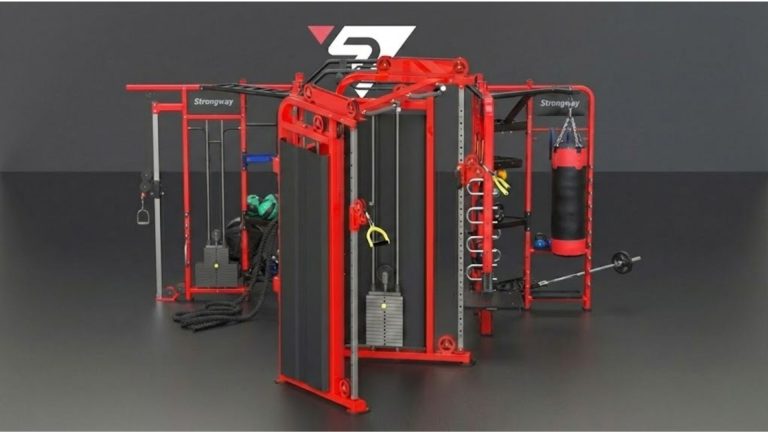
The functional group includes the dual adjustable pulley, cable crossover, single-column functional trainer, multi-station jungle gym and cable-based rotation units. For studios under 2,000 square feet, a single functional trainer combined with a small selection of fixed stations delivers broader movement coverage than a conventional strength circuit at the same cost.
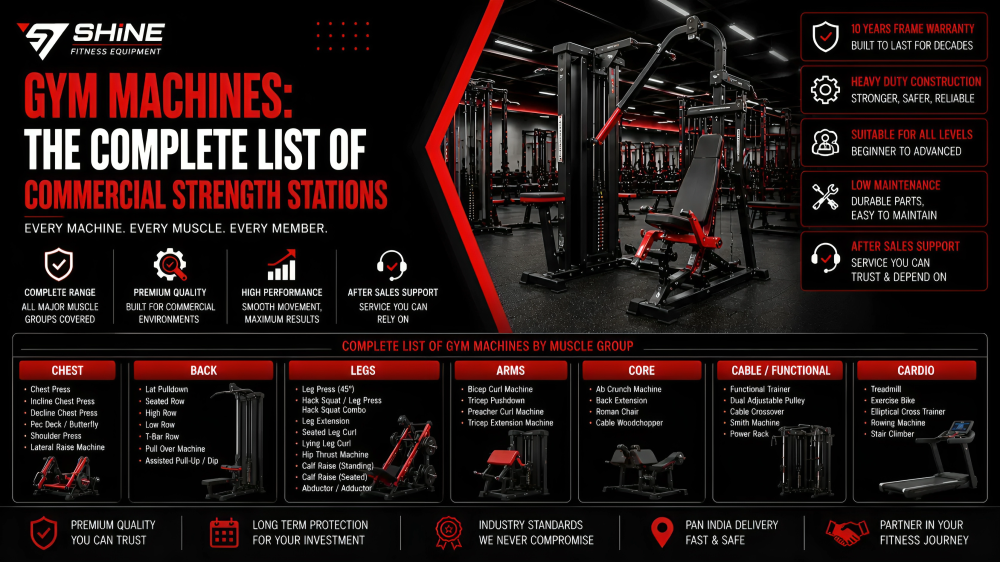
Complete Commercial Gym Machine List by Muscle Group
The table below consolidates the discussion into a reference buyers can work from directly. Gym equipment names vary between manufacturers, so alternative terms are included where they are commonly used.
| Muscle Group | Primary Stations | Common Alternative Names |
| Chest | Chest press, incline press, pec deck | Butterfly, chest fly, seated press |
| Back | Lat pulldown, seated row, T-bar row | High row, low row, pulldown station |
| Shoulders | Shoulder press, lateral raise machine | Overhead press, delt fly |
| Arms | Biceps curl machine, triceps extension, dip station | Preacher curl, pushdown station |
| Legs | Leg press, hack squat, leg extension, leg curl | Squat press, quad extension, hamstring curl |
| Glutes / Hips | Hip thrust, abductor, adductor, glute kickback | Glute bridge machine, hip machine |
| Core | Ab crunch machine, rotary torso, back extension | Abdominal station, oblique twist |
| Full body | Functional trainer, cable crossover, Smith machine | Dual pulley, jungle gym, multi-station |
.
Cardio Equipment Worth Carrying
Cardio typically consumes 30 to 40 per cent of floor area in a mainstream club and considerably less in a strength-led gym. The standard specification comprises motorised treadmills, upright and recumbent cycles, elliptical cross-trainers, rowing machines, stair climbers and air or assault bikes. Guidance published by the Health & Fitness Association indicates that treadmills remain the highest-utilisation cardio category across most club formats, which justifies over-specifying motor rating and belt quality on those units specifically.
Building your equipment list? Shine Fitness manufactures the full range of commercial gym machines described in this article (selectorised, plate-loaded, cable and functional systems) built to commercial gauge and load-tested in-house. Send your floor area and member profile to shinefitness.in and our team will return a station-by-station equipment list matched to your budget.
How Many Gym Machines Does a Commercial Floor Need?
The number of gym machines should follow projected peak occupancy rather than floor area alone. The planning ratios below are widely used in commercial facility design and give a defensible starting point.
| Facility Size | Peak Users | Strength Stations | Cardio Units |
| 1,500 to 2,500 sq ft | 15 to 25 | 12 to 18 | 6 to 10 |
| 2,500 to 5,000 sq ft | 25 to 50 | 20 to 30 | 12 to 20 |
| 5,000 to 10,000 sq ft | 50 to 100 | 32 to 50 | 22 to 40 |
| 10,000+ sq ft | 100+ | 55+ | 45+ |
These figures assume a conventional membership mix. A strength-led gym shifts the ratio towards more stations and less cardio; a corporate or residential facility shifts it the other way.
Specification Checks Before You Buy
Two units carrying identical gym equipment names can differ substantially in build. The following checks should be applied to every line on a purchase order.
- Frame gauge: 2.5 mm minimum wall thickness on upper-body stations, 3 mm on leg equipment.
- Cable specification: 7 x 19 aircraft-grade steel cable with nylon coating, rated to at least seven times working load.
- Pulley quality: sealed ball-bearing pulleys in glass-filled nylon housings, not bushed plastic.
- Upholstery: high-density foam under double-stitched commercial vinyl, with replaceable pad assemblies.
- Adjustment mechanisms: pop-pin or gas-assisted adjustment that a member can operate one-handed mid-set.
- Warranty structure: separate terms for frame, moving parts and upholstery, a single blanket figure usually conceals a short parts warranty.
Manufacturers that publish conformity to ISO 20957 class S give buyers an objective reference point rather than a marketing claim. Where certification is unavailable, request the steel test certificate and a written load rating for each station.
Layout Considerations for the Equipment List
A list of gym machines only performs if the floor plan supports it. Group pushing and pulling stations so members can superset without crossing walkways. Place leg machines against a load-bearing wall or over a structurally sound span. Keep cable and functional systems in an open area with at least 2.5 metres of clear working radius, and position cardio where members can see the entrance and the floor rather than facing a blank wall.
Accessibility should also be designed in from the start. Maintaining minimum 900 mm circulation paths between stations, in line with published accessible design standards, keeps the floor usable for members with mobility limitations and simplifies emergency egress.
Conclusion
A commercial gym machine list is not a catalogue to be copied. It is a set of decisions about member profile, peak occupancy, floor geometry and capital availability, expressed as equipment. Get the categories right first, balance pressing against pulling, over-specify the leg stations, and treat cable systems as the highest-value square metres on the floor. The specific gym machines then follow logically from those choices.
Shine Fitness manufactures commercial strength and cardio equipment for gyms, hotels, corporate facilities, residential clubs and sports academies across India. Every station is fabricated to commercial gauge, finished with electrostatic powder coating, and supported by on-site installation, spare-part availability and long-term service. If you are compiling a strength station list for a new facility or replacing ageing equipment, the Shine Fitness team will build the specification around your floor plan and membership rather than around a stock catalogue. Visit shinefitness.in to start the conversation.
Frequently Asked Questions
What are the most essential gym machines for a new commercial gym?
Prioritise a leg press, lat pulldown, seated row, chest press, shoulder press, functional trainer, leg extension and leg curl. These eight stations cover every major movement pattern and typically account for the majority of member usage in the first year.
How many machines should a 3,000 square foot gym have?
Plan for roughly 22 to 28 strength stations and 14 to 18 cardio units at that size, assuming peak occupancy of 30 to 45 members. Adjust upward for strength-led positioning and downward for a class-heavy format.
Is sectorised or plate-loaded equipment better for a commercial floor?
Neither is universally better. Sectorised units suit beginners and high-throughput circuits; plate-loaded units suit experienced lifters and generally cost less per station. Most commercial floors run a deliberate mix of the two.
What is the difference between a strength station list and a full equipment list?
A strength station list covers resistance equipment only. A full equipment list adds cardio, free weights, benches, racks, storage, functional accessories and flooring, which together often represent a third of total project cost.
How long do commercial gym machines last?
Correctly specified commercial gym machines last eight to twelve years on frames, with cables, pulleys and upholstery treated as consumables replaced every two to four years depending on traffic.
Do gym equipment names differ between manufacturers?
Yes. The same station may be called a pec deck, butterfly or chest fly machine depending on the brand. When comparing quotations, compare movement pattern, frame gauge and load rating rather than product names.
Does Shine Fitness supply complete gym setups?
Yes. Shine Fitness provides end-to-end commercial gym setup including equipment selection, floor layout planning, manufacturing, delivery, installation and after-sales service across India. Enquiries can be raised through shinefitness.in.