The chest press machine is the most contested station on any gym floor. It is used by beginners on their first session and by advanced lifters on their heaviest, which makes it one of the few machines that has to serve two completely different user profiles well. Get the selection right and it becomes a station members queue for happily. Get it wrong wrong resistance type, wrong arc, wrong seat geometry and you own a frame that experienced lifters bypass and new members find uncomfortable.
Choosing a chest press machine is therefore less about brand than about matching four specific design decisions to who actually trains in your facility. This guide works through those decisions in the order they should be made: resistance type, movement path, build specification, and finally sizing and layout. It also covers the mistakes that cost Indian gym owners the most money usually made in the first purchase, and usually discovered in year two.
The Four Machine Types You Are Choosing Between
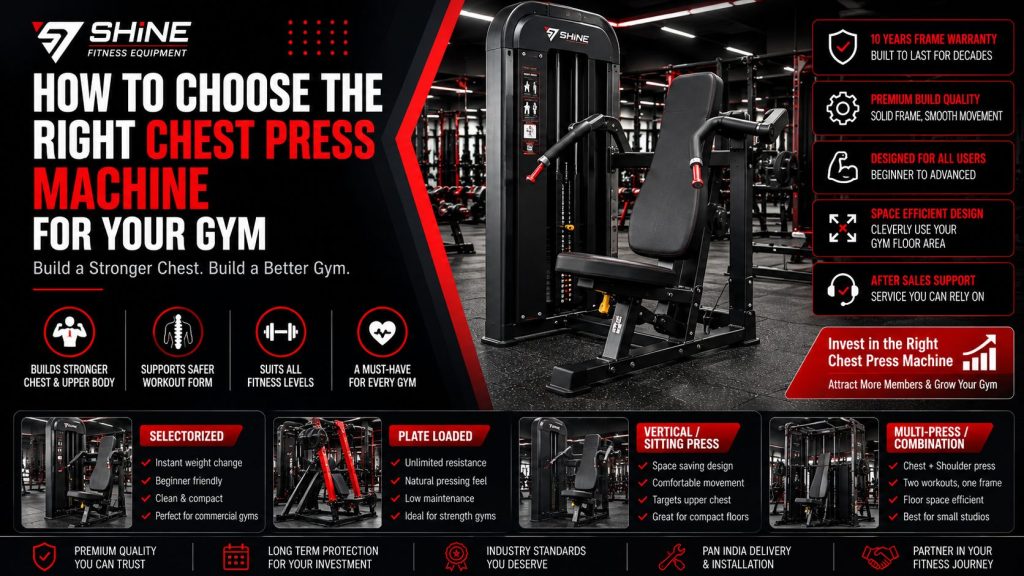
Plate-Loaded Chest Press Machine
Resistance comes from Olympic plates loaded onto lever arms. There is no upper limit beyond the frame rating, which matters in strength-focused facilities where members outgrow weight stacks. The feel sits closer to free weights resistance builds and releases with the movement rather than staying flat and many experienced lifters prefer it for exactly that reason.
A plate-loaded chest press machine has fewer moving parts, no cables to fray and no stack to service, so maintenance cost over ten years is meaningfully lower. The trade-off is convenience: members load and unload plates between sets, which slows circuit training and creates plate clutter around the station. These units also sit naturally alongside the rest of your plate loaded gym equipment, sharing one plate inventory across the floor.
Selectorized (Weight Stack) Chest Press Machine
A pin selects resistance from an integrated stack. Weight changes take two seconds, which makes this the right choice for circuit formats, drop sets, and any facility where a high proportion of members are new to training and intimidated by loading plates.
The limitation is ceiling. Most commercial stacks top out around 100-120 kg, and with a 2:1 pulley ratio the effective resistance is lower still. Strong members will outgrow it. Cables, pulleys and guide rods also need periodic service, so factor cable replacement into your maintenance budget every 18-30 months depending on traffic.
Vertical and Sitting Chest Press Machine
A vertical chest press uses a more upright seat and a pressing path angled slightly upward, sitting somewhere between a flat press and an incline. It recruits the upper pectorals and anterior deltoids more than a horizontal press, and its footprint is noticeably narrower often 30-40% less floor width than a conventional unit.
For gyms tight on space this is a genuinely useful option. A sitting chest press machine is also more comfortable for members who find the deep shoulder extension of a flat press irritating, since the upright position reduces the stretch at the bottom of the movement. In mixed-ability facilities that upright geometry is often the difference between a station beginners use and one they avoid.
Multi-Press and Combination Stations
A multi press machine delivers chest press Machine and shoulder press from one frame via an adjustable seat and multiple handle positions. Combination units such as an ISO lat pulley with chest press go further, pairing a pushing and a pulling station back to back on a shared frame.
These are the strongest option for small studios. Two movements from one footprint at roughly 1.4 times the price of a single station is compelling arithmetic when floor space costs ₹60-₹140 per sq ft per month. The trade-off is the one all combo equipment carries: one user at a time, and an adjustment step between configurations.
Comparing the Four Types Side by Side
| Factor | Plate-Loaded | Selectorized | Vertical | Multi-Press Combo |
| Typical India price | ₹45,000 to ₹90,000 | ₹65,000 to ₹1,40,000 | ₹40,000 to ₹85,000 | ₹70,000 to ₹1,50,000 |
| Resistance ceiling | Frame-rated, very high | 100-120 kg stack | Frame-rated or stack | Varies by build |
| Weight change speed | Slow (load plates) | Instant (pin) | Depends on type | Depends on type |
| Floor space | 40-55 sq ft | 35-50 sq ft | 25-35 sq ft | 45-60 sq ft |
| Maintenance load | Low | Moderate (cables) | Low | Moderate |
| Best for | Strength gyms, advanced members | Circuits, beginners, hotels | Space-constrained floors | Small studios, home gyms |
| Beginner friendliness | Moderate | High | High | Moderate |
Most successful Indian gyms above 2,000 sq ft eventually run both a plate-loaded and a selectorized chest press machine, because the two serve genuinely different members. If your budget allows only one at launch, let your membership profile decide: a strength-led catchment means plate-loaded first, a general-fitness catchment means selectorized first.
Movement Path: Converging vs Parallel
This is the design detail that most affects how a machine feels, and the one buyers most often overlook.
On a parallel or fixed-path unit, the handles travel straight forward, staying the same distance apart from start to lockout. It is simple, robust and predictable.
On a converging unit, the handles move forward and inward simultaneously, meeting closer to the midline at lockout. This mirrors what your arms do naturally during a dumbbell press or a push-up, where the hands arc toward each other rather than tracking straight lines.
That converging path adds a horizontal adduction component at the top of the rep, which increases contraction through the chest and is what most lifters describe as the machine feeling better. It also tends to be gentler on the shoulder, because the humerus is not locked into a single plane throughout the movement.
Iso-lateral designs take this further by giving each arm an independent lever, so left and right sides move separately. This lets a member train around a shoulder issue, correct a strength imbalance, or press single-arm. In commercial facilities serving mixed ability levels, an iso-lateral converging chest press machine draws the fewest complaints of any configuration.
Converging and iso-lateral builds cost more typically 20-35% over a fixed-path equivalent. In a gym where the chest press machine ranks among your three most-used stations, that premium is usually recovered in member satisfaction alone.
Build Quality: What to Inspect Before You Commit
- Frame tube and gauge. Main uprights should be 60-75 mm square section at 2.5-3 mm wall thickness. Anything lighter flexes perceptibly under heavy load, and flex is what members interpret as a cheap machine.
- Pivot bearings, not bushings. Sealed ball bearings at the lever pivots stay smooth for years. Nylon or brass bushings develop play within 12-24 months of commercial traffic, producing the side-to-side wobble that ruins the feel of any pressing station.
- Upholstery density and stitching. Look for high-density foam of at least 50 mm on the back pad, wrapped in commercial-grade PU or rexine with double-stitched seams. Thin pads compress permanently within a year and expose the board underneath.
- Seat adjustment range and mechanism. A minimum of five vertical seat positions, adjustable with a pop-pin the user can reach while seated. Gas-assisted adjustment is a genuine upgrade in high-traffic gyms because it removes the excuse not to adjust.
- Handle geometry and grip options. Dual grips neutral and pronated meaningfully expand who can use the station comfortably. A grip diameter of 30-35 mm suits the widest range of hand sizes.
- Finish quality. Powder coating over a shot-blasted and phosphated surface resists the humidity and sweat exposure of an Indian gym floor far better than paint over bare steel. Ask specifically about surface preparation, not just the coating itself.
Sizing the Machine to Your Facility
Small studios under 1,500 sq ft. One station, and make it count. A vertical or multi-press unit gives you chest work without surrendering 55 sq ft. If your members skew toward general fitness, choose selectorized for the faster weight changes. A sitting chest press machine with a compact base is often the single best use of a constrained wall.
Mid-size gyms of 2,000-3,500 sq ft. Two stations: one plate-loaded converging unit for strength-oriented members and one selectorized for beginners and circuits. This pairing covers essentially your whole membership and removes the peak-hour bottleneck a single station creates. Add a pec fly and rear delt machine to complete the chest zone with an isolation option.
Commercial clubs above 5,000 sq ft. Three or more units, including at least one incline or vertical variant. At 500-plus members, a single chest press machine station generates visible queues between 6 pm and 9 pm, and queue time correlates directly with non-renewal. Duplicate your highest-traffic stations before you add exotic ones.
Layout and Clearance Planning
Allow a working envelope of roughly 7 ft × 6 ft per station. That figure includes the frame itself plus space behind the seat for entry and exit, and side clearance for plate loading on plate-loaded units.
Three placement rules save trouble later:
- Face the mirror wall, not a corner. Members check pressing form constantly, and a station facing a blank wall gets used less.
- Keep the loading side clear of walking corridors. A member sliding a 20 kg plate onto a horn should not be stepping into traffic.
- Group the push zone. Placing the chest press machine near the shoulder press and an adjustable bench lets members complete a full pushing session in one area, which measurably improves floor flow at peak hours.
The Mistakes That Cost the Most
Buying on stated capacity rather than build. A frame rated for 250 kg means nothing if the pivots use bushings. Ask about bearings, tube gauge and weld quality before you ask about capacity.
Ignoring the smallest and largest users. A machine that fits a 5’9” member perfectly may leave a 5’2” member pressing from an awkward shoulder angle. Check the seat range at both extremes before ordering.
Forgetting spare parts availability. Cables, pads and pop-pins are consumables. Sourcing from a domestic strength equipment manufacturer means replacements arrive in days rather than the months an imported line can take.
Under-buying at launch, then paying twice. Owners who buy one cheap station and replace it in year two spend more than those who bought one good station at the start. If the budget is tight, buy fewer machines of better quality rather than more machines of worse.
To match a chest press machine to your floor plan, member profile and budget, speak with the Shine Fitness team or browse the complete product range built for Indian commercial gyms.
Frequently Asked Questions
How much does a chest press machine cost in India?
Commercial-grade units run ₹40,000 to ₹1,50,000 factory-direct. Plate-loaded builds occupy the ₹45,000-₹90,000 band, selectorized units ₹65,000-₹1,40,000 because of the stack and cable assembly, and multi-press combination frames ₹70,000-₹1,50,000. Converging and iso-lateral geometry adds roughly 20-35% over a fixed-path equivalent.
Plate-loaded or selectorized which should a new gym buy first?
Let your membership decide. Strength-led catchments should start plate-loaded, because the resistance ceiling never limits a member and maintenance is lower. General-fitness catchments, hotel gyms and circuit-format studios should start selectorized, because two-second weight changes keep sessions moving and beginners are not put off by loading plates.
Is a sitting chest press machine better than a flat press?
Neither is better; they emphasise different things. The upright seat shifts load toward the upper chest and front deltoids and reduces the shoulder stretch at the bottom of the rep, which many members find more comfortable. A flat path allows heavier loading through the mid-chest. Gyms with space for one unit and a broad membership often choose upright for the comfort advantage.
How much floor space does a chest press machine need?
Plan 40-55 sq ft for a plate-loaded unit, 35-50 sq ft for a selectorized unit, and 25-35 sq ft for a vertical build. Add entry and exit space behind the seat and loading clearance at the sides, giving a practical working envelope of about 7 ft × 6 ft per station.
What maintenance does the station need?
Plate-loaded units need little more than monthly pivot inspection, a light grease film on moving joints and periodic bolt torque checks. Selectorized units add cable inspection every quarter and cable replacement every 18-30 months under commercial traffic. Upholstery typically needs replacing every three to five years at ₹3,000-₹8,000 per pad.
Can one machine serve both beginners and advanced lifters?
Partly. An iso-lateral converging unit with a wide seat range and dual grips covers the broadest span of ability, which is why it is the most common single-station choice. But members pressing above 120 kg will always prefer plate loading, so gyms above 2,000 sq ft generally end up running both resistance types side by side.