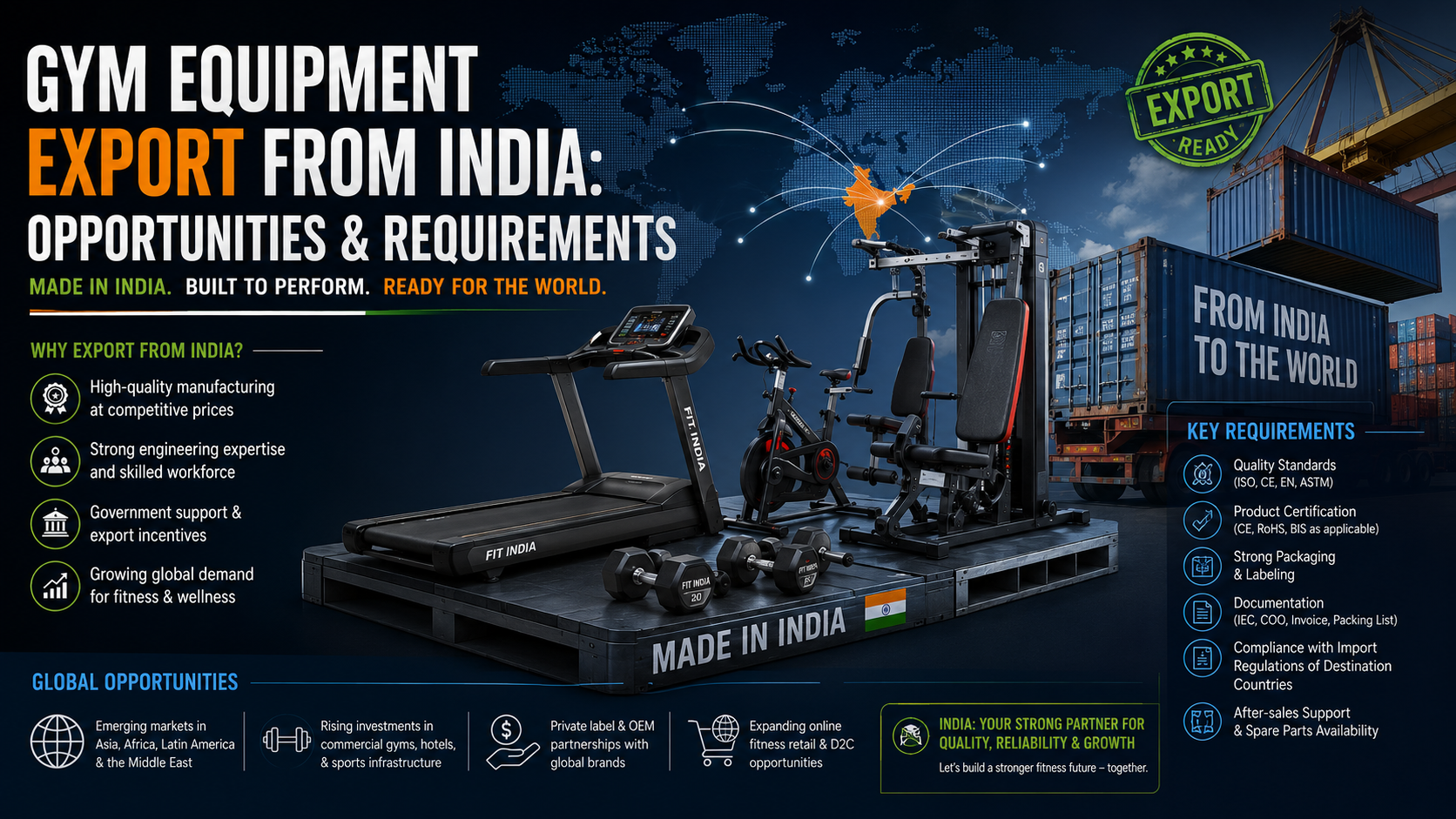
India has quietly become one of the most competitive bases in the world for fitness equipment production, and for any gym equipment manufacturer with international ambitions, the export opportunity has rarely looked stronger. A mix of skilled engineering talent, cost-efficient production, and steady demand across mature and emerging markets has turned what was once a largely domestic trade into a credible presence on the global stage. Buyers in North America, Europe, the Gulf, and Australia are actively sourcing strength and cardio equipment from Indian factories that can match international quality at a sharper price.
The timing matters. The Indian fitness equipment market alone was valued at roughly USD 790 million in 2024 and is expanding at close to a 10% annual rate, while the broader domestic fitness economy is on track to approach USD 4.5 billion by 2030. That growth has built deep local manufacturing capability, and much of that capacity is now turning outward. For exporters, distributors, and brand owners, understanding both the openings and the obligations of this trade is the difference between a profitable shipment and a stalled one. This guide breaks down where the demand is, what compliance the markets require, and how to identify a manufacturing partner that can actually deliver abroad.
Why India Has Become a Hub for Fitness Equipment Manufacturing
A few structural advantages explain why global buyers increasingly look to India before sourcing elsewhere.
- Cost-competitive production. Lower input and labor costs let Indian factories quote prices that undercut Western producers without the corner-cutting buyers fear from the cheapest suppliers.
- A maturing engineering base. Years of supplying a fast-growing domestic market have built genuine expertise in frame fabrication, welding, powder coating, and assembly.
- Strong raw-material access. Reliable supply of quality steel and components keeps lead times and costs predictable.
- Scalable capacity. Established plants can handle both small custom runs and large container orders, which suits everyone from boutique brands to national gym chains.
- Improving design sophistication. Indian producers are moving up the value chain, from basic plate-loaded machines toward ergonomic, smart-enabled commercial gym equipment.
The result is a manufacturing ecosystem that can serve a budget importer and a premium distributor from the same industrial corridors, which is precisely what global sourcing teams want.
The Export Opportunity: Where Demand Is Growing
Export success starts with knowing who is buying and what they want. Demand is not uniform; it concentrates in specific regions and product categories.
Key Export Destinations
Indian fitness equipment finds its largest audiences in a handful of established markets:
- The United States, the single biggest buyer, where commercial gym chains and hotel fitness centers drive volume.
- The United Kingdom and Ireland, where boutique studios and chain expansion sustain steady orders.
- Australia, a consistent destination with strong demand for both commercial and home equipment.
- Germany, France, and the wider European Union, where certification-aware buyers reward compliant, well-built products.
- The Gulf and Middle East, where new hotels, residential developments, and wellness centers are fitting out at pace.
Emerging markets across Southeast Asia, Africa, and Latin America are also opening up, often with lower certification barriers, making them practical entry points for newer exporters.
Product Categories in Demand
Not every product travels equally well. Some categories consistently attract international orders:
- Strength training equipment such as plate-loaded machines, multi-stations, and functional trainers, valued for their durability and long service life.
- Cardio equipment, including treadmills and bikes, though motorized units carry extra electrical compliance requirements.
- Abdominal exercise machines and core stations, popular in both commercial circuits and home setups.
- Free-weight and rack systems, where Indian fabrication quality competes strongly on price.
- Compact home-gym solutions, riding a global home fitness trend that accelerated after the pandemic and has not fully receded.
A manufacturer that builds across several of these categories can serve full-facility orders rather than single items, which makes for larger, stickier export relationships.
Export Requirements Every Manufacturer Must Meet
Opportunity comes with obligation. Exporting from India involves three layers of requirements: registration and paperwork at home, product certification for the destination, and the documentation that moves with each shipment. Missing any one of them causes delays, rejected claims, or blocked entry.
Registrations and Documentation
Before a single container leaves port, an exporter needs the right credentials and paperwork in order.
- Import Export Code (IEC). Issued by the Directorate General of Foreign Trade, the IEC is mandatory for anyone trading across India’s borders. It is inexpensive to obtain and valid for the life of the business.
- GST registration. Required for tax compliance and for claiming input credit on zero-rated exports.
- Core shipping documents. Most consignments need a commercial invoice, packing list, shipping bill, and a bill of lading or airway bill from the carrier.
- Certificate of Origin. Often required to confirm Indian origin and to unlock preferential duties under trade agreements.
- Insurance certificate. Recommended, and sometimes contractually required, to cover goods in transit.
Most shipments end up carrying seven to nine documents depending on product, destination, and volume, and they must all agree with one another to clear customs cleanly.
Product Certifications and Safety Standards
This is where many exporters stumble, because the requirements depend entirely on the destination market. Commercial buyers will not risk liability on uncertified machines.
- ISO 20957 (EN 957 in Europe) is the primary international standard for stationary training equipment. It sets safety, strength, and stability requirements and runs rigorous endurance tests that simulate years of daily commercial use. The standard is multi-part, covering everything from exercise bikes to strength and functional machines, and it classifies equipment by use: Class S for studio and commercial settings, Class H for home use.
- CE marking is legally mandatory for equipment sold in the European Union. It draws on EN 957 along with directives for electromagnetic compatibility and low-voltage safety on powered machines, and it requires a Declaration of Conformity backed by test reports from a recognized laboratory.
- ASTM standards (such as F2276) are the reference point for the United States commercial market, where buyers use them as liability protection.
- ISO 9001 certifies the quality management system behind the products and reassures buyers that consistency is built into the process, not left to chance.
A practical roadmap for a fitness equipment manufacturer is to certify against ISO 20957 first, which establishes international credibility and effectively covers EN 957 for Europe, then add CE marking and ASTM compliance as you target those specific markets. One caution worth passing to buyers: a genuine CE mark requires real testing and documentation, and should not be confused with the visually similar “China Export” mark that carries no such backing.
Government Incentives and Schemes
India actively supports exporters, and these schemes can meaningfully improve margins.
- RoDTEP (Remission of Duties and Taxes on Exported Products) refunds embedded taxes and levies that other schemes do not cover. Claims are filed electronically through ICEGATE at the shipping-bill stage and issued as transferable duty credit scrips.
- EPCG (Export Promotion Capital Goods) lets manufacturers import machinery at zero or concessional duty against an export obligation, useful for upgrading production lines.
- Advance Authorization permits duty-free import of raw materials and components proportionate to export commitments.
Used well, these programs lower the effective cost of building for export and help Indian products stay price-competitive on the world market.
What Defines Export-Ready Gym Equipment
Meeting certifications is the floor, not the ceiling. Equipment that wins repeat international orders shares a set of qualities buyers can feel and inspect.
- Frame integrity. Heavy-gauge steel and clean, consistent welds that survive years of intensive commercial loading.
- Material and finish quality. Corrosion-resistant powder coating and durable upholstery that hold up under sweat, chalk, and humid shipping conditions.
- Engineering durability. Cable systems, pulleys, bearings, and weight stacks tested to clear safety margins rather than built to a price.
- User comfort and ergonomics. Natural movement paths, adjustable settings, and thoughtful contact points that members notice and appreciate.
- Smart fitness readiness. Optional rep tracking, app connectivity, and performance monitoring, increasingly expected in premium markets where connected equipment is a major buying driver.
- Reliable customization. The ability to adjust stack weights, colors, branding, and attachments so distributors can position products for their own customers.
These are the attributes that separate equipment which clears customs and lasts a decade from equipment that arrives, disappoints, and generates warranty claims across an ocean.
How to Evaluate a Manufacturing Partner for Export
For brand owners and distributors sourcing from India, choosing the right factory protects both reputation and revenue. A disciplined evaluation reduces risk.
- Verify certifications directly. Ask for current ISO 20957, CE, or ASTM documentation and confirm the issuing body is recognized in your target market.
- Review export experience. A partner that already ships to your region understands its compliance quirks, packaging norms, and customs expectations.
- Inspect build specifications in writing. Steel gauge, cable ratings, weight ranges, and warranty terms should be documented, not promised verbally.
- Assess production capacity and lead times. Confirm the factory can scale to your order size and hold delivery commitments during peak demand.
- Check after-sales and spare-parts support. International buyers especially need assurance that cables, pads, and pulleys are available and that issues are handled promptly.
- Request samples or a facility visit. Nothing replaces feeling a cable glide or a stack travel before committing to a full container.
A credible gym machine manufacturer will welcome this scrutiny. Reluctance to share specifications or certification records is a reliable signal to keep looking.
Building Long-Term Value and Business Growth
Export is best treated as a relationship, not a transaction. The manufacturers who thrive abroad invest in consistency, communication, and product development rather than chasing the lowest one-time price. For distributors, partnering with a reliable factory means dependable supply, fewer service headaches, and equipment that protects their own brand in front of demanding members.
The long-term value is real on both sides. Durable, well-finished machines hold up in commercial use, reduce replacement cycles, and earn repeat orders. As global fitness participation rises and connected, ergonomic equipment becomes the norm, the producers who pair manufacturing discipline with compliance and customization are positioned to grow alongside the markets they serve. Export, done properly, compounds.
Conclusion
Exporting gym equipment from India offers a genuine and growing opportunity, but it rewards preparation. The producers who succeed combine the country’s manufacturing strengths with rigorous attention to certification, documentation, and product quality. Buyers, in turn, benefit from choosing a partner who treats those requirements as standard practice rather than an afterthought.
For businesses planning to source or scale internationally, the choice of partner matters most. As an experienced gym equipment manufacturer, Shine Fitness builds commercial-grade products engineered for the demands of global markets and long-term ownership. Recognized as a dependable gym machine manufacturer and fitness equipment manufacturer, and counted among India’s largest gym equipment manufacturers, the company supports distributors and facility operators with compliant, durable, and customizable equipment.
If you are exploring export sourcing, expanding a distribution range, or fitting out a new facility, it is worth discussing specifications, certifications, and the right configuration for your market. Reach out to learn how the right manufacturing partner can support your growth across borders.
Frequently Asked Questions
Is gym equipment export from India profitable?
Yes, for manufacturers who meet international standards. India’s cost-competitive production, skilled fabrication, and access to growing markets in the US, UK, Europe, and the Gulf make exporting attractive, especially when paired with government incentive schemes that improve effective margins.
What certifications are required to export gym equipment from India?
The main requirement is ISO 20957 (EN 957 in Europe) for safety and durability. CE marking is mandatory for the EU, ASTM standards apply to the US commercial market, and ISO 9001 reassures buyers about quality management. Requirements depend on the destination country.
What documents are needed to export fitness equipment from India?
An Import Export Code (IEC) is mandatory, along with GST registration. Each shipment typically needs a commercial invoice, packing list, shipping bill, bill of lading or airway bill, certificate of origin, and often an insurance certificate, usually seven to nine documents in total.
Which countries import the most gym equipment from India?
The United States is the largest destination, followed by the United Kingdom, Australia, Ireland, and several European Union markets such as Germany and France. The Gulf region and emerging markets in Southeast Asia and Africa are also growing buyers.
What government schemes support gym equipment exporters in India?
Key schemes include RoDTEP, which refunds embedded taxes on exports, EPCG, which allows duty-free import of production machinery against export obligations, and Advance Authorization for duty-free raw materials. All require a valid IEC and are managed through DGFT and ICEGATE.
How do I choose a reliable gym equipment manufacturer for export?
Verify current certifications, check export experience to your region, review written build specifications and warranty terms, confirm production capacity and lead times, and assess spare-parts support. Requesting samples or a factory visit before a large order is strongly advised.
Is there demand for Indian-made home gym equipment abroad?
Yes. The global home fitness trend that accelerated during the pandemic continues to support demand for compact, multifunctional equipment. Indian manufacturers compete well on price and quality in this segment, particularly for strength and functional home-gym products.