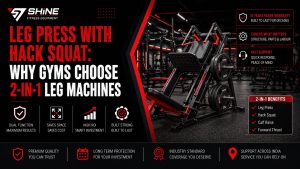
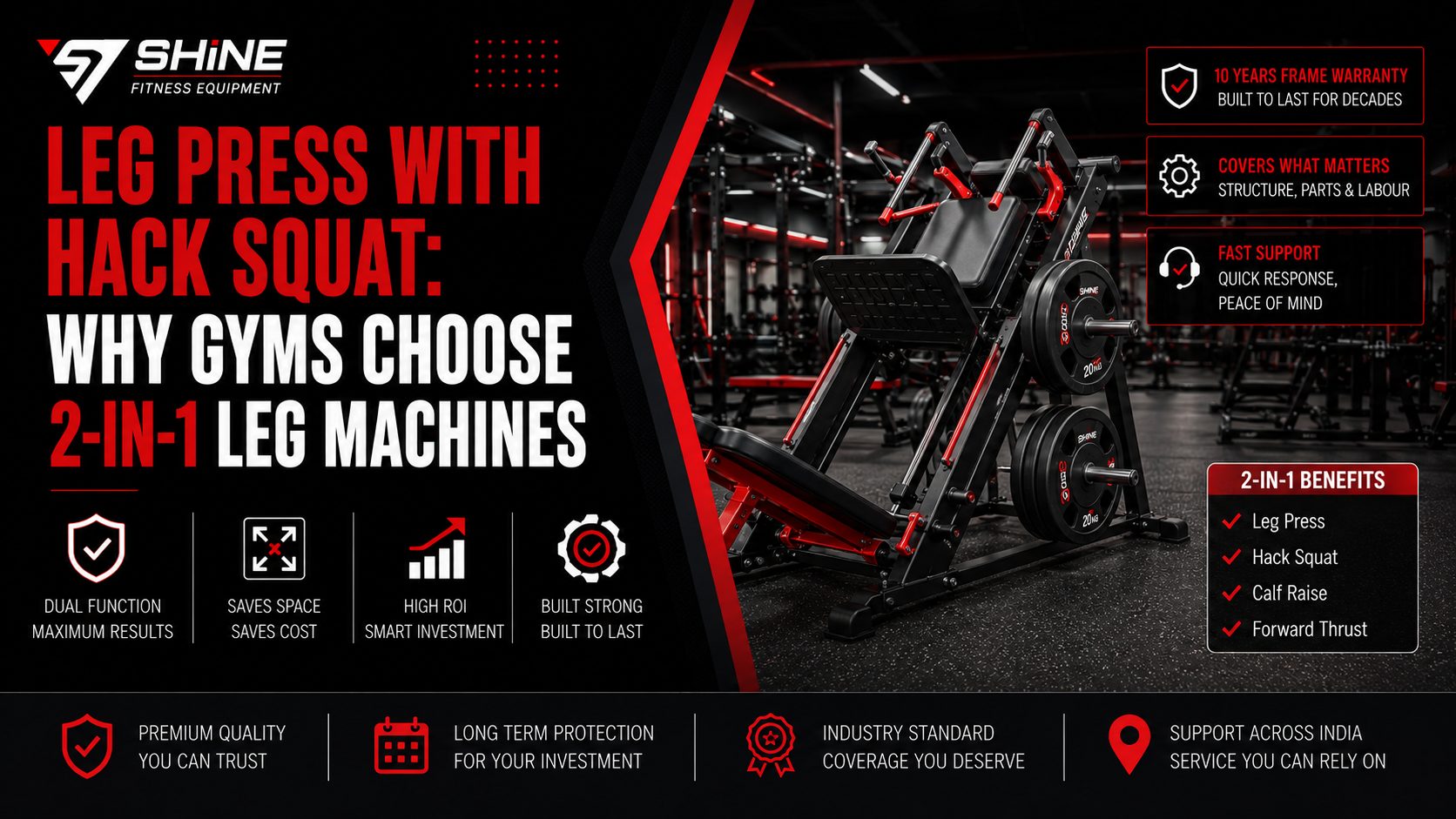
The two-station lower-body zone is disappearing from Indian gym floors. In its place sits a single angled sled performing both movements. A leg press with hack squat has become the default lower-body anchor for facilities between 1,000 and 4,000 square feet, for reasons that are commercial rather than fashionable.
Two dedicated stations occupy 130–160 sq ft and demand two separate capital outlays. One well-engineered leg press with hack squat delivers both movements, usually a calf raise and often a forward thrust, within 60–75 sq ft.
What a Leg Press With Hack Squat Machine Is
A leg press with hack squat is a plate-loaded sled travelling on a fixed track, normally inclined at 45 degrees, usable in two orientations.
In press mode the user reclines against a back pad and drives a footplate away from the body. The spine remains supported and axial loading is effectively removed, making this mode accessible to members with lower-back limitations and those returning from injury. In squat mode the same leg press with hack squat is used standing beneath shoulder pads, with load across the shoulders and feet on a lower platform. The trunk braces genuinely against the load and quadriceps emphasis increases through deeper knee flexion.
Conversion between modes takes 20–60 seconds on a competent machine. On a poorly designed leg press hack squat machine the same operation requires three minutes and two people, which is why the conversion mechanism is the first specification to evaluate.
Almost every leg press is plate-loaded rather than selectorized. Pressing loads routinely exceed 300–400 kg, and a weight stack of that magnitude is neither economical nor serviceable. Plate loading also integrates the machine with the remainder of your plate loaded gym equipment, sharing one Olympic plate inventory across the floor.
The Commercial Case for a Leg Press With Hack Squat
Floor Space Economics
Commercial rent in Indian tier-1 suburbs runs ₹60–₹140 per sq ft monthly. A standalone 45° leg press machine requires roughly 8 ft × 5 ft plus loading clearance, and a dedicated hack squat machine requires a comparable envelope. With the circulation corridor between them, the pair commits around 140 sq ft.
A leg press with hack squat measures 7–8 ft in length and 4–4.5 ft in width, requiring about 70 sq ft including clearances. At ₹90 per sq ft, the recovered area is worth ₹6,300 monthly ₹75,600 annually, exceeding the machine’s entire yearly depreciation in most facilities.
Capital Efficiency
Purchased as separate frames, a commercial press and squat station together cost ₹1.6–₹2.9 lakh. A comparable leg press and hack squat machine in combination form costs ₹1.1–₹2.2 lakh. The saving accrues on purchase price and floor rent simultaneously, which is unusual in equipment procurement.
Leg Press With Hack Squat vs Two Separate Stations
| Factor | Combination Unit | Two Separate Stations |
| Floor space required | 60–75 sq ft | 130–160 sq ft |
| Typical India price band | ₹1.1 – ₹2.2 lakh | ₹1.6 – ₹2.9 lakh |
| Movements available | 3–4 (press, squat, calf, thrust) | 2–3 |
| Peak-hour throughput | One user at a time | Two users simultaneously |
| Mode conversion | 20–60 seconds | Not required |
| Track geometry | One angle serving both | Optimised per movement |
| Maintenance points | Single carriage, one track | Two carriages, two tracks |
Throughput decides most leg press with hack squat purchasing cases. Facilities exceeding 400 members encounter simultaneous lower-body demand nightly, and above that threshold separate stations justify their area many clubs pair a dual leg press with a standalone squat frame. Below it, a hack squat leg press machine in combination form outperforms on every metric appearing on a profit and loss statement.
Specification Checklist
Carriage and bearings. This is where a durable leg press with hack squat separates from a disposable one. Linear ball bearings on hardened, ground steel shafts deliver travel that stays smooth under load. Nylon or polyurethane rollers feel acceptable when new but flat-spot within 12–18 months of commercial traffic. Ask explicitly what the carriage runs on; where the answer is imprecise, assume rollers.
Frame gauge and welds. On any leg press with hack squat, specify 60–75 mm square tube at 2.5–3 mm minimum wall thickness. Inspect welds at track mounts, shoulder pad uprights and the footplate hinge. Continuous, evenly deposited welds indicate controlled fabrication.
Footplate and pad adjustment. The footplate should offer at least three angle positions, since a fixed plate suiting a 5’10” lifter forces a 5’3” member into an unsustainable ankle angle. Verify shoulder pad height adjusts sufficiently for taller members to reach full extension.
Safety catches. Four or more racking positions is the benchmark, and this matters more on a leg press with hack squat than on a single-purpose frame because one catch system serves two user postures. Catches should engage against a positive mechanical stop rather than friction.
Plate storage. Six to eight integrated pegs on the leg press keep the floor clear. Confirm 60 cm of clearance on both flanks, without which staff manoeuvre 20 kg plates sideways between every set.
Price Bands in India
| Build Tier | Price Band | Specification |
| Entry / light commercial | ₹85,000 – ₹1,10,000 | Roller carriage, lighter tube, 2–3 racking positions |
| Standard commercial | ₹1,10,000 – ₹1,60,000 | Linear bearings, 60–70 mm frame, 4+ positions, 6 pegs |
| Heavy commercial | ₹1,60,000 – ₹2,20,000 | Hardened ground shafts, 75 mm frame, calf and thrust positions, 8 pegs |
A leg press with hack squat priced below ₹90,000 almost invariably employs roller carriages and lighter section tube a false economy, since replacement within three years exceeds the initial saving. Freight and installation are frequently quoted separately and add 3–6% to the delivered price.
Installation and Floor Loading
Plan a total envelope of approximately 8.5 ft × 6 ft including loading clearance. Ceiling height rarely constrains a 45-degree unit.
Floor loading warrants genuine attention. A fully plated leg press with hack squat carrying a heavy user concentrates 700–900 kg across a small footprint. Ground floors present no issue; upper floors in older buildings require a structural opinion before installation.
Orient the leg press with hack squat with its long axis parallel to a wall and direct the loading side away from the principal circulation corridor.
Completing the Lower-Body Zone
Most facilities add three complementary stations: a seated calf machine where the combo unit lacks a calf position, a leg extension machine for quadriceps isolation at lighter loads, and either a leg curl and extension combo or a CC squat station. That arrangement addresses every lower-body requirement within roughly 180 sq ft.
When Separate Machines Remain the Better Choice
A leg press with hack squat is not universally correct. Specify separate stations where the facility exceeds 400 active members, where a powerlifting focus demands uncompromised track geometry and loading beyond 500 kg, where circuit programming cannot tolerate a station occupied for an entire block, or where surplus floor area makes the 70 sq ft saving irrelevant.
For every other facility, the arithmetic favours the combination format. To specify a unit against your floor plan, contact the Shine Fitness team or review the complete range of commercial machines.
Frequently Asked Questions
How much does a leg press with hack squat cost in India?
A commercial-grade leg press runs ₹1.1–₹2.2 lakh factory-direct, determined by frame gauge, bearing type, plate storage and racking positions. Machines below ₹90,000 generally use roller carriages and lighter tube, shortening service life considerably.
Is a leg press and hack squat combination as effective as separate stations?
For training outcomes, yes. Both movements deliver the same range of motion and load capacity as standalone equivalents. The compromise is geometric rather than functional: one track angle serves both movements instead of each being independently optimised. Most members do not perceive the difference.
What weight capacity should a leg press with hack squat offer?
Specify at least 400 kg rated capacity for commercial use, and confirm whether that figure includes the sled’s own mass. Six to eight plate pegs is a practical minimum, since a single heavy user may load 350 kg at once.
Can a leg press with hack squat be installed on an upper floor?
Usually, but verify first. A fully loaded machine plus user concentrates 700–900 kg over a small footprint. Unreinforced slabs warrant a structural engineer’s assessment; a rubber-and-ply base plate assists but does not substitute for it.
How is this machine referred to in the market?
Buyers search for it as leg press with hack squat, leg press hack squat machine, hack squat leg press machine, leg press and hack squat machine, and occasionally as the misspelt “leg press with hacks scaut” all describing the same 2-in-1 plate-loaded station.
How much maintenance does it require?
Minimal. There are no cables to fray and no stack to service. Monthly, wipe and inspect the guide shafts, apply a light lithium grease film and confirm catch pins engage cleanly. Upholstery needs replacement every three to five years at ₹3,000–₹8,000 per pad; quality bearings deliver seven to ten years.