Introduction
Women-only fitness spaces have moved from a niche concept to one of the most reliable growth segments in the industry, and the quality of your buildout decides whether members stay or drift away. Getting it right starts long before opening day, with two decisions that shape everything else: which machines you bring in, and which gym equipment manufacturer you trust to build them. A women-only gym carries its own set of expectations around comfort, privacy, ergonomics, and the kind of training women actually come in to do. Floors that feel cramped, machines sized for larger frames, or equipment that wobbles after a year all push members toward the competition down the road.
This guide walks through the full picture: understanding what your members want, selecting the right mix of strength, cardio, and functional equipment, planning a layout that flows, and vetting the manufacturer behind the machines. Whether you’re an operator opening your first studio or a distributor advising clients, the goal is the same: a space that performs on day one and still feels solid five years later.
Why Women-Only Gyms Keep Gaining Ground
Demand for women-focused fitness isn’t a passing trend. Several forces are pushing it forward at once:
- Many women prefer a space where they can train without feeling watched, especially in the free-weight and strength zones.
- Strength training among women has climbed sharply, replacing the older “cardio-only” assumption that shaped gym design for decades.
- Smaller, community-driven facilities are winning members who want familiarity over a crowded big-box floor.
- Operators see lower equipment-conflict during peak hours, since member usage patterns tend to be more predictable.
For a business buyer, this adds up to a segment with strong retention and clear word-of-mouth potential. The investment case is solid, provided the equipment and layout match what this audience expects rather than recycling a generic gym template.
Understanding What Women Members Actually Want
Before you order a single machine, it helps to map the real reasons members walk through the door. A women-only gym usually serves a wider range of experience levels than a typical strength-focused facility, from complete beginners to seasoned lifters. Your equipment plan has to hold all of them.
A few patterns show up again and again:
- Approachability matters. Guided machines with clear movement paths reduce intimidation for newcomers and let them train confidently without a coach hovering nearby.
- Strength is central, not optional. Resistance training is now a primary draw, so a credible strength section is non-negotiable.
- Comfort and fit influence loyalty. Equipment sized and adjusted for a broader range of body types keeps members coming back.
- Hygiene and space feel personal. Breathing room between stations reads as respect, not just compliance with a floor-plan minimum.
When you design around these expectations instead of guessing, your retention numbers tend to take care of themselves.
Essential Equipment Categories for a Women-Only Gym
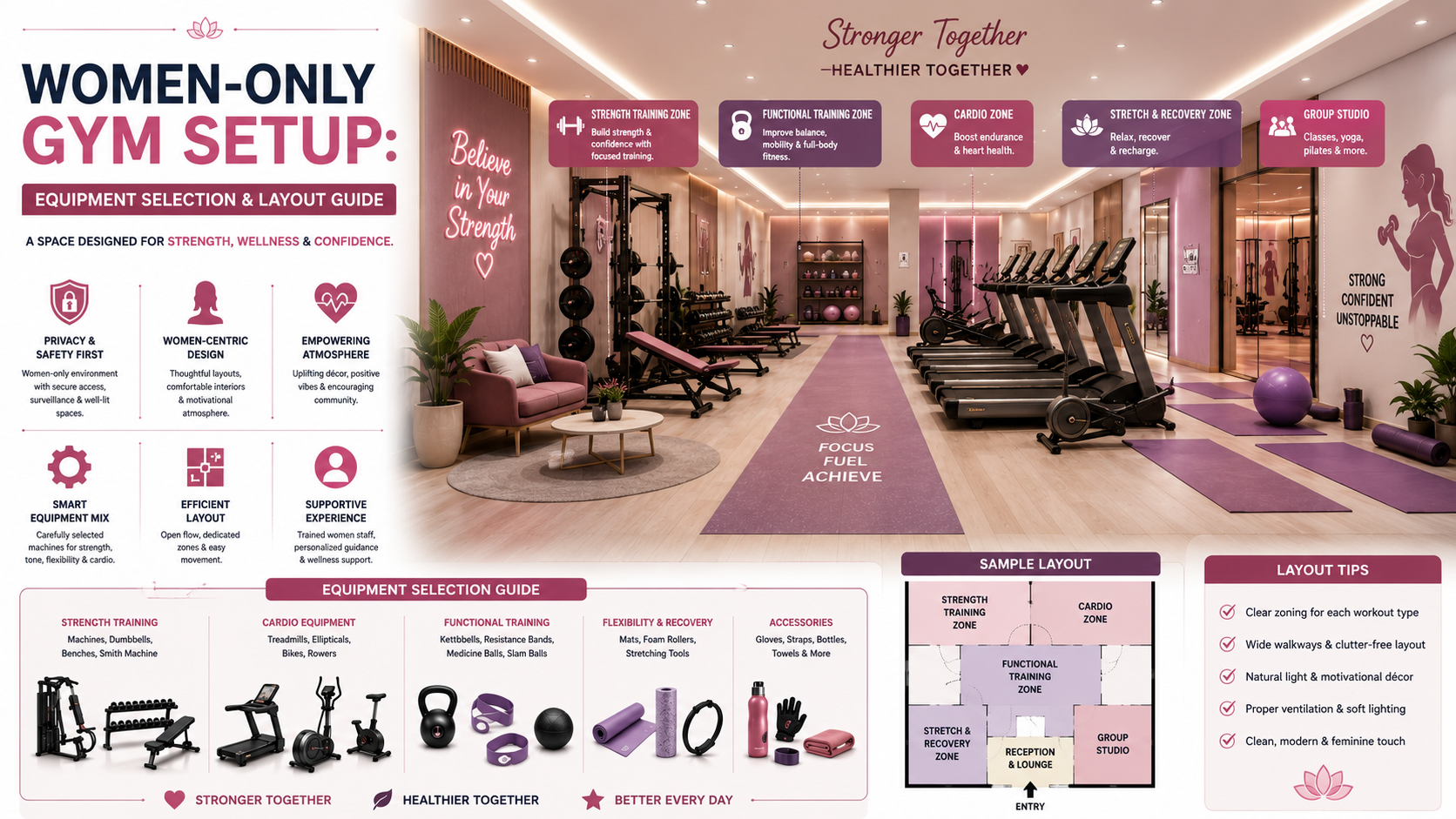
A balanced floor mixes four core categories. Get the proportions right and the space serves beginners and advanced members equally well.
Strength Training Equipment
This is the backbone of the modern women-only gym. A smart mix includes selectorized (pin-loaded) machines for guided, low-risk training and a measured selection of free weights for members ready to progress.
Prioritize:
- Lower-body machines such as leg press, hip thrust, and glute-focused stations, which see heavy demand in this segment.
- Upper-body selectorized units with adjustable seats and ranges that fit smaller frames.
- A compact free-weight area with dumbbells in tighter increments, plus a couple of squat racks and benches.
A capable gym machine manufacturer will offer adjustable seat heights, accessible weight stacks, and starting resistances that suit lighter loads without forcing members to fight the equipment.
Cardio Equipment
Cardio still anchors warm-ups, conditioning, and steady-state sessions. You don’t need a wall of identical treadmills, but you do need variety and reliability.
A practical cardio lineup covers:
- Treadmills with responsive cushioning and intuitive controls.
- Cross-trainers and ellipticals for lower-impact options.
- A few upright or recumbent bikes for accessibility across fitness levels.
- One or two rowers for full-body conditioning.
Reliable cardio equipment production is where manufacturing quality really shows. These machines run for hours daily, so motor durability and frame stability separate a sound investment from a constant repair headache.
Functional and Group Training Zones
Functional fitness has become a defining feature of women-focused gyms, often paired with small-group classes that build community and recurring revenue.
Stock this zone with:
- Kettlebells, resistance bands, and medicine balls in a tidy, accessible rack system.
- A cable or functional trainer station for versatile multi-plane movement.
- Open matted floor space for mobility work, stretching, and class formats.
This area delivers high member value with a relatively modest footprint and spend, which makes it one of the smartest allocations in a new build.
Abdominal and Core Machines
Core training remains a consistent member request, so dedicated abdominal exercise machines earn their place. Look for ab crunch stations, rotary torso units, and back-extension benches that pair well with the functional zone. Well-engineered core equipment supports proper form and reduces strain, which matters most for the beginners who use these stations the most.
Choosing the Right Gym Equipment Manufacturer
Equipment selection means little if the build quality behind it falls short. The manufacturer you choose determines durability, safety, member experience, and your long-term cost of ownership. Here’s how to evaluate one properly.
Build Quality, Materials, and Durability
Commercial gym equipment lives a hard life. Frames should use heavy-gauge steel with quality welds, and moving parts should rely on sealed, serviceable bearings rather than bargain components that fail under daily load.
When assessing product engineering and durability, ask about:
- Steel grade, frame thickness, and powder-coat or finish quality.
- Cable, pulley, and bearing specifications on selectorized machines.
- Upholstery materials and how they hold up to constant cleaning.
- Real-world lifespan expectations under commercial use.
A serious fitness equipment manufacturer will answer these questions directly and back the answers with warranty terms.
Ergonomics and Adjustability
This is where many generic suppliers fall short for a women-only setting. Machines built around a single “average” male frame leave shorter members straining to reach handles or settle into seats. Insist on wide adjustment ranges, accessible weight stacks, and movement paths that feel natural across body types. Good ergonomics aren’t a luxury here; they’re the difference between a member who progresses and one who quietly stops showing up.
Safety Standards and Certification
Member safety protects both your community and your business. Confirm that equipment meets recognized safety standards, with secure locking mechanisms, smooth resistance curves, and stable bases that won’t tip under load. Reputable manufacturers test and certify their machines, and they’ll share that documentation without hesitation.
Customization Capabilities
A strong manufacturer treats your floor as a custom project rather than a catalog order. Useful customization options include:
- Color schemes and upholstery that match your branding.
- Machine configurations tuned to your member mix.
- Layout-aware sizing for compact or unusually shaped studios.
These capabilities help your gym stand apart instead of looking like every other facility in town.
After-Sales Support and Maintenance
Even excellent equipment needs servicing. Before signing, understand the manufacturer’s support model: spare-parts availability, response times, warranty coverage, and whether technicians are reachable when a machine goes down. Equipment maintenance and reliability are ongoing realities, and a supplier who disappears after delivery turns a good purchase into a recurring frustration.
Smart Floor Planning and Layout
Even the best machines underperform in a poorly planned space. Layout shapes how members move, how safe they feel, and how many people the floor comfortably holds at peak hours.
Work through these layout priorities:
- Zone clearly. Group cardio, strength, functional, and core areas so traffic flows logically and members aren’t crisscrossing busy paths.
- Respect spacing. Leave generous clearance around free weights and machines with moving parts to prevent collisions and create a sense of personal space.
- Place cardio with sightlines. Members often prefer cardio stations facing windows, screens, or an open view rather than a wall.
- Position mirrors thoughtfully. Mirrors aid form in strength areas but can feel exposing if overused near entrances or free-weight zones.
- Light it well. Bright, even lighting reads as clean and welcoming and makes the whole space feel larger.
- Keep entries open. A clutter-free entrance and a clear front desk set a calm, organized first impression.
A manufacturer experienced with women-only buildouts can often help with space planning, turning a blank floor into a layout that maximizes both capacity and comfort.
Technology, Trends, and Member Comfort
Smart fitness technology is increasingly an expectation rather than an upgrade. Members respond well to machines with clear digital displays, app connectivity, and progress tracking that lets them see results over time. You don’t need to chase every feature, but a few well-chosen connected machines add real perceived value.
It’s worth noting how the home gym trend intersects with commercial demand. As more people train at home, brick-and-mortar gyms compete by offering what a home setup can’t: professional-grade machines, community, expert support, and a designed environment. That’s exactly why user comfort, ergonomics, and atmosphere carry so much weight in a women-only facility. You’re selling an experience the living room can’t replicate.
Budgeting and Long-Term Investment Value
Gym equipment is a major capital decision, so plan it as an investment rather than a one-time expense.
Keep these principles in front of you:
- Buy for the long run. Lower-priced equipment often costs more over time through repairs, downtime, and early replacement.
- Weigh total cost of ownership. Factor in maintenance, parts, and expected lifespan, not just the sticker price.
- Phase if you must. Open with core essentials, then expand as membership grows rather than overextending on day one.
- Protect resale value. Quality commercial equipment from a respected manufacturer holds value far better if you ever upgrade or relocate.
Viewed this way, durable equipment isn’t the expensive option. It’s usually the cheaper one across the life of the business.
Common Mistakes to Avoid
A few recurring missteps undermine otherwise promising women-only gyms:
- Overloading the floor with cardio while underbuilding the strength section that members now want most.
- Choosing equipment sized for a single body type and ignoring adjustability.
- Cramming in too many machines and sacrificing the open, breathable feel that defines the segment.
- Picking a supplier on price alone, then paying for it through downtime and poor support.
Sidestepping these keeps your buildout aligned with what actually retains members.
Conclusion
A successful women-only gym comes down to thoughtful equipment selection, a layout that respects how members move and feel, and a manufacturing partner who stands behind the machines for years, not months. Strength, cardio, functional, and core training each have a role, and the right balance serves beginners and experienced lifters alike. Just as important, the gym equipment manufacturer you choose shapes durability, safety, and the long-term value of your investment.
When you weigh your options, look for a gym machine manufacturer with proven build quality, strong ergonomics, and dependable after-sales support, and a fitness equipment manufacturer willing to customize around your space and brand. As one of India’s largest gym equipment manufacturers, Shine Fitness works with operators and distributors to design women-only setups that perform on opening day and hold up to years of daily use. If you’re planning a new facility or upgrading an existing one, it’s worth exploring how the right equipment partner can turn your floor plan into a space members genuinely want to return to.
Frequently Asked Questions
What equipment do I need to set up a women-only gym?
Start with a balanced mix of strength machines, cardio units, a functional training zone, and a few core stations. Lower-body and glute-focused strength equipment tends to see the heaviest demand, so prioritize quality there.
How do I choose the right gym equipment manufacturer?
Evaluate build quality, materials, ergonomics, safety certification, customization options, and after-sales support. A reliable manufacturer answers technical questions directly and backs its machines with clear warranties and serviceable parts.
Are women-only gyms a good business investment?
They serve a growing, loyal segment with strong retention and word-of-mouth potential. Profitability depends heavily on choosing durable equipment and a layout that matches what members expect.
How much space do I need to open a women-only gym?
It varies with your equipment mix and class formats, but generous spacing matters more than raw size. Open, well-zoned layouts feel comfortable and often outperform crowded floors on member experience.
Why is ergonomics so important for women-only gym equipment?
Many standard machines are built around larger frames, which makes them awkward for shorter members. Adjustable seats, accessible stacks, and natural movement paths improve comfort, safety, and long-term retention.
Is commercial gym equipment worth the higher cost?
Yes. Commercial-grade machines withstand daily use, need fewer repairs, and last far longer than budget alternatives. Across the life of the business, durable equipment usually costs less than cheaper options that fail early.
Can a manufacturer customize equipment for my gym?
Many can. Strong manufacturers offer custom colors, upholstery, configurations, and layout-aware sizing so your facility reflects your brand and fits your space rather than looking like a generic catalog build.