The home gym vs gym membership debate usually gets answered with a gut feeling rather than actual numbers - "gyms are a waste of money" or "home equipment is too expensive upfront." Both miss the point, because the real answer depends entirely on the time horizon. Over one month, a gym membership almost always wins on cost. Over five years, the answer changes considerably, and it changes differently depending on which type of gym you're comparing against. This guide runs the full home gym vs gym membership comparison across a 5-year period, using realistic Indian pricing for both sides, so you can see exactly where the breakeven point falls for your situation.
What This Comparison Assumes and What Could Change It
Every cost comparison rests on assumptions, and it's worth being transparent about them so you can adjust the numbers to your own situation:
- Gym prices are assumed flat across 5 years, but most gyms raise renewal prices by 5-10% periodically, which would shorten every breakeven point calculated above
- Home gym maintenance is assumed conservative at ₹2,000 a year; a heavily used setup or one built from lower-quality equipment could run higher
- No inflation is applied to either side, which roughly cancels out since both equipment and membership prices tend to rise together over time
- Usage is assumed consistent on both sides a membership you rarely use, or a home gym that sits idle, changes the value equation entirely regardless of the raw cost numbers
Why a 5-Year View Matters More Than a Monthly One
Most online comparisons stop at "gym membership costs ₹2,000 a month, home gym costs ₹50,000 upfront," and leave it there which makes the gym look cheaper by default, since ₹50,000 feels like a big number in isolation. That framing hides the fact that a membership is a recurring cost with no end date, while a home gym setup is front-loaded and then drops to near-zero. Stretching the comparison across five years a realistic horizon for anyone serious about fitness rather than trying it out for a season is what actually reveals which option costs less in total, and by how much. It also exposes the one case where cost alone doesn't favor a home gym: a genuinely cheap local gym, which this guide deliberately includes rather than only comparing against pricier chains.
The Real Cost of a Home Gym: One-Time Plus Maintenance
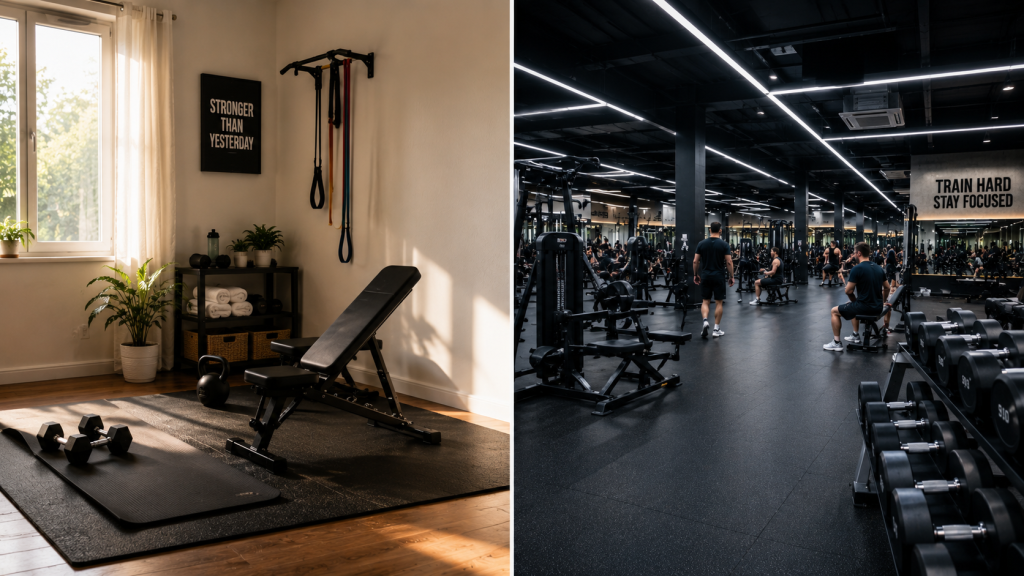
A functional strength-training home gym adjustable bench, dumbbells or a barbell with plates, a storage rack, and basic flooring realistically costs somewhere between ₹35,000 and ₹60,000 as a one-time setup, with ₹50,000 being a reasonable mid-point for planning purposes. That number isn't quite the full picture, though:
- Initial equipment: ₹35,000-₹60,000 depending on quality tier and whether you choose dumbbells or a full barbell set
- Flooring: ₹4,000-₹8,000, often bundled into the initial setup cost
- Annual maintenance: ₹1,500-₹3,000 a year for replacement grips, bolts, upholstery repair, or added plates as you progress
- Delivery and installation: ₹1,500-₹3,000, usually a one-time cost
- Electricity: negligible for strength equipment, though a motorized treadmill or cross-trainer would add a modest recurring cost
For this comparison, we'll use ₹50,000 as the one-time setup cost and ₹2,000 a year as an average ongoing maintenance figure a conservative, middle-of-the-road estimate.
The Real Cost of a Gym Membership: Monthly, Annual, and Hidden Fees
Gym membership pricing in India varies enormously by city and tier. For a fair home gym vs gym membership comparison, it helps to look at three realistic tiers:
- Budget local gym: roughly ₹600-₹1,000 a month (~₹800 average), basic equipment, no classes
- Mid-range gym: roughly ₹1,500-₹3,000 a month (~₹2,000 average), better equipment, occasional classes
- Premium chain gym: roughly ₹3,000-₹9,000+ a month (~₹5,000 average), full amenities, group classes, sometimes personal training included
Beyond the sticker price, most memberships carry additional costs that rarely make it into the initial comparison: a one-time registration or joining fee, locker rental, personal training sessions billed separately, and easy to underestimate the fuel or transport cost and time spent commuting to and from the gym several times a week.
Why a Home Gym Scales Better for Families
The comparison so far assumes one person. In a household with two or more people training regularly, the numbers shift even further in favor of a home setup, because gym memberships are almost always billed per person while a home gym's fixed cost is shared automatically.
| Scenario (5 years, mid-range gym) | 1 Person | 2 People | 3 People |
| Gym membership (₹2,000/mo each) | ₹1,20,000 | ₹2,40,000 | ₹3,60,000 |
| Home gym (shared setup + maintenance) | ₹60,000 | ₹60,000-₹70,000* | ₹65,000-₹80,000* |
*A slightly higher maintenance allowance accounts for faster wear with more frequent daily use across multiple people, and possibly an extra set of dumbbells to reduce waiting between sets.
For a family of three all training regularly, five years of mid-range gym memberships adds up to well over ₹3 lakh, while a shared home setup barely needs upgrading over the same period. This is one of the clearest financial cases for a home gym in the entire comparison, independent of any convenience argument.
5-Year Cost Comparison: Home Gym vs. Gym Membership
Here's how the cumulative cost stacks up over five years, assuming flat pricing with no annual fee increases (in reality, most gyms raise prices at renewal, which would shift these numbers further in favor of the home gym):
| Year | Home Gym (Cumulative) | Budget Gym (₹800/mo) | Mid-Range Gym (₹2,000/mo) | Premium Gym (₹5,000/mo) |
| Year 1 | ₹52,000 | ₹9,600 | ₹24,000 | ₹60,000 |
| Year 2 | ₹54,000 | ₹19,200 | ₹48,000 | ₹1,20,000 |
| Year 3 | ₹56,000 | ₹28,800 | ₹72,000 | ₹1,80,000 |
| Year 4 | ₹58,000 | ₹38,400 | ₹96,000 | ₹2,40,000 |
| Year 5 | ₹60,000 | ₹48,000 | ₹1,20,000 | ₹3,00,000 |
A few things stand out immediately. Against a premium chain gym, a home gym setup pays for itself inside the first year. Against a mid-range gym, the breakeven point lands between year two and year three. Against a genuinely cheap local gym charging under ₹1,000 a month, however, a home gym does not fully pay for itself in raw cost terms even after five years, which is an honest result worth knowing before you assume a home gym is automatically the cheaper option.
When Does a Home Gym Actually Break Even?
| Comparison | Approximate Break-Even Point |
| vs. Premium gym (₹5,000/mo) | Under 1 year |
| vs. Mid-range gym (₹2,000/mo) | Roughly 2-2.5 years |
| vs. Budget gym (₹800/mo) | Beyond 5 years at this maintenance estimate |
This is the single most useful number in the entire home gym vs gym membership decision: figure out honestly which tier of gym you would actually use, not the cheapest one you could theoretically find, and compare against that.
What the Numbers Don't Capture
Cost is only one part of the decision, and it's worth being upfront about what a pure 5-year cost comparison leaves out on both sides:
- In favour of a home gym: zero commute time, complete schedule flexibility, no waiting for equipment, and full privacy
- In favour of a gym membership: access to a much wider range of equipment, group classes, trainers on-site for form correction, and a social/accountability environment that some people genuinely need to stay consistent
- Neutral factors: a home gym requires self-discipline without external accountability; a membership requires travel time that a busy schedule may not accommodate
- Often overlooked: the cost of a car/bike trip or cab fare to and from the gym multiple times a week, which can add a meaningful amount to the "membership" side of the ledger over a year
None of this changes the arithmetic above, but it's worth weighing alongside the numbers rather than treating the cheaper option as automatically the better one for your situation.
Which Option Fits Which Person
- Choose a home gym if: you have a consistent self-directed training style, a realistic 40-60 sq ft of space, and expect to train for 2+ years
- Choose a gym membership if: you value classes, on-site trainers, or the accountability of a scheduled environment, or you're not certain training will stick long-term
- A hybrid approachsome people keep a basic home setup for consistency and add a low-cost gym membership for equipment variety or occasional classes, worth considering if budget allows, and often a reasonable middle ground for someone who isn't ready to commit fully to either side
Building a Cost-Efficient Home Gym
If the numbers point you toward a home setup, the equipment choices you make have a direct effect on where your breakeven point lands. Spending on a durable adjustable bench and a proper dumbbell and plate storage rack upfront avoids the replacement costs that erode the "one-time cost" advantage over five years. If you're weighing this decision as part of a larger project - say, converting a spare room into a dedicated training space - it's also worth reviewing our commercial gym setup cost guide for how the same cost logic scales up for a small studio or multi-user setup.
Working with an established gym equipment manufacturer in India rather than a generic budget listing also tends to reduce the maintenance line in this comparison, since commercial-grade frames and upholstery hold up to years of daily use with far less repair and replacement.
For the complete pros-and-cons picture beyond just the cost side - space, motivation, variety, and long-term sustainability - our full home gym vs gym membership comparison guide covers the decision in more depth.
If you've decided a home gym makes sense for your budget and goals, contact our team for a cost-efficient equipment recommendation built to last the full five years and beyond.
Conclusion
The home gym vs gym membership decision isn't a universal answer, it's a breakeven calculation that depends entirely on which gym tier you're actually comparing against, and how many people in your household would use the equipment. Against premium and mid-range memberships, a one-time home gym investment typically pays for itself well within the five-year window this guide covers, and the case gets considerably stronger for families sharing one setup. Against a genuinely cheap local gym, the math is closer, and cost alone may not settle the decision. Run your own numbers against the specific gym you'd realistically join, factor in your actual space, household size, and consistency, and let the five-year total not the upfront price tag guide the decision.
FAQs
1. Is a home gym cheaper than a gym membership over 5 years?
It depends on the gym tier. Against mid-range and premium gym memberships, a home gym setup is typically cheaper within 1-2.5 years and stays cheaper for the rest of the 5-year period. Against a very low-cost local gym, the home gym may not fully break even within 5 years.
2. What is the average breakeven point for a home gym vs gym membership?
For a ₹50,000 home gym setup compared against a mid-range gym membership (~₹2,000/month), the breakeven point is roughly 2 to 2.5 years, after which the home gym continues at a much lower ongoing cost.
3. Does a home gym really cost only ₹50,000 with no other expenses?
No, budget for ongoing maintenance (roughly ₹1,500-₹3,000 a year) and occasional equipment additions as you progress in strength. This guide includes both in the 5-year comparison rather than only the upfront purchase price.
4. Are gym memberships worth it if I already have a home gym?
Some people keep both a home setup for daily consistency and a low-cost membership for equipment variety, classes, or occasional training. Whether this is worth the extra cost depends on your budget and how much you value that variety.
5. What hidden costs do gym memberships have that people forget to count?
Registration or joining fees, locker charges, personal training sessions billed separately, and the transport cost and time spent commuting to and from the gym several times a week are the most commonly overlooked costs.
6. Is it cheaper to build a home gym gradually or all at once?
Buying gradually can ease cash flow, but tends to cost slightly more overall since you lose any combo or bulk pricing available on a single order. If your budget allows, a single, well-planned purchase is usually more cost-efficient over 5 years.
7. Does equipment quality affect the 5-year cost comparison?
Yes, significantly. Cheaper, low-quality equipment often needs partial replacement within 2-3 years, which pushes the effective 5-year cost of a "budget" home gym closer to or even above a mid-quality setup bought once from a durable, commercial-grade manufacturer.