Ask any gym owner which piece of equipment causes the most daily friction on their floor, and the answer is rarely a machine. It is the free weight area dumbbells left on benches, mismatched pairs, members circling for space. Almost all of it traces back to one decision made during setup: which dumbbell rack was installed, and whether it suited the room it went into. A rack is not a passive storage object. It dictates traffic flow, how quickly members find the weight they want, and whether your ₹1.5 lakh dumbbell set survives five years or gets chipped and mismatched inside eighteen months.
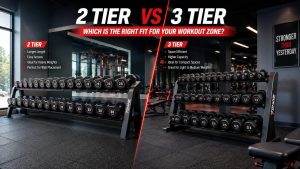
The choice usually comes down to two configurations: horizontal two-tier or vertical three-tier. Neither is universally better. This guide sets out where each one earns its place.
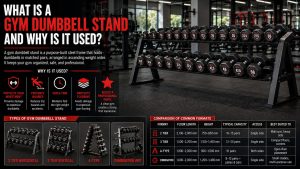
What a Dumbbell Rack Is Actually Being Asked to Do
Before comparing configurations, it is worth being precise about the job. A commercial dumbbell rack has to do four things simultaneously.
- Carry the load safely. A full 2.5kg–50kg set in pairs weighs roughly 1,000–1,300kg. That load sits on a handful of welded joints.
- Present weights in a readable sequence. Members should locate a pair in under three seconds without bending or squinting at worn stickers.
- Survive being loaded badly. Dumbbells get dropped onto the saddle, not placed. The rack absorbs that impact thousands of times a year.
- Occupy the smallest footprint that still allows safe lifting and retrieval. Storage that blocks the working area defeats its own purpose.
A dumbbell rack that fails on any one of these creates a problem that compounds daily.
The 2 Tier Configuration: Long, Low and Fast
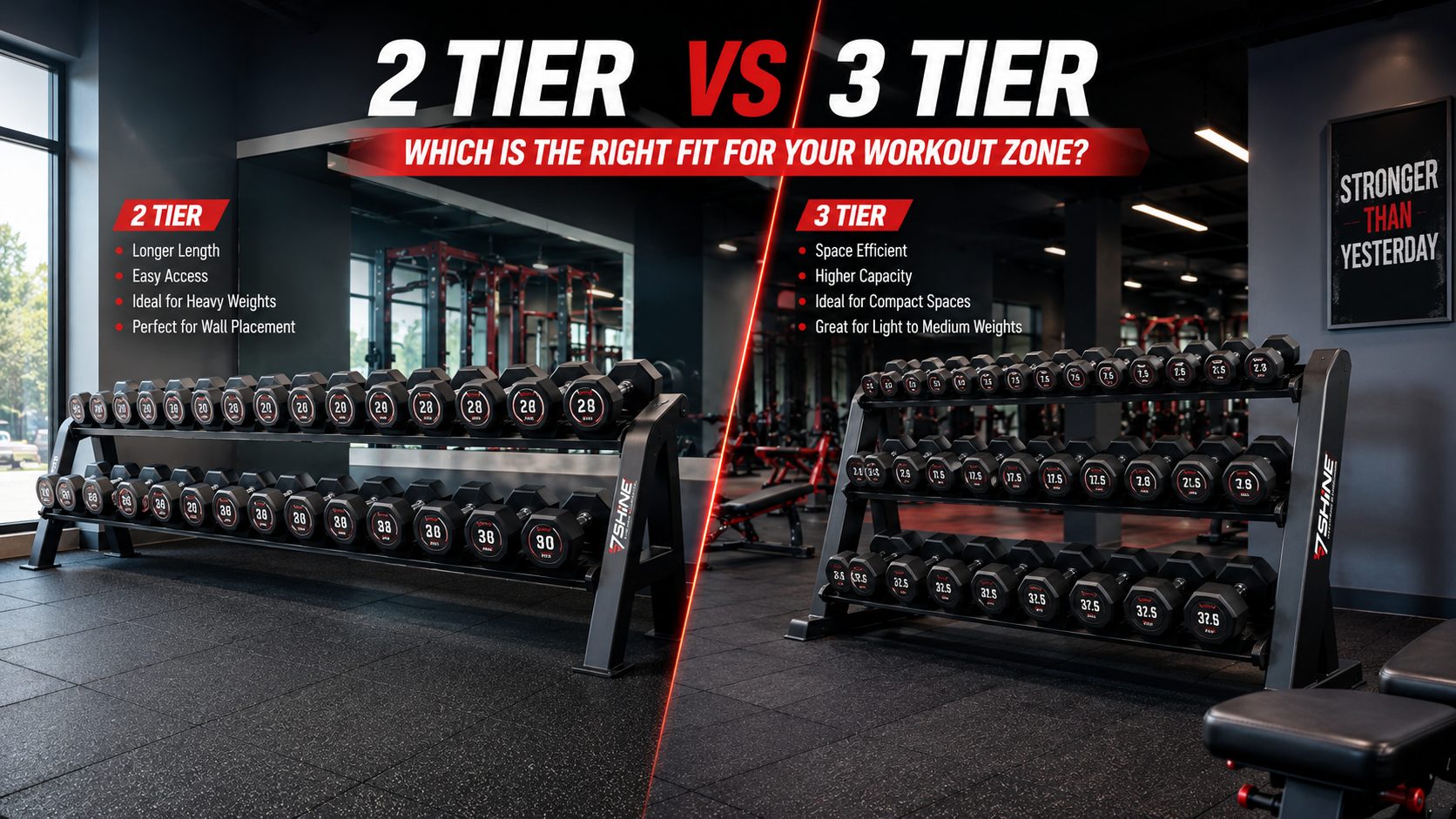
A 2 tier dumbbell rack arranges pairs across two horizontal levels, typically holding ten to fifteen pairs on a single long frame. The lower tier sits close to the floor and the upper tier at roughly hip height.
This layout suits gyms where the free weight zone runs along a wall and floor length is available.
Where the two-tier configuration performs well:
- Retrieval is fast. Both tiers are at comfortable lifting height, so members are not squatting to floor level or reaching overhead with a heavy pair.
- Heavy dumbbells are handled safely. Anything above 30kg belongs on a low tier where the lift is short and controlled.
- The sightline stays open. A low rack does not visually divide the room, which matters in smaller studios where perceived space affects how full a gym feels.
- Loading stress is distributed. The load spreads across a longer frame and more uprights rather than stacking vertically.
- Wall mounting is straightforward. It fits naturally against mirrors and along the perimeter.
The limitation is linear space. A long dumbbell rack needs an uninterrupted wall run, and in a narrow room that wall may already be committed to benches or a mirror bay.
The 3 Tier Configuration: Vertical Efficiency
A three-tier dumbbell rack stacks the same or greater number of pairs across three levels, shortening the frame considerably while raising its height. For gyms fighting for floor area, this trade is often worth making.
Where the three-tier configuration performs well:
- Footprint drops significantly. The same capacity occupies roughly 60–70% of the floor length required by a two-tier layout.
- Corners become usable. Shorter frames fit into bays and returns where a long rack simply cannot go.
- Light dumbbells are ideally placed. The top tier suits the 2.5kg–10kg range that members lift frequently and easily.
- Capacity scales without extending the wall run. Adding pairs means adding height, not length.
The trade-off is ergonomic. The top tier can sit at chest height or above, which is acceptable for lighter pairs but unsafe for heavy ones. A 40kg dumbbell retrieved from a high saddle is an injury waiting to happen, so heavy pairs must be assigned to the lower tiers.
Side-by-Side Comparison
| Criterion | 2 Tier | 3 Tier |
| Typical capacity | 10–15 pairs | 12–20 pairs |
| Floor length required | Longer (2.1–2.7 m) | Shorter (1.5–1.9 m) |
| Overall height | 750–900 mm | 1,150–1,450 mm |
| Retrieval ergonomics | Excellent across all tiers | Good on lower tiers, compromised on top |
| Suitability for heavy pairs | Very good | Lower tiers only |
| Effect on sightlines | Minimal | Creates a visual barrier |
| Best suited to | Wall runs, wide floors, strength-led gyms | Compact studios, corners, mixed-weight sets |
| Relative cost per pair stored | Slightly higher | Lower |
Understanding Dumbbell Rack Size and Load Capacity
Getting the dumbbell rack size right begins with the set you own, not the space you have. Count your pairs, note your heaviest dumbbell, and measure the widest handle-to-handle span in the set usually the top weight. Every saddle must accommodate that widest pair with clearance, or the top end of your set will not sit properly.
Two figures matter beyond length and height. The first is saddle pitch, meaning the centre-to-centre spacing between adjacent cradles, typically 190–230 mm on commercial racks. Tight pitch means knuckles collide during retrieval. The second is rated load capacity per tier, which should carry a clear margin above your actual set weight.
Indicative Dumbbell Rack Dimensions
The figures below reflect typical commercial-duty builds. Confirm exact dumbbell rack dimensions against the specific model before finalising your layout, since designs vary between manufacturers.
| Configuration | Length | Depth | Height | Typical Capacity |
| 2 tier, 10 pair | 2,100–2,300 mm | 600–700 mm | 750–850 mm | 10 pairs to 50 kg |
| 2 tier, 15 pair | 2,600–2,900 mm | 600–700 mm | 750–850 mm | 15 pairs to 50 kg |
| 3 tier, 12 pair | 1,500–1,700 mm | 650–750 mm | 1,150–1,300 mm | 12 pairs to 40 kg |
| 3 tier, 20 pair | 1,900–2,200 mm | 650–750 mm | 1,300–1,450 mm | 20 pairs to 40 kg |
| A-type, 10 pair | 1,800–2,000 mm | 700–800 mm | 900–1,000 mm | 10 pairs to 50 kg |
Planning Clearance Around the Rack
A rack’s footprint is not its true space requirement. Members need working room in front of it, and that working room is where most layout mistakes happen.
- Allow a minimum of 1,200 mm of clear floor in front of any dumbbell rack for retrieval and return. For sets above 30kg, 1,500 mm is safer.
- Keep a 900 mm circulation lane behind that working zone so passing traffic does not collide with someone lifting a heavy pair.
- Position the rack within four to five metres of your benches. Longer carries mean more dumbbells abandoned mid-floor.
- Avoid placing racks directly opposite mirrors where the lifting zone and mirror-checking zone overlap and create congestion.
- For three-tier racks, confirm ceiling and lighting clearance, particularly in basement facilities with low soffits or ducting.
Where the A-Type and Combination Racks Fit
Between the two main dumbbell rack formats sits the A-type frame, which angles saddles outward from a central spine and is accessible from both sides. It suits open-floor placement where a rack sits away from walls, since members can approach from either direction. Combination units that pair dumbbell storage with plate and barbell holders are worth considering when space is genuinely constrained, though they concentrate a lot of traffic in one spot.
Five Mistakes That Show Up on Indian Gym Floors
The same handful of errors recur across facilities of every size, and each one is avoidable at the planning stage.
Buying capacity for today’s set rather than next year’s.
Dumbbell sets grow. A gym that opens with pairs to 30kg almost always extends to 40kg or 50kg within two years, and by then the storage is full. Specify capacity with two or three spare positions.
Ignoring saddle pitch.
Two racks of identical length can hold different pair counts because of cradle spacing. Racks with tight pitch look efficient on paper and become frustrating in use when knuckles catch on the neighbouring pair.
Placing storage where it blocks the mirror or the walkway.
The rack is only usable if the space in front of it is usable. A layout that saves 400 mm by pushing storage into a walkway costs far more in daily congestion.
Mixing dumbbell brands and profiles.
Hex, round and urethane dumbbells have different handle spans and body diameters. A saddle designed for one profile holds another badly, and the rack ends up half-loaded.
Treating the rack as an afterthought in the budget.
Storage is usually the last line on the quotation and the first to be downgraded. Given that it carries more weight than any single machine on the floor, that logic is backwards.
Build Quality: What Separates a Ten-Year Rack From a Two-Year One
A dumbbell rack looks like the simplest product on a gym floor, which is precisely why cost gets removed from it. Check these before you buy:
- Frame section and gauge. Commercial racks use 50×50 mm or larger sections at 2 mm minimum. Lighter tubing bows visibly under a full load within a year.
- Saddle construction. Formed steel saddles with rubber or high-density protective inserts protect both the dumbbell chrome and the rack finish.
- Weld quality at the tier junctions. These joints carry the entire load of the dumbbell rack. Continuous welds, not tack welds.
- Levelling feet. Adjustable feet with rubber pads stop rocking on uneven floors, which is the most common cause of long-term weld fatigue.
- Pre-treatment before powder coating. Multi-stage phosphating prevents rust creeping from weld seams, particularly important in coastal and humid cities.
So Which One Belongs in Your Workout Zone?
Choose the two-tier layout if you have a usable wall run of 2.5 metres or more, your set extends above 30kg, and your members are strength-focused. The ergonomics and safety advantages are decisive for heavy training.
Choose the three-tier layout if your floor is compact, your set is weighted towards lighter pairs, or you need to place storage in a corner. The footprint saving is real and often the difference between fitting an extra bench or not.
Many well-planned gyms use both a two-tier rack carrying the heavy end of the set along the main wall, and a three-tier unit holding light pairs near the functional training area. The dumbbell rack that works is the one matched to the room, the set and the member profile, not the one that looked best in a catalogue.
Conclusion
The two-tier versus three-tier decision is genuinely a space-and-ergonomics trade, not a quality question. A two-tier layout buys you safer retrieval and cleaner sightlines at the cost of wall length. A three-tier layout buys you floor area at the cost of top-tier ergonomics. Measure your set, measure your wall, allow proper clearance, and the right answer usually becomes obvious.
What should never be traded is build quality. A dumbbell rack carries over a tonne of steel every day of its life, and the frame gauge, weld integrity and saddle design determine whether that load is carried safely for a decade. Shine Fitness manufactures two-tier, three-tier, A-type and combination racks in commercial-duty specification, and can build to your floor plan where a standard size does not fit. Share your layout and dumbbell set details, and our team will recommend the configuration and capacity that suits your space.
Frequently Asked Questions
How much floor space does a dumbbell rack need?
Allow the rack’s own footprint plus 1,200–1,500 mm of clear working space in front of it. Add a 900 mm circulation lane behind that zone for passing traffic.
Is a 2 tier dumbbell rack better than a 3 tier?
Neither is universally better. Two-tier suits heavy sets and long wall runs; three-tier suits compact floors and lighter dumbbell ranges.
What is the standard dumbbell rack size for a commercial gym?
A 10-pair two-tier rack typically runs 2,100–2,300 mm long and 750–850 mm high. Three-tier units of similar capacity are shorter but 1,150–1,450 mm tall.
How much weight can a commercial dumbbell rack hold?
Commercial-duty racks are generally rated between 800 kg and 1,500 kg depending on tier count and frame section. Always confirm the rated capacity exceeds your full set weight.
Where should heavy dumbbells be placed on a rack?
Always on the lowest tier. Retrieving a 40 kg pair from chest height or above is a shoulder and lower-back injury risk.
Do dumbbell rack dimensions vary between manufacturers?
Yes, considerably. Saddle pitch, depth and tier spacing differ by design, so verify measurements against the specific model before finalising your floor plan.
Can a dumbbell rack be customised to fit my space?
A manufacturer that fabricates in-house can adjust length, tier count and saddle pitch to suit your bay width. Resellers working from stocked variants generally cannot.