Every serious strength floor in the world contains at least one guided lower-body station, and almost nobody stops to ask where it came from. The modern leg squat machine is the result of roughly a century of trial, injury, engineering and commercial competition beginning with a Russian wrestler holding a barbell behind his legs and arriving, eventually, at the 45-degree plate-loaded stations that anchor commercial gyms today. Understanding that lineage is not merely of historical interest. Each design solved a specific problem, and knowing which problem each machine was built to solve tells you exactly which one belongs on your floor.
Before the Machines: Why an Alternative to the Barbell Squat Was Needed
The barbell back squat remains the most complete lower-body exercise ever devised. It also carries three practical constraints that have never been solved.
It requires substantial technical competence. It demands a spotter or a rack with reliable safeties once loads get serious. And it loads the spine axially, which excludes a meaningful proportion of any gym’s membership anyone with a disc issue, a shoulder that will not accept the bar, or simply the mobility of a desk worker in their forties.
For commercial gyms, that last point is decisive. A facility whose only squatting option is a barbell serves perhaps a third of its members. The entire history of the guided squat is an attempt to widen that number without abandoning the movement itself.
The Early Twentieth Century: Hackenschmidt and the Original Hack Squat
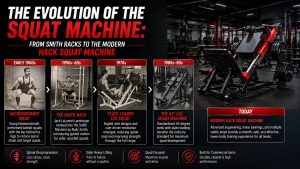
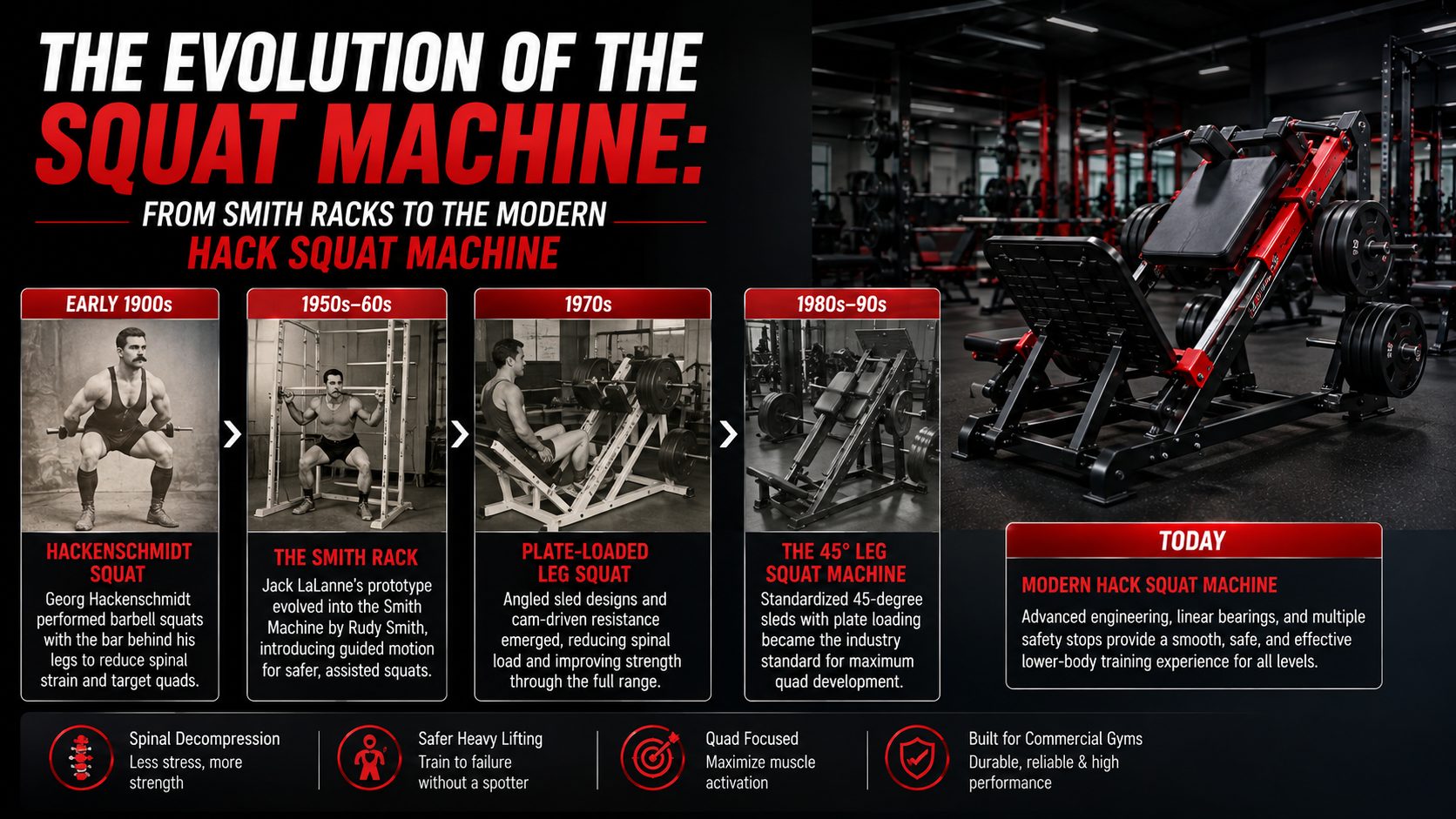
The name attached to today’s most popular machine belongs to Georg Hackenschmidt, the Estonian-born wrestler and strongman known as the Russian Lion, who competed in the early 1900s. He performed a squat with the barbell held behind his legs rather than across his back a variation that shifted the load line rearward, reduced spinal compression and biased the quadriceps.
The exercise took his name. The barbell version was awkward, however: the bar scraped the calves, grip limited the load long before the legs did, and balance was precarious. It was a good movement waiting for the right piece of hardware.
The 1950s and 60s: The Smith Rack and the Idea of Guided Motion
The first serious attempt at a guided squat came from Jack LaLanne, who built a prototype in his own gym in the early 1950s using a barbell running on vertical guides. Rudy Smith, who managed a gym in the Vic Tanny chain, refined the concept and put it into production which is why the machine carries his name rather than LaLanne’s.
The Smith rack introduced the principle that shaped every leg squat machine built afterwards: if the bar path is fixed, the lifter no longer has to stabilise the load, and can therefore train closer to failure without a spotter. That single idea made a squat machine gym environment viable for general members rather than only for experienced lifters.
Its limitation, understood only later, is that a strictly vertical bar path does not match the natural arc of a human squat. The hips travel back as the knees travel forward; a fixed vertical path forces the lifter to adapt to the machine. Later designs corrected this with angled rails.
The 1970s: Plate Loading, Cams and the Purpose-Built Leg Squat Machine
The 1970s brought the most significant change in strength equipment design since the barbell. Arthur Jones and the Nautilus range popularised variable-resistance cams, and the industry accepted a principle that seems obvious now: a machine should match the strength curve of the muscle rather than apply constant load through a range where the joint is weakest.
Applied to the lower body, this produced the first genuinely purpose-built leg squat machine angled sled rails, a shoulder yoke, a fixed back pad and a foot platform positioned so the load ran through the legs instead of the spine. The design finally delivered what Hackenschmidt’s barbell variation had promised: heavy quadriceps loading with the torso supported.
Through the 1980s and 90s these machines standardised around the 45-degree sled that remains dominant today, with plate loading preferred over selectorised stacks for the simple reason that lower-body strength quickly outruns any practical weight stack.
The Modern Hack Squat Machine
The leg squat machine most gym owners install today descends directly from those 1970s designs. A contemporary hack squat machine is a mature piece of engineering rather than a novelty. The sled runs on linear bearings along 45-degree rails, the back pad and shoulder yoke support the torso completely, and multiple safety catch positions allow a lifter to bail out mid-rep without assistance.
A well-engineered leg squat machine of this type delivers several things a barbell cannot:
- Spinal decompression. With the back supported, axial load through the vertebral column is largely removed while the quadriceps still receive heavy work.
- Foot placement control. Moving the feet high, low, wide or narrow on the platform reliably shifts emphasis between quadriceps, glutes and adductors.
- Safe training to failure. Catch mechanisms mean a lifter can push a set genuinely close to failure without a spotter present.
- Fast learning curve. A member can be taught competent form in a single session, against the weeks a barbell squat typically requires.
- Consistent range of depth. The fixed path makes depth repeatable, which matters for measuring progress honestly.
The trade-off is that stabiliser recruitment drops. The machine builds the prime movers efficiently but does not develop the balance and bracing that a free barbell demands, which is why a leg squat machine and a barbell rack belong together on a floor rather than in competition.
The Current Family of Lower-Body Machines
The leg squat machine category has continued to branch since then. Each variant solves a slightly different problem.
| Machine | Load Path | Primary Emphasis | Best Suited To |
| Smith machine | Vertical or slightly angled | Quads, glutes, general strength | Mixed-use floors, assisted training |
| 45° hack squat | Angled sled, back supported | Quadriceps, outer sweep | Hypertrophy training, all levels |
| V-squat / CC squat | Arced sled, converging path | Quads and glutes together | Members with limited mobility |
| Pendulum squat | Arced, hip-following path | Quads with glute engagement | Advanced hypertrophy work |
| Belt squat | Hip-loaded, spine unloaded | Quads and glutes | Rehab, back-sensitive lifters |
| 45° leg press | Seated, feet on angled sled | Quads, glutes, hamstrings | High-volume leg work |
Choosing a Leg Squat Machine for a Commercial Floor
Specification matters more here than on almost any other station, because a lower-body machine takes the heaviest loads in the building. A well-built leg squat machine should be assessed against the following:
- Frame section and gauge. Uprights and rails should use heavy MS sections at 2.5–3 mm minimum. This machine will routinely carry 200–300 kg plus body weight.
- Linear bearings, not bushes. Sealed linear bearings on hardened, chrome-plated rails give the smooth travel members notice immediately. Bushes bind once dust enters, which in Indian conditions is a matter of months.
- Multiple safety catch positions. At least three or four positions, engaged by a simple rotation, reachable mid-rep under load.
- Back pad and yoke padding. High-density moulded foam, not thin sheet foam, which compresses permanently under shoulder loading.
- Platform size and grip. A wide, deep, aggressively knurled or ribbed platform allows genuine foot placement variation. A small platform limits the machine’s usefulness.
- Plate storage on the frame. Loose plates around a heavily used station are the most common trip hazard on any strength floor.
For a growing facility, a squat machine with plate loading is generally the better investment over a selectorised alternative it costs less per kilogram of usable resistance and imposes no ceiling as members get stronger.
Four Errors That Undermine the Machine’s Value
The equipment is only half the outcome. These are the mistakes trainers correct most often on a busy squat machine gym floor, and they are worth covering in your induction sessions.
Loading the platform before checking the catch position. Members frequently set the safeties too low, which removes the bail-out option exactly when it matters. The catch should sit just below the intended bottom position, not at the bottom of the rail travel.
Placing the feet too low for the intended emphasis. A low foot position drives extreme knee flexion. It is effective for quadriceps development but punishing on the patellar tendon when combined with heavy loads and a deep range.
Locking the knees at the top of each repetition. The fixed path makes it easy to lock out and rest against the joint rather than the muscle. Stopping just short of extension keeps tension where it belongs.
Treating it as a warm-up station. Because the movement is easy to learn, members often use light loads for high repetitions and never progress. The design is built for heavy work with the spine supported that is the entire point of the machine.
A short laminated card at the station covering foot positions and catch settings resolves most of these without staff intervention, and it noticeably reduces the injury risk that comes with a heavily used lower-body station.
Placement, Footprint and Floor Loading
A 45-degree station typically occupies a footprint of around 2,000–2,300 mm in length and 1,000–1,300 mm in width, with a working height of roughly 1,500 mm. Plan for these practicalities:
- Allow 1,000 mm of clearance on the loading side so plates can be handled without twisting.
- Keep the station out of primary walkways. The sled travel path must never intersect circulation.
- Position it near the plate tree, since long carries with 20 kg plates are how floors get untidy.
- Verify floor loading if installing above ground level the machine plus full plate load can exceed 500 kg concentrated over a small area.
A well-planned squat machine gym layout groups the leg press, hack station and free-weight rack within the same zone, so members moving through a lower-body session are not crossing the floor between sets. In practice, most Indian commercial gyms find that one guided lower-body station serves comfortably up to about 150 active members before queuing becomes noticeable at peak hours.
Conclusion
The path from Hackenschmidt’s awkward behind-the-back barbell to today’s linear-bearing sled is a century of engineers solving one problem at a time: how to load the legs heavily without punishing the spine, and how to let an ordinary member train hard without an experienced spotter at their shoulder. Every design decision on a modern leg squat machine the 45-degree angle, the catch positions, the platform size, the moulded yoke exists because an earlier design fell short in a specific way.
For a gym owner, the practical conclusion is straightforward. A barbell rack alone serves your experienced minority. Adding a leg squat machine widens your addressable membership, reduces injury exposure and gives your floor a station that stays busy from morning to close. What matters then is build quality: frame gauge, bearing type and catch reliability decide whether that machine performs for a decade or becomes a maintenance problem in year two. Shine Fitness manufactures 45-degree hack squat, CC squat and leg press stations in commercial-duty specification, and our team can advise on the right lower-body configuration for your floor area and member profile.
Frequently Asked Questions
What muscles does a leg squat machine primarily work?
It targets the quadriceps most heavily, with meaningful involvement from the glutes, adductors and hamstrings. Foot placement on the platform shifts the emphasis between these groups.
Is a hack squat machine better than a barbell squat?
Neither replaces the other. The machine loads the quadriceps heavily with the spine supported, while the barbell develops stabiliser strength and full-body bracing.
Can beginners use a leg squat machine safely?
Yes, and it is often the better starting point. The fixed path and safety catches let a new member train the movement competently within one supervised session.
How much space does a squat machine need in a commercial gym?
Plan for roughly 2,000–2,300 mm by 1,000–1,300 mm plus a metre of loading clearance on the plate side. Keep the sled travel path clear of walkways.
Is a plate-loaded or selectorised leg squat machine better for a gym?
Plate loading is generally preferable for lower-body work. It costs less per kilogram of resistance and imposes no upper limit as members get stronger.
Why do foot positions change the result on the platform?
A higher foot position increases hip and glute involvement, while a lower position increases knee flexion and quadriceps demand. A wider stance recruits the adductors more.
How many lower-body stations should a commercial gym install?
One guided station generally serves up to about 150 active members. Beyond that, add a second machine or a complementary leg press to prevent peak-hour queuing.