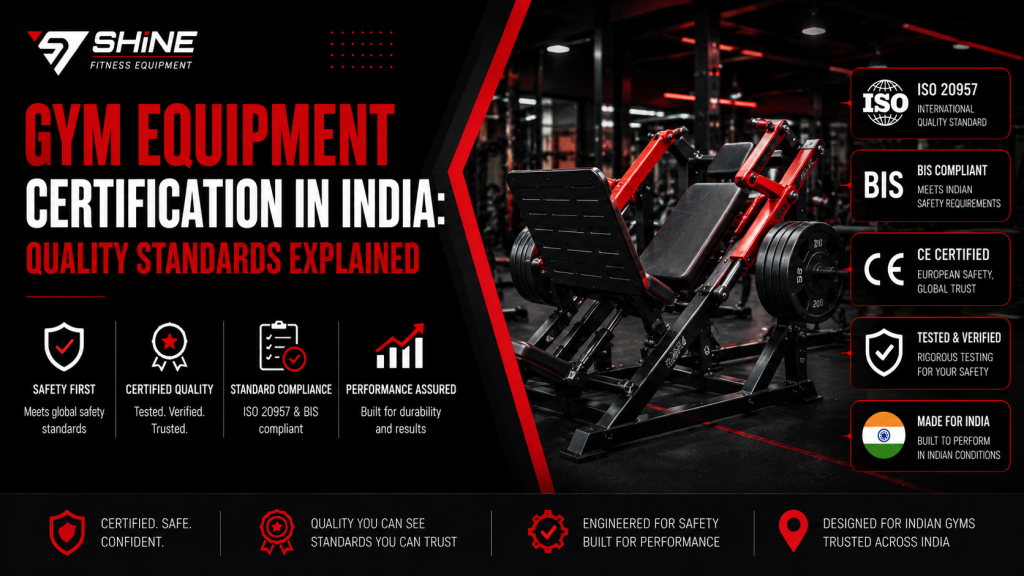
Ask three suppliers whether their machines are certified and you will get three confident yes answers, three different certificates, and no clarity at all. One shows an ISO 9001 sticker. One mentions CE. One says the steel is ISI marked. None of those statements means what most buyers assume it means. Gym equipment certification is not a single badge but a stack of separate claims covering product safety, materials, manufacturing systems and market access, and each layer answers a different question. Understanding gym equipment certification properly is what separates a buyer who can read a quotation from one who is simply trusting a logo. This guide explains which standards genuinely apply to fitness equipment in India, which are voluntary, which are legally mandatory, and exactly what to ask for before releasing a purchase order.
What Gym Equipment Certification Actually Means
Gym equipment certification, stripped of marketing language, is a third party's statement that something was tested against a written standard and passed. That definition contains three variables that buyers routinely overlook: which standard, tested by whom, and applied to what.
The most common confusion in Indian gym equipment certification concerns the difference between product certification and management-system certification. An ISO 9001 certificate says a company follows documented, auditable processes. It says nothing whatsoever about whether a particular leg press is safe under load. Both matter, but they are not interchangeable, and a supplier presenting ISO 9001 as proof of product safety is either confused or hoping you are.
The second frequent gap in gym equipment certification is scope. A certificate may cover one model, one product family or one factory location. Certification issued for a treadmill line does not extend to the strength range built in the same plant. Always read what the certificate actually covers rather than the logo printed on the brochure.
ISO 20957: The Standard That Genuinely Matters
For stationary training machines, ISO 20957 is the core international standard and the reference point for serious gym equipment certification anywhere in the world. It sets safety, strength and stability requirements, defines test methods, and provides a classification system so that equipment is matched to the environment it will actually work in.
Gym equipment certification under ISO 20957 is published in multiple parts. Part 1 carries the general safety requirements and test methods, and every other part is read alongside it rather than instead of it.
| Part | Scope |
| ISO 20957-1 | General safety requirements, test methods and classification |
| ISO 20957-2 | Strength machines and stations |
| ISO 20957-4 | Strength training benches and free-standing barbell racks |
| ISO 20957-5 | Stationary training bicycles and upper body crank equipment |
| ISO 20957-6 | Treadmills, power driven and manual |
| ISO 20957-7 | Rowing equipment |
| ISO 20957-8 | Steppers, stair climbers and climbers |
| ISO 20957-9 | Elliptical trainers |
| ISO 20957-10 | Exercise bicycles with a fixed wheel |
The current general part is ISO 20957-1:2024, which superseded the 2013 edition and added environmental considerations alongside the safety and classification requirements. If a supplier quotes gym equipment certification against ISO 20957, ask which edition and which part.
Usage Classes: H, S and I
Usage class is the single most useful concept in gym equipment certification in the whole standard, and the one that most directly protects a commercial buyer.
- Class H (home). Designed for domestic use only. Tested for lower frequency and lower intensity of use. Installing Class H machines on a commercial floor is a genuine safety risk, not merely a durability compromise, because the equipment is being used outside its declared purpose.
- Class S (studio and commercial). Intended for professional environments such as commercial gyms, studios, hotels and clubs where the owner regulates access. Tested for frequent, intensive use.
- Class I (professional). Meets the Class S requirements with an additional level of accuracy.
For any commercial facility in India, Class S is the minimum you should accept. This one line in a specification does more practical work than any other single element of gym equipment certification, because it filters out home-grade equipment being sold into commercial use at commercial prices.
Accuracy Classes: A, B and C
Separately from usage class, gym equipment certification under ISO 20957 grades how precisely a machine reports what it claims to measure. Class A is high accuracy, Class B medium and Class C low. This matters for cardio consoles displaying speed, power or distance, and for anything used in rehabilitation or performance testing. For plate-loaded and selectorized strength training equipment, accuracy class is far less relevant than usage class.
Where BIS and ISI Fit In for Indian Buyers
This is where most published guidance on gym equipment certification becomes vague, so it is worth being precise.
The Bureau of Indian Standards, operating under the BIS Act 2016, is India's national standards body and the reference point for any domestic gym equipment certification question. The critical point is that BIS product certification is voluntary by default. It becomes compulsory only when a ministry issues a Quality Control Order for a specific product category, at which point that product cannot legally be manufactured, imported or sold in India without a valid BIS licence and the Standard Mark.
Mechanical Strength Equipment
Gym equipment certification for mechanical products is voluntary in India. There is currently no Quality Control Order covering mechanical strength machines, benches, racks or free weights. A chest press, a squat rack or a set of plate loaded racks therefore does not carry an ISI mark, and no honest manufacturer will claim one for them. If a supplier tells you their leg press is ISI marked, treat that as a signal to verify everything else they have told you.
What this means in practice is that for the majority of commercial gym equipment sold in India, gym equipment certification is a voluntary quality claim rather than a legal requirement. The burden of verification sits with the buyer.
Electrically Powered Equipment
Motorized equipment sits in a different gym equipment certification position. Electrical appliances intended for household, commercial and similar use fall within the scope of a Quality Control Order requiring conformity to IS 302 (Part 1), which is aligned with IEC 60335-1, and the Standard Mark under a BIS licence. This framework has been revised more than once and compliance deadlines have been extended, so if you are buying motorized treadmills or powered cardio, ask the supplier for their current BIS position in writing and verify it against the latest gazette notification rather than relying on a brochure claim. The same applies if you intend to import gym equipment in India, since non-compliant electrical goods can be held at customs.
Material Standards Behind the Frame
Even where gym equipment certification does not apply to the finished machine, the steel inside it is governed by Indian Standards that a serious manufacturer can evidence:
- IS 2062 covers hot rolled medium and high tensile structural steel, used for plates, brackets and load-bearing sections
- IS 4923 covers hollow steel sections for structural use, which is what most machine frames are built from
- IS 1161 covers steel tubes for structural purposes, common in uprights and guide assemblies
- IS 513 covers cold reduced low carbon steel sheet and strip, used for guards and panels
Asking for mill test certificates against these standards is a far more revealing question than a general gym equipment certification enquiry. Mill certificates are difficult to fake, specific to a batch, and tell you the actual grade and thickness of steel you are buying rather than what a brochure claims.
Management System Certifications
This layer of gym equipment certification covers the organisation rather than the product, and it is still worth having:
- ISO 9001:2015 covers quality management systems. It demonstrates documented processes, traceability and corrective action, which is why it correlates with consistent output even though it certifies nothing about safety.
- ISO 14001:2015 covers environmental management, which increasingly appears in corporate and hotel tenders.
- ISO 45001:2018 covers occupational health and safety management within the factory.
A commercial gym equipment manufacturer holding ISO 9001 with in-house testing facilities and documented inspection at each production stage is materially more reliable than one without. Just do not accept it as a substitute for product-level gym equipment certification.
Export Certifications and Why They Matter to Indian Buyers
Even if you never export, a manufacturer's export-facing gym equipment certification tells you something useful, because export markets impose testing that the Indian market does not.
| Certification | Market | What it covers |
| CE marking with EN ISO 20957 | European Union | Legally required for sale; product safety conformity |
| EN ISO 20957 | Europe | European adoption of ISO 20957, technically aligned |
| ASTM F2276 | United States | Fitness equipment specification: stability, edges and corners, moving parts, pinch and crush points, locking mechanisms, handgrips, load-bearing components |
| ASTM F2216 | United States | Selectorized strength training equipment specification |
| ISO 9001 | Global | Quality management system, not product safety |
A manufacturer already building to EN ISO 20957 for European customers is applying that engineering discipline across the production line, which benefits domestic buyers too. This is one of the quiet advantages of the growth in gym equipment export from India: factories serving regulated markets tend to build everything to the tighter specification because running two quality regimes in one plant is impractical.
Documents to Demand Before Signing a Purchase Order
Move the gym equipment certification conversation from logos to paperwork. Request these five items in writing:
- Test reports, not certificates. A certificate is a summary. The test report shows the load applied, the cycles run, the pass criteria and the laboratory that performed the work. Ask for the report covering the specific model you are buying.
- Declared usage class per model. Written confirmation that each machine is Class S or above, model by model, stated on the proforma invoice rather than in an email.
- Mill test certificates for structural steel, referencing IS 2062, IS 4923 or IS 1161 as applicable, with tube wall thickness stated explicitly in millimeters.
- Weld and finish specification. Weld type, coverage and the powder coating process including pre-treatment, film thickness and cure schedule. Coating failure is the most common early complaint on Indian gym floors.
- Written warranty terms tied to the specification. Confirm what is covered and for how long by component, and make sure the gym equipment warranty references the same standards the sales conversation did.
Red Flags in Certification Claims
Gym equipment certification language is easy to misuse, and these five patterns come up repeatedly:
- "ISO certified" with no number. ISO publishes thousands of standards. A claim without a standard number and edition is not a claim at all.
- ISI marks on mechanical equipment. As covered above, there is no ISI scheme for a squat rack. This claim is either an error or a fabrication.
- Certificates with no scope or expiry. Every legitimate certificate names the issuing body, the accreditation, the covered scope and a validity period. Verify the certificate number on the issuing body's register.
- Component certificates presented as machine certificates. A certified bearing or a certified steel supplier does not make the assembled machine certified.
- "CE" without a declaration of conformity. CE marking requires a documented declaration naming the standards applied. Ask for it; a genuine exporter will have it ready.
Buying for a commercial floor and want the paperwork to match the promise? Shine Fitness has manufactured commercial gym equipment in Ahmedabad since 2007, with in-house testing, documented quality control at every production stage and full material traceability. Share your equipment list and we will send specifications, steel grades and test documentation alongside the quotation. Speak to our team.
How Certification Affects Cost, Insurance and Liability
Proper gym equipment certification adds cost. Testing a single model against ISO 20957 involves laboratory fees, sample destruction and engineering time, and that expense is distributed across production. Equipment built and tested to Class S therefore cannot compete on price with untested equipment, which is precisely why the cheapest quotation in a tender is often the one with the least documentation behind it.
Three consequences of gym equipment certification follow for a gym owner:
Insurance. Public liability insurers increasingly ask what equipment is installed and to what standard. Following an injury claim, the absence of any documented gym equipment certification weakens your position considerably.
Liability. As the facility operator you owe members a duty of care. Being able to show that machines were specified to Class S, installed to manufacturer instructions and maintained on a schedule is the core of a defensible position.
Total cost. Equipment carrying real gym equipment certification is built to survive the test cycles it was subjected to. That engineering shows up as longer bearing life, better weld integrity and less downtime. When planning a commercial gym setup, the certified line usually costs more upfront and less per year of service.
The Indian Manufacturing Picture
The standard of gym equipment certification available from Indian factories has improved substantially over the past decade. As domestic gym equipment manufacturing has scaled and more manufacturers have entered export markets, testing capability, material traceability and documentation have all moved forward.
Improving gym equipment certification standards at home creates a genuine opportunity for Indian buyers. A domestic manufacturer building to export requirements can supply equipment with credible documentation at a price well below imported alternatives, while offering spare-part availability and service response that no imported brand can match on the ground. The practical task is separating manufacturers with real gym equipment certification from those assembling to no defined standard at all, and documentation is how you do it.
Conclusion
Gym equipment certification is not one thing, and treating it as one thing is what allows weak claims to survive a sales conversation. Product safety standards, material standards, management-system certifications and market-access marks each answer a different question, and a supplier who conflates them is telling you something useful.
For a commercial buyer in India, three requirements carry most of the weight. Insist on ISO 20957 Class S or above, model by model, stated in writing. Ask for mill test certificates against IS 2062, IS 4923 or IS 1161 with declared wall thickness. Request the actual test reports rather than the certificates. A manufacturer who can supply all three without hesitation has invested in real gym equipment certification. One who deflects to logos and general assurances has told you what you need to know.
Gym equipment certification does not guarantee a machine will never fail. It guarantees that somebody tested it properly before selling it to you, and on a floor carrying paying members, that distinction is worth paying for.
Frequently Asked Questions
Is gym equipment certification mandatory in India?
For mechanical strength equipment, no. BIS certification is voluntary unless a Quality Control Order applies to that product category, and no such order currently covers strength machines, benches, racks or free weights. Motorized and electrically powered equipment is treated differently, falling within the electrical appliance QCO framework requiring conformity to IS 302 (Part 1) and a BIS licence, so verify the current position with your supplier before ordering powered cardio.
What is the most important certification to look for when buying commercial gym equipment?
ISO 20957 compliance with a declared usage class of S or above. This is the standard that specifically covers stationary training equipment safety, strength and stability, and the usage class confirms the machine was designed and tested for commercial rather than domestic use. Ask for the test report covering your exact model, and confirm which part and edition of the standard was applied.
Does an ISO 9001 certificate mean the gym equipment is safe?
No, and this is the most widespread misunderstanding in gym equipment certification. ISO 9001 certifies a quality management system, meaning the company follows documented and auditable processes. It is a genuine positive indicator of consistency, but it makes no statement about whether a particular machine passed a load or stability test. Product safety is covered by ISO 20957, not by ISO 9001.
Does gym equipment certification in India include an ISI mark?
Not for mechanical strength equipment, because no Quality Control Order exists for that category and therefore no ISI scheme applies. The ISI mark is relevant to raw materials and to certain electrical products. A supplier claiming an ISI mark on a plate-loaded machine or a bench is misrepresenting the scheme, and that alone justifies stepping back to verify their other claims.
What does Class S mean in gym equipment certification?
Class S is the ISO 20957 usage class for studio and commercial environments, covering gyms, hotels, clubs and studios where the owner controls access. It is tested for frequent, intensive use. Class H is domestic only and should never be installed commercially. Class I meets Class S requirements with a higher level of accuracy. For any facility charging membership, Class S is the minimum specification.
How do I verify that a gym equipment certification certificate is genuine?
Check four things. First, the certificate must name the issuing or accreditation body, which you can then check directly on that body's public register using the certificate number. Second, it must state a scope covering the specific model or product family. Third, it must carry a validity period that has not expired. Fourth, ask for the underlying test report, since certificates are easily reproduced while detailed test reports with load figures, cycle counts and laboratory identification are not.
Does gym equipment certification affect my insurance or liability position?
Yes, increasingly. Public liability insurers ask what equipment is installed and to what standard, and after an injury claim your ability to demonstrate that machines were specified to a recognized standard, professionally installed and maintained on a documented schedule is central to your defence. Keeping certification documents, installation records and service logs together in one file is a small administrative task with a large payoff if it is ever needed.