Introduction: A Decision That Shapes Your Entire Training Floor
Walk into almost any well-equipped gym and you will find two pieces of equipment that tend to draw more attention and more debate than anything else on the floor. The Power Rack and the Smith Machine have both earned their place in commercial and home fitness environments, but they serve different purposes, suit different users, and carry different implications for gym owners making long-term investment decisions.
This is not just a question of personal preference. For gym owners, fitness center operators, and commercial buyers, choosing between a Power Rack and a Smith Machine involves thinking about member demographics, training goals, available floor space, budget, and the kind of fitness experience you want to deliver. Get it right, and your equipment becomes a selling point. Get it wrong, and you have a machine collecting dust while members ask why something better isn’t available.
This article breaks down both options clearly what each does well, where each falls short, and how to make the right call for your specific facility.
Understanding the Power Rack: What It Is and Why It Matters
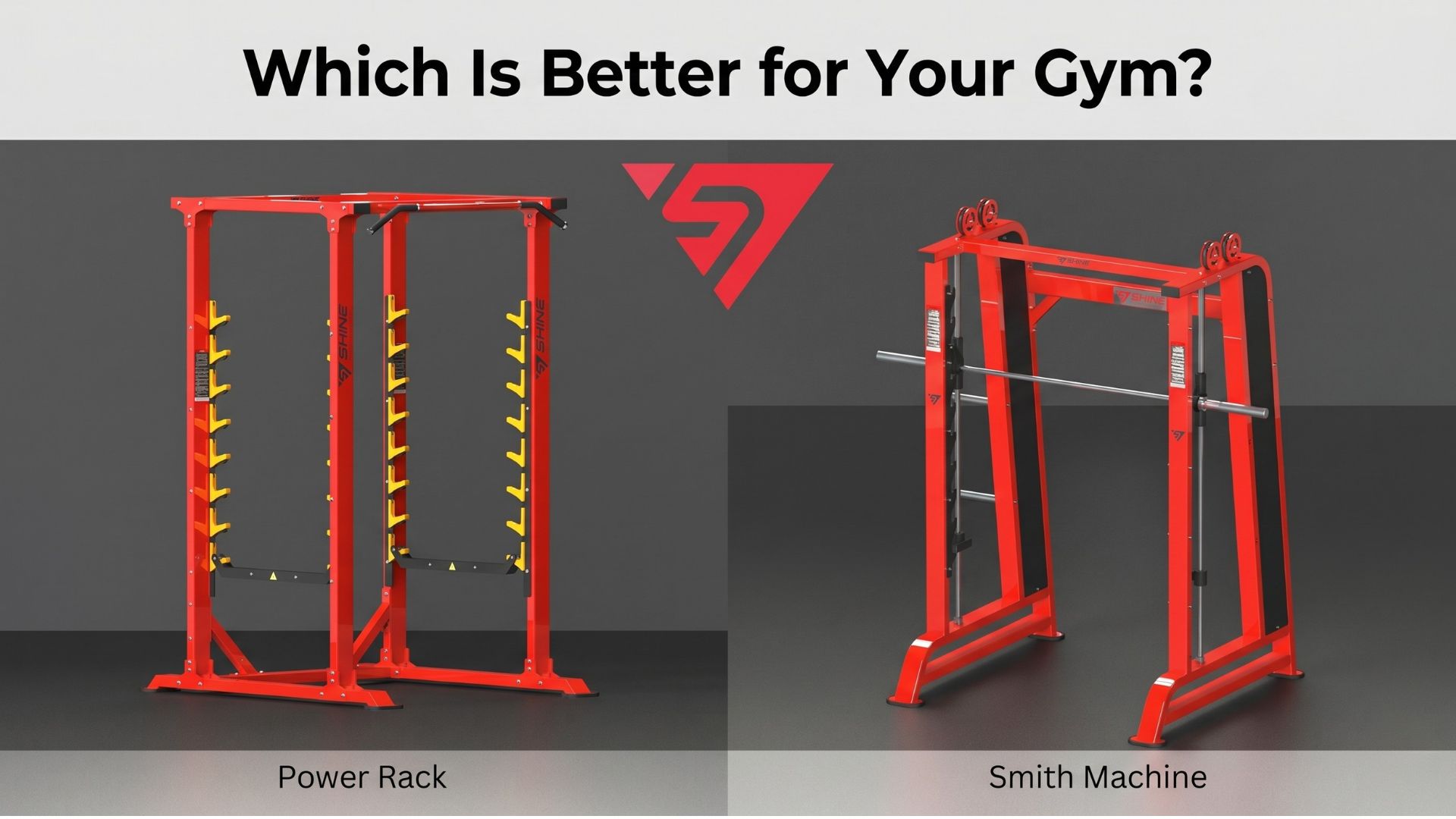
A Power Rack sometimes called a squat cage or power cage is a freestanding steel frame with adjustable safety bars and J-hooks that allow a user to safely perform barbell exercises without a spotter. It is widely considered the most versatile piece of strength training equipment available in any gym environment.
The design is deliberately simple. Four vertical steel uprights, horizontal cross-members for structural integrity, and a system of adjustable pins and hooks that can be repositioned for dozens of different movements. That simplicity is part of what makes it so effective.
What You Can Do With a Power Rack
The range of exercises a quality power rack supports is genuinely broad:
- Back squats and front squats at any depth and with full safety protection
- Bench press using the horizontal bar supports and a flat or adjustable bench
- Overhead press with proper height adjustment for tall or shorter lifters
- Deadlifts from the floor or from raised pin positions for rack pulls
- Pull-ups and chin-ups using the integrated pull-up bar on most models
- Barbell rows and other accessory pulling movements
- Box squats and pause squats with precise pin placement
- Weighted dips with compatible dip bar attachments
For any gym that caters to serious lifters, strength athletes, or users who want to follow structured progressive overload programs, a power rack is close to essential.
Build Quality and Material Standards
In the commercial gym market, power rack quality varies considerably. The uprights are typically manufactured from heavy-gauge steel often 11-gauge or 7-gauge with thicker gauge steel indicating greater durability under heavy loads. Weight capacity ratings in commercial-grade racks typically start at around 1,000 lbs and can exceed 2,000 lbs in heavy-duty models.
Weld quality, hardware grade, and surface finishing all affect long-term durability. A well-manufactured power rack, properly maintained, can last 15 to 20 years in a high-traffic commercial environment.
Understanding the Smith Machine: Guided Strength Training at Scale
The Smith Machine takes a different approach to barbell training. Rather than a free barbell that moves through any range of motion, the Smith Machine guides the bar along a fixed vertical — or slightly angled track. The bar is attached to a counterbalanced carriage system, and safety hooks allow the user to rack and unrack the bar at any point in the movement.
This guided movement is the defining feature of the Smith Machine, and it is both its greatest strength and its most significant limitation, depending on who is using it.
Who Benefits Most From a Smith Machine
The Smith Machine genuinely excels in certain use cases:
- Beginners who are learning movement patterns and need guidance and safety
- Rehabilitation users returning from injury who require a controlled range of motion
- Solo lifters who want to train heavy on pressing or squatting movements without a spotter
- Bodybuilding-focused users who want to isolate specific muscle groups with less stabilizer involvement
- Older gym members who benefit from the additional stability and confidence the fixed bar provides
In a commercial gym setting where member demographics are diverse, these use cases represent a meaningful portion of your membership base. The Smith Machine serves users who might otherwise avoid free barbell work entirely.
Key Features to Look for in a Quality Smith Machine
Not all Smith Machines are built equally. When evaluating options for commercial purchase, consider:
- Bar angle — True vertical bar travel versus angled (7-degree) travel affects exercise biomechanics; angled is generally considered more natural
- Counterbalance weight — Affects the effective starting weight of the bar; commercial models typically start at 15–20 lbs effective weight
- Safety catch positions — More catch positions allow finer adjustment and greater user safety
- Frame gauge and weld quality — Commercial Smith Machines should be built to withstand heavy daily use without frame flex or noise
- Linear bearing quality — Smooth, silent bar travel is the hallmark of a well-engineered Smith Machine
Power Rack vs Smith Machine: A Direct Comparison
Both machines have legitimate roles in a well-designed gym. But when placed side by side, the differences become clear.
Movement Freedom and Athletic Development
This is where the two machines diverge most significantly. A Power Rack allows completely free barbell movement, which means the user’s stabilizing muscles the small muscles that control balance, joint alignment, and coordinated movement are fully engaged throughout every lift.
This matters enormously for athletic development, injury prevention, and functional strength. Compound movements performed with a free barbell build strength that transfers directly to real-world performance and sports.
The Smith Machine, by design, removes most of that stabilizer demand. The fixed bar path does the alignment work for the user, which reduces the training stimulus for stabilizing muscles. For general fitness users, this is not necessarily a problem. For athletes or anyone focused on building transferable strength, it is a meaningful limitation.
Safety Considerations for Gym Environments
Both machines offer safety mechanisms, but they work differently.
The Power Rack relies on properly set safety pins or arms. If a lifter fails a lift misses the squat, can’t press the bar back up the safety bars catch the weight before it reaches the lifter. This system works very well when safety bars are set correctly, but it does require the user to understand how to position them.
The Smith Machine’s self-locking hook system allows the bar to be racked at any point in the movement with a simple twist of the wrists. For users who are unfamiliar with setting safety bars, or who train alone regularly, this can feel more accessible and reassuring.
From a gym management perspective, both machines are safe when used properly. Staff education and clear equipment instructions remain important regardless of which machine a gym provides.
Space and Floor Planning
A standard commercial power rack occupies roughly 8 to 12 square feet of floor space, though users need clear space around it for loading plates and moving safely. A dedicated power rack zone in a commercial gym might require 50 to 80 square feet per unit when surrounding space is factored in.
Smith Machines have a smaller footprint in many configurations, though integrated Smith Machine and cable combo units can be larger. If floor space is genuinely limited, a Smith Machine often requires slightly less total area per unit.
Cost and Long-Term Value
Power Racks in the commercial range typically cost between $800 and $4,000 per unit, depending on gauge, features, and attachments. Smith Machines span a broader price range from around $1,500 for basic models to $6,000 or more for premium integrated units with cable systems.
Over a 10 to 15-year commercial lifespan, both represent reasonable value if manufactured to proper standards. Power Racks tend to have fewer mechanical components, which means lower maintenance costs. Smith Machines require regular maintenance of the linear bearings and bar carriage to keep movement smooth and safe.
What Fitness Equipment Manufacturers Are Doing Differently in 2026
The commercial fitness equipment market has evolved significantly. Leading fitness equipment manufacturers are no longer simply producing functional machines they are engineering integrated training systems designed around real-world gym workflows, user safety, and facility longevity.
Innovation in Power Rack Design
Modern power rack development has focused on modularity. Rather than selling a single fixed product, many manufacturers now offer rack systems that can be expanded over time adding cable attachments, landmine units, storage horns, band pegs, and even integrated technology for tracking bar speed and training load.
This shift toward modular, upgradeable systems reflects a broader industry understanding: gym owners want equipment that can grow with their facility rather than require full replacement every few years.
Materials innovation has also advanced. High-tensile steel alloys, precision laser-cut hole patterns, and improved powder-coat finishes are now standard expectations in the commercial tier.
Smith Machine Engineering Advances
The Smith Machine category has seen notable refinement on the mechanical side. Dual linear bearing systems that run silently under heavy loads, improved counterbalance mechanisms, and ergonomically angled bar paths represent meaningful upgrades over older designs.
Combination Smith Machine and functional trainer units integrating cable systems, pull-up bars, and additional attachment points into a single footprint have become increasingly popular with gym owners working in limited square footage.
How Gym Machine Manufacturer Relationships Affect Buying Decisions
Sourcing decisions for commercial gym equipment are rarely straightforward. Most gym owners are not just buying a product they are entering a relationship with a gym machine manufacturer that will affect their business for years.
The quality of post-sale support matters as much as the quality of the equipment itself. Spare parts availability, warranty terms, lead times for replacements, and access to technical support all become relevant the moment something needs attention after installation.
When evaluating manufacturers, gym owners should consider:
- Warranty coverage — Does it cover both parts and labor? How long?
- Parts availability — Are replacement bearings, J-hooks, safety bars, and hardware stocked domestically?
- Lead times — How quickly can replacement parts or additional units be sourced?
- Technical documentation — Is clear installation, maintenance, and safety guidance provided?
- Customization options — Can uprights be finished in brand colors? Can custom logos or branding be added?
The relationship between a gym owner and their equipment supplier is a long-term one. Treating it as such from the beginning leads to better outcomes.
Making the Decision: Which Is Right for Your Gym?
There is no universal right answer here the better question is which machine is right for your specific facility, membership base, and training philosophy.
Choose a Power Rack If:
- Your facility serves serious lifters, athletes, or strength-focused members
- You want maximum versatility from a single piece of equipment
- Your staff can orient new members on proper use and safety bar setup
- You are building a strength training zone with a long-term vision
- You value lower maintenance requirements over time
Choose a Smith Machine If:
- Your membership is primarily general fitness users, beginners, or older adults
- You have members who frequently train without a partner or spotter
- You want to offer guided barbell training with a lower barrier to entry
- Floor space is a meaningful constraint and a combo unit suits your layout
- You are outfitting a hotel gym, rehabilitation facility, or multi-purpose fitness space
Consider Both If:
Many successful commercial gyms choose not to make this an either/or decision. A strength zone with two or three power racks and a separate Smith Machine station serves a broader member demographic without compromising the needs of either user type. If your budget and floor plan allow it, this is often the most commercially sound approach.
Conclusion
Both the Power Rack and the Smith Machine have earned their place in modern gym design — and the decision between them ultimately comes down to who your members are and what kind of training experience you want to deliver. A Power Rack remains the gold standard for functional strength development, free movement, and long-term versatility. A Smith Machine offers guided training, greater accessibility, and genuine value for diverse membership bases.
For gym owners and facility operators sourcing at scale, the quality of the equipment matters as much as the type. Partnering with trusted fitness equipment manufacturers who prioritize material quality, engineering precision, and long-term support will always be a better investment than choosing on price alone. And for those evaluating options from a gym machine manufacturer that offers customization, modularity, and commercial-grade durability, the conversation doesn’t stop at Power Rack or Smith Machine it extends to the full training ecosystem you are building.
If you are planning a gym build-out, expanding your current facility, or sourcing equipment for commercial distribution, our team is ready to help. Reach out today to discuss your requirements, explore customization options, and get expert guidance on building the right strength training floor for your specific goals.
Frequently Asked Questions
1. Is a Power Rack or a Smith Machine better for building strength?
For building functional, transferable strength, a Power Rack is generally considered the better option. Free barbell movement engages stabilizing muscles throughout each lift, producing more complete neuromuscular development. That said, a Smith Machine can support strength building for users who are new to barbell training, returning from injury, or working without a spotter, making it a practical tool in those contexts.
2. Can beginners safely use a Power Rack without a personal trainer?
Yes, with proper orientation and correctly set safety pins, a Power Rack can be used safely by beginners. Most commercial gyms provide a brief equipment introduction for new members. The key is understanding how to set safety bars at the right height before beginning any heavy work. Many beginners find that starting with lighter loads and building form before adding weight is the most effective and safest approach.
3. How much floor space does each machine require in a commercial gym?
A standard commercial power rack typically requires a footprint of around 8 to 12 square feet for the unit itself, with additional surrounding space needed for plate loading and safe user movement often 50 to 80 square feet per station total. Smith Machines have a comparable or slightly smaller machine footprint, though combination units with integrated cable systems can require more space overall.
4. How often do Smith Machine linear bearings need maintenance?
In a high-traffic commercial gym environment, Smith Machine bearings should be inspected and lubricated every three to six months. Regular maintenance keeps bar movement smooth and quiet and extends the operational life of the carriage system significantly. A gym machine manufacturer or equipment supplier should provide clear maintenance documentation at the time of purchase, including recommended lubricants and inspection schedules.
5. What weight capacity should a commercial power rack have?
Commercial power racks should have a rated capacity of at least 1,000 lbs for general gym use. Facilities that cater to powerlifters or serious strength athletes should consider heavy-duty models rated at 1,500 to 2,000 lbs or more. Always verify the manufacturer’s tested load rating — not just a stated capacity and ensure the rating applies to both the main uprights and the safety bar system.
6. Do fitness equipment manufacturers offer customization for commercial gyms?
Yes, most reputable fitness equipment manufacturers offer customization options for commercial buyers. Common customizations include branded color finishes on uprights and frames, custom logo placement, modified upright heights for low-ceiling environments, and accessory bundles tailored to specific training programs. For large orders, lead times and pricing for custom work vary by manufacturer, so it is worth discussing requirements early in the sourcing process.
7. Is it worth buying both a Power Rack and a Smith Machine for a mid-sized gym?
For most mid-sized commercial gyms, having both is a sound investment if the budget and floor plan support it. A power rack zone serves strength-focused and experienced lifters, while a Smith Machine station provides accessible guided barbell training for beginners, rehabilitation users, and solo trainees. Together, they allow the facility to serve a broader range of members without compromising the experience of either group.
8. What is the typical lifespan of a commercial power rack?
A well-manufactured commercial power rack, built from heavy-gauge steel with quality welds and hardware, can last 15 to 20 years in a high-traffic gym environment with proper care. Routine maintenance checking and tightening hardware, inspecting safety bars, and repairing any surface damage to prevent rust extends the lifespan further. Choosing a reputable manufacturer with available spare parts is important for ensuring the equipment remains serviceable over its full operational life.