Introduction: Building Strength on Engineered Foundations
The success of a commercial gym is rarely accidental. Behind every thriving facility lies a deliberate infrastructure decision selecting equipment that is engineered for performance, longevity, and biomechanical precision. The Top 10 Commercial Full-Body Exercise Machines by Leading Fitness Equipment Manufacturer are not simply categories of gym tools; they are structural assets that determine training outcomes, member safety, and long-term operational efficiency. When partnering with a professional gym equipment manufacturer like Shine Fitness, gym owners are not merely purchasing steel frames and weight stacks. They are investing in structural engineering, fatigue-resistant metallurgy, precision welding, mechanical alignment, and commercial durability tested under high-frequency usage conditions. As a growing and trusted gym equipment company in India, Shine Fitness understands that commercial fitness equipment must survive real-world pressure: heavy compound lifts, repetitive motion cycles, constant cable tension, sweat exposure, environmental humidity, and operational demands that often extend beyond twelve hours per day.
In this comprehensive guide, we will explore the ten most essential full-body machines that form the backbone of modern fitness facilities. More importantly, we will examine the deep technical manufacturing standards that separate high-performance commercial equipment from consumer-grade imitations. When properly engineered, these machines become the mechanical language through which human strength is expressed and developed.
The Engineering Philosophy Behind Commercial-Grade Equipment
Before exploring individual machines, it is essential to understand what defines true commercial-grade construction. Commercial equipment must withstand continuous stress cycles without structural fatigue. This requires the use of high-tensile steel tubing, typically 11-gauge or 12-gauge, which offers superior resistance to bending and torsional stress. The rectangular and square tubing used in Shine Fitness machines is selected not only for strength but for its ability to distribute load evenly across frame intersections. Uneven load concentration leads to micro-fractures over time, and micro-fractures eventually lead to structural failure. Preventing this begins at the material selection stage.
Welding is another foundational component of durability. In commercial manufacturing, welding must penetrate fully into the joint, creating continuous seam integrity. Cosmetic welding might look clean from the outside, but without proper heat control and penetration depth, the structural bond remains weak. Shine Fitness machines are fabricated with uniform weld beads and reinforced stress points to ensure long-term resilience. Following fabrication, electrostatic powder coating is applied and cured at high temperatures. This coating not only enhances visual appeal but protects against corrosion caused by humidity, sweat, and environmental exposure a critical factor for gyms operating in diverse climates across India.
Mechanical systems also demand precision. Cable-driven machines rely on aircraft-grade steel cables encased in protective nylon sheathing. These cables must withstand high tensile loads while maintaining smooth movement through sealed bearing pulleys. Misaligned pulleys create friction, uneven wear, and inconsistent resistance curves. Therefore, pulley placement and angle calibration are engineered to maintain tension consistency across the entire range of motion.
Commercial-grade bearings, chrome-plated guide rods, self-lubricating bushings, and reinforced pivot joints all contribute to reducing friction and enhancing smoothness. Mechanical smoothness is not an aesthetic luxury; it directly affects user experience, safety, and equipment longevity.
1. Commercial Functional Trainer: Multi-Plane Biomechanical Mastery
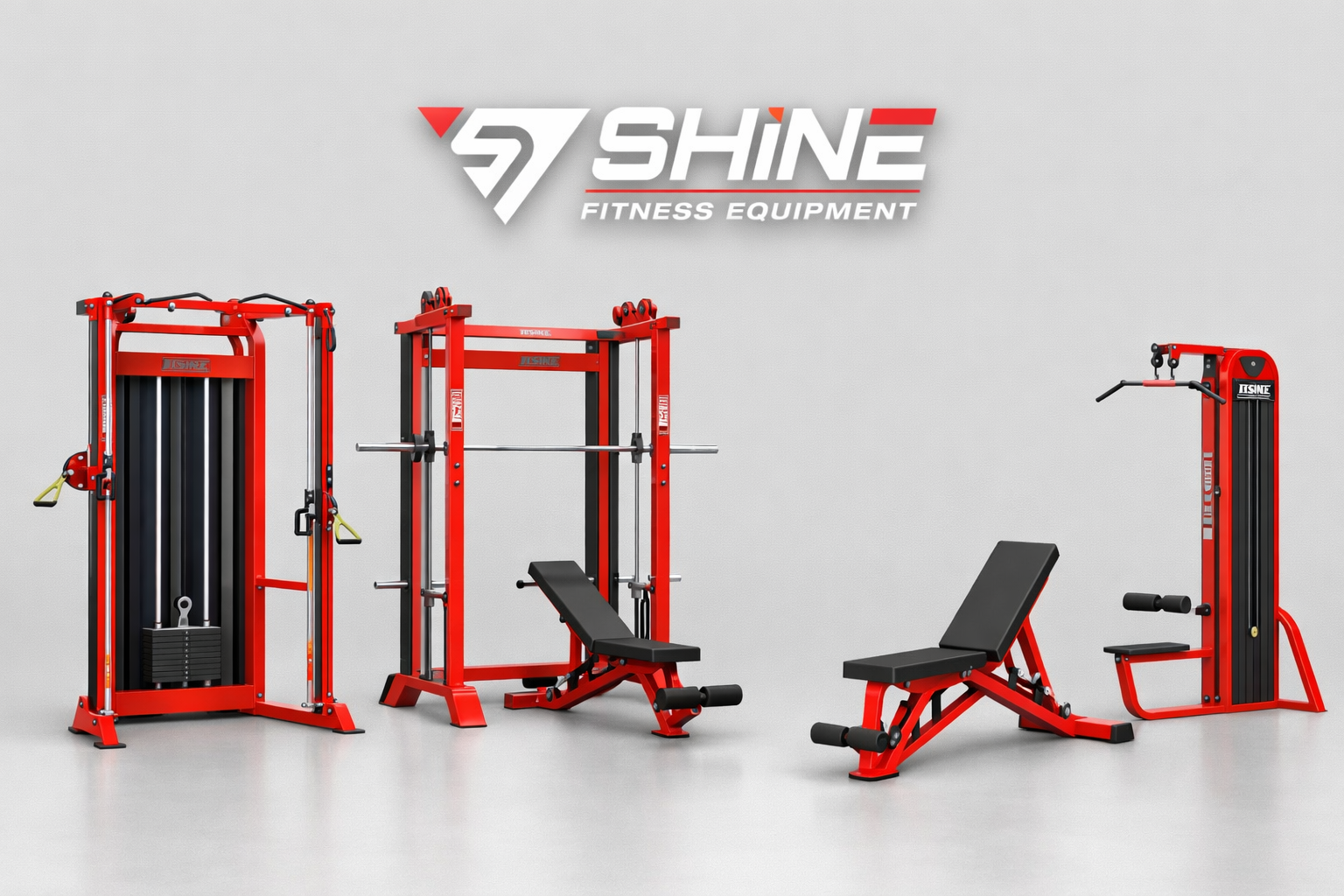
The commercial functional trainer represents one of the most sophisticated machines in a modern gym. Designed with dual adjustable pulley columns and independent weight stacks, this system enables multi-plane movement patterns that replicate natural human motion. Unlike fixed-path machines that restrict movement to a single plane, the functional trainer supports sagittal, frontal, and transverse plane exercises. This capability allows users to perform rotational core movements, unilateral strength training, and compound pushing or pulling actions that engage stabilizing musculature.
From a manufacturing standpoint, the functional trainer demands exceptional structural stability. Dual vertical columns must remain rigid even under asymmetric load application, which occurs when one side is engaged more heavily than the other. Shine Fitness reinforces these columns with cross-bracing and heavy-gauge steel construction to prevent lateral sway. The pulley system operates on a calibrated mechanical ratio, often 2:1, which allows finer resistance increments and smoother tension distribution. Precision-machined guide rods ensure the weight stacks glide vertically without binding, even under high repetition use.
This machine effectively replaces multiple isolated stations, making it not only biomechanically superior but also financially strategic for gym owners seeking maximum return on floor space.
2. Multi-Station Commercial Gym: Structural Load Distribution at Scale
The multi-station commercial gym integrates multiple strength stations within a single structural framework. Unlike standalone machines, multi-station systems must account for simultaneous load application from different directions. When two or more users apply force at the same time, stress patterns shift unpredictably across the frame. To counteract this, Shine Fitness designs multi-station systems with reinforced vertical load columns and cross-bracing that distributes mechanical stress evenly.
Each weight stack within the multi-station system is independently calibrated to ensure smooth transition between plates. Uneven plate machining leads to jerky motion, which increases wear and reduces user comfort. The cams and pivot arms are designed to mimic natural joint rotation patterns, minimizing stress on shoulders, knees, and elbows. High-density commercial upholstery supports users while resisting compression fatigue over time.
The multi-station machine is especially valuable in environments where space optimization is critical, such as corporate wellness centers or mid-sized gyms. By consolidating multiple exercises into one cohesive unit, gym operators improve equipment utilization rates while maintaining biomechanical integrity.
3. Smith Machine: Guided Strength with Precision Alignment
The commercial Smith machine provides guided vertical barbell movement along hardened chrome-plated rods. Precision alignment is critical in this design. Even minor deviation between guide rods can create friction drag or bar sticking, compromising smooth motion. Shine Fitness ensures guide rod spacing is calibrated with millimeter-level precision to maintain vertical consistency.
The bar carriage operates through industrial-grade linear bearings, reducing friction while supporting high axial loads. The integrated safety locking system allows users to rack the bar at multiple height intervals, enhancing safety during heavy lifts. Structurally, the frame must absorb shock loads when the bar is re-racked forcefully. Reinforced base plates and cross-members prevent structural distortion during repeated impact.
This machine supports compound exercises such as squats, lunges, presses, and hip thrusts, making it an essential full-body strength platform in commercial facilities.
4. Commercial Power Rack: Load-Bearing Architecture for Serious Lifters
The power rack is arguably the most structurally demanding piece of strength equipment in a gym. Designed to withstand heavy compound lifts, it must remain stable under extreme compressive and lateral forces. Shine Fitness fabricates power racks using thick-gauge steel uprights with precisely spaced hole patterns for adjustable safety bars.
The safety bars themselves are reinforced to absorb dropped loads without bending. Pull-up bars, dip attachments, and optional lat pulldown modules expand functionality without compromising stability. The base frame is engineered to maintain equilibrium even during high-intensity rack pulls or band-resisted squats.
Because compound lifts activate multiple muscle groups simultaneously, the power rack forms the core of any serious strength training zone.
5. Cable Cross Over Machine: Continuous Resistance Engineering
The cable cross over machine provides continuous tension throughout the range of motion, enhancing muscle engagement and control. Structural symmetry is critical in this design. Both vertical columns must maintain identical height and weight stack alignment to prevent resistance imbalance.
The pulley system is engineered to minimize angular deviation, ensuring smooth resistance during chest flys, cross-body pulls, and rotational movements. Reinforced anchor points prevent frame sway during heavy use. This machine supports aesthetic training as well as functional stability work, making it a staple in commercial gyms.
6. Plate-Loaded Machines: Lever Mechanics and Natural Resistance Curves
Plate-loaded machines rely on pivot-based lever systems that replicate natural strength curves. The placement of pivot points determines the resistance arc. If positioned incorrectly, joint stress increases and muscle activation decreases. Shine Fitness aligns pivot arms with anatomical joint centers to ensure ergonomic movement.
Industrial-grade bearings support smooth arm motion even under high plate loads. Reinforced steel arms resist flexion, maintaining consistent resistance across repetitions. Plate-loaded systems offer the advantage of progressive overload using standard Olympic plates, making them popular among serious lifters.
7. Commercial Leg Press: Angled Load Engineering
The leg press operates under significant compressive force. The sled must glide along reinforced linear rails without wobble, even when heavily loaded. Shine Fitness incorporates high-density bearings and precision-aligned guide rails to ensure smooth travel.
The angled sled design reduces spinal compression while maximizing quadriceps and glute activation. The foot platform is textured for grip, and seat adjustments allow users of varying heights to maintain proper knee alignment. Structural reinforcements prevent frame torsion during maximal lifts.
8. Assisted Pull-Up and Dip Machine: Counterbalance Precision
The assisted pull-up and dip machine incorporates a counterweight system that offsets a portion of the user’s bodyweight. The pulley ratio must be carefully calibrated to ensure predictable assistance. Smooth knee platform mechanics and stable base anchoring prevent lateral sway during movement.
This machine enables progressive development of upper-body strength, making advanced bodyweight exercises accessible to beginners.
9. Seated Row and Lat Pulldown Combo: Balanced Force Application
The seated row and lat pulldown machine combines vertical and horizontal pulling patterns. Cable alignment must maintain consistent tension throughout the movement arc. Adjustable thigh pads stabilize the user, preventing unwanted lift during heavy pulldowns.
This machine strengthens the posterior chain, improves posture, and balances pressing movements performed elsewhere in the gym.
10. Core and Abdominal Machine: Cam-Based Resistance Curves
The core machine often incorporates cam-based resistance systems that vary tension throughout the contraction phase. Cams allow peak resistance during maximal muscle engagement while reducing strain at vulnerable joint angles. Lumbar support cushioning enhances comfort while maintaining spinal alignment.
Strong core development supports heavy compound lifts and athletic performance.
Long-Term ROI and Maintenance Strategy
Commercial machines represent long-term capital investments. Proper maintenance significantly extends lifespan. Daily cleaning prevents corrosion and upholstery degradation. Weekly inspection of cables and guide rods ensures mechanical consistency. Monthly mechanical audits prevent minor wear from becoming major repairs.
Well-maintained commercial equipment can operate effectively for ten to fifteen years, delivering substantial return on investment.
Why Shine Fitness Stands Out as a Gym Equipment Manufacturer
Shine Fitness combines heavy-gauge steel fabrication, precision welding, industrial powder coating, calibrated pulley systems, and rigorous load testing to produce commercial machines built for real-world use. As a leading gym equipment company in India, Shine Fitness designs products tailored for high-traffic environments while maintaining competitive pricing and service support.
Conclusion
The Top 10 Commercial Full-Body Exercise Machines represent more than gym equipment categories. They are mechanical systems engineered to convert human effort into measurable progress. When constructed with precision steel fabrication, calibrated pulley alignment, reinforced weld integrity, and biomechanical accuracy, these machines do more than endure. They perform.
Strong equipment builds strong gyms. And strong gyms build lasting fitness communities.
Frequently Asked Questions (FAQs)
1. What makes commercial gym equipment different from home equipment?
Commercial equipment is built with heavier steel, industrial-grade components, and higher load capacity to handle continuous daily usage in gyms.
2. Which full-body machine is most versatile for a commercial gym?
The functional trainer is considered the most versatile because it allows multi-plane movement and hundreds of exercise variations.
3. How long does commercial gym equipment last?
With proper maintenance, high-quality commercial machines can last 10–15 years or more in high-traffic environments.
4. Why choose a gym equipment manufacturer in India?
A reliable gym equipment company in India offers cost-effective pricing, customization options, and faster after-sales support.
5. What should I check before purchasing commercial gym machines?
Evaluate steel thickness, weld quality, cable system durability, warranty coverage, and the manufacturer’s service support network.