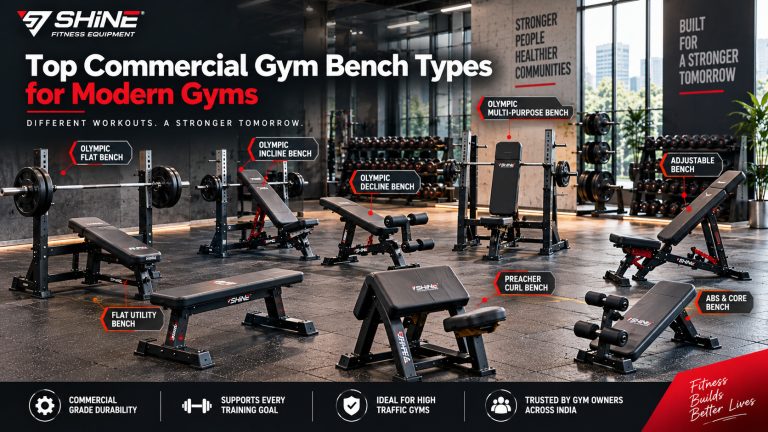
Selecting commercial gym equipment is a capital decision that shapes your operating costs, member retention and floor layout for the next eight to ten years. This guide explains how the Indian supply market is structured, what separates one commercial gym equipment manufacturer from another once you look past the brochure, and how to run a disciplined gym brand comparison before you release a purchase order. You will learn which construction details predict longevity, how to read a quotation line by line, and which questions expose a weak supplier early.
Why Commercial Gym Equipment Is Built to a Different Standard
A home machine is engineered for a few sessions a week by one or two users of similar size. Commercial gym equipment is engineered for dozens of users a day, many of whom load it aggressively, drop the stack and adjust seats without care. That difference shows up in frame gauge, weld quality, bearing selection and upholstery density.
Comparing a light-duty product against genuine commercial fitness gym equipment on price alone is therefore misleading. The cheaper machine is not a discounted version of the same product it is a different specification built for a different duty cycle. Members notice within weeks: cables develop slack, pivots squeak, seat pads compress unevenly.
The practical consequence is downtime. A machine out of service in a busy facility is lost revenue and a visible signal that the gym is not being maintained. Durable commercial gym machines are, in effect, an availability guarantee.
How the Indian Supply Market Is Structured
Before shortlisting anyone, understand the three tiers you will encounter when researching gym equipment brands in India. Each tier has a legitimate use case, and the common mistake is comparing across tiers as though they were interchangeable.
Imported Global Brands
International manufacturers supply premium strength lines and cardio to large chains and five-star properties. Build quality and biomechanics research are strong, but landed cost includes freight, duty and distributor margin. Spare parts often ship from overseas, so one failed component can idle a machine for weeks.
Indian Manufacturers Producing Commercial-Grade Lines
Domestic factories now fabricate commercial gym equipment using heavy-section steel, in-house powder coating and standardised wear parts. Because production and stock are local, lead times and spare availability are usually far better. Buyers evaluating top gym equipment brands increasingly shortlist from this tier because the cost-to-durability ratio is favourable.
Local Fabricators and Light-Commercial Suppliers
Small workshops build to order at low cost. For a budget studio with limited footfall this can work, but consistency varies between batches and there is rarely a documented warranty or parts catalogue. Treat these quotations as a separate category rather than folding them into your main gym brand comparison.
Comparison Table: The Three Supply Tiers
| Factor | Imported Global Brands | Indian Commercial Manufacturers | Local Fabricators |
| Typical buyer | Large chains, premium hotels | Independent gyms, hotels, institutional facilities | Budget studios, small setups |
| Capital cost | Highest | Moderate | Lowest |
| Spare parts lead time | Often long; imported stock | Usually short; domestic stock | Unpredictable |
| Customisation | Limited to catalogue | Frames, colours and layouts often adaptable | High but inconsistent |
| Warranty documentation | Formal and detailed | Generally formal | Frequently informal |
| Best suited for | Brand-led premium positioning | Heavy daily use on controlled budgets | Low-footfall, low-load use |
Most commercial gym equipment brands sit clearly within one tier, so use the table as a filter rather than a verdict. Well-built Indian commercial gym equipment can outlast a poorly maintained import, and an imported cardio line may still be right where members expect a specific brand experience.
Key Factors to Evaluate Before You Commit
A structured gym brand comparison tests the same points across every supplier. These factors separate the best commercial gym equipment from machines that merely photograph well.
- Frame section and steel gauge. Ask for tube dimensions and wall thickness in writing. Heavier sections resist flex under eccentric loading and keep pivot alignment true for years.
- Weld quality and finish. Continuous, evenly dressed welds at high-stress joints matter more than paint colour. Powder coating over properly prepared steel resists chipping and sweat corrosion.
- Bearings, bushes and pulleys. Sealed bearings and glass-filled nylon pulleys outlast plain bushes on high-cycle machines. These fail first, so confirm they are standard sizes.
- Cable specification. Aircraft-grade steel cable with a nylon coating and correctly sized swages is the difference between a five-year cable and a one-year cable.
- Upholstery density. Higher-density foam under commercial-weight vinyl keeps its shape. Thin foam bottoms out and tears at the seams within months.
- Spare parts policy. Confirm that cables, pads, pins, bearings and grips are stocked and shipped individually rather than only as assemblies.
Service and Spares Decide Long-Term Cost
Most buyers over-weight purchase price and under-weight service. Across a machine’s life, downtime, replacement pads and cable changes absorb a meaningful share of the original invoice. When comparing commercial gym equipment brands, ask for the realistic service response time in your city, not the national marketing claim.
Three questions are unusually revealing. Is there a documented parts list with individual part numbers? Are installation and commissioning included or billed separately? Will the supplier support the machine in five years, and can they point to an installed base of that age? A manufacturer with consistent production history answers all three immediately.
Warranty wording deserves the same scrutiny. Frame warranties are often long because frames rarely fail; the meaningful terms cover cables, bearings, upholstery and weight stacks. Read the exclusions, and check whether cover depends on documented preventive maintenance.
Matching the Equipment Mix to Your Facility
The strongest specification is built around your member profile rather than a generic package. A neighbourhood strength gym and a corporate wellness centre need very different floors at the same budget.
- High-footfall strength gyms. Prioritise plate-loaded stations, racks and heavy benches, which carry most of the load in these facilities.
- Mixed-membership gyms. A balanced spread of selectorised commercial gym machines keeps beginners moving safely while free-weight areas serve experienced members.
- Corporate and institutional gyms. Guided-path machines reduce supervision requirements and injury risk where trained staff are not always present.
- Hotels and residential clubs. Compact commercial fitness gym equipment with guided movement paths suits unsupervised, mixed-ability users.
- Boutique studios. Fewer stations, higher quality. Multi-function commercial gym equipment protects floor area without limiting programming.
Facilities that specify well usually build around a proven core and expand once usage patterns are clear, rather than buying every category at once.
Common Mistakes Buyers Make
- Buying on unit price instead of cost per year. A machine lasting nine years at a higher price is cheaper than one replaced twice in six.
- Ignoring floor loading and ceiling height. Cable towers and racks have real clearance requirements; measure before finalising a layout.
- Over-buying isolation machines. Duplicated small-muscle stations sit idle while queues form at presses, racks and rowing stations.
- Skipping a factory or installed-site visit. Seeing production tells you more than any brochure ranking gym equipment brands in India.
- Accepting verbal specifications. If frame gauge, cable grade and upholstery density are not on the quotation, they are not committed.
Where Manufacturer Origin Genuinely Matters
Domestic manufacturing shortens the loop between a problem and its fix. When a bearing fails and the factory is in the same country, the replacement ships the same week. That logistical reality is why many operators treat locally produced commercial fitness gym equipment as the default and reserve imports for specific categories.
Origin also affects customisation. Frame dimensions, upholstery colour and stack weights can often be adjusted for a specific floor plan, which is rarely available from a catalogue import. For operators running several sites, that consistency has real brand value. For neutral technical grounding on how resistance machines work, the weight machines is a reasonable starting point before you engage suppliers.
Conclusion
The right commercial gym equipment is neither the most expensive option nor the cheapest; it is the specification that matches your footfall, your budget and your capacity to maintain it. Judge suppliers on steel gauge, weld integrity, cable and bearing quality, upholstery density and spare parts support, and the field narrows quickly. A disciplined comparison across those points identifies the best commercial gym equipment for your site far more than any published ranking of top gym equipment brands.
If you are planning a new facility or replacing an ageing floor, map your available space, expected daily footfall and equipment priorities first, then request written specifications against those requirements. Explore the Shine Fitness range of commercial gym equipment or contact the team for a layout and specification recommendation based on your facility.
Frequently Asked Questions
What is the difference between commercial and home gym equipment?
Commercial gym equipment is built for continuous multi-user loading, with heavier steel sections, sealed bearings, higher-grade cables and denser upholstery. Home equipment is rated for occasional light use and degrades quickly under gym-level footfall.
How do I compare gym equipment brands in India fairly?
Compare identical specification points across suppliers: frame gauge, weld quality, cable grade, bearing type, upholstery density, warranty inclusions and spare parts availability. Price becomes meaningful only once those are held constant.
Are Indian manufacturers as good as imported brands?
Established Indian manufacturers producing to commercial specification compete closely with imports on durability and usually win on lead time, spares and cost. Imports retain an edge in some cardio categories and in premium brand perception.
How long should commercial gym machines last?
Well-built commercial gym machines commonly serve eight to twelve years with routine maintenance. Cables, upholstery and bearings are consumables and should be budgeted for replacement well before the frame reaches end of life.
What maintenance does commercial gym equipment need?
Weekly cleaning and inspection, monthly cable and fastener checks, and periodic lubrication of guide rods and pivots. Documented preventive maintenance also protects warranty validity with most manufacturers.
Which are the top gym equipment brands for a new gym?
There is no single answer, because the right choice depends on footfall, budget and service access in your city. Shortlist three suppliers, compare written specifications against the same checklist, and verify spare parts support before deciding.
Should I buy everything at once or in phases?
Phasing works well when member demand is uncertain. Buy core strength and rack stations first, observe usage for a few months, then add specialised machines where queues actually form.