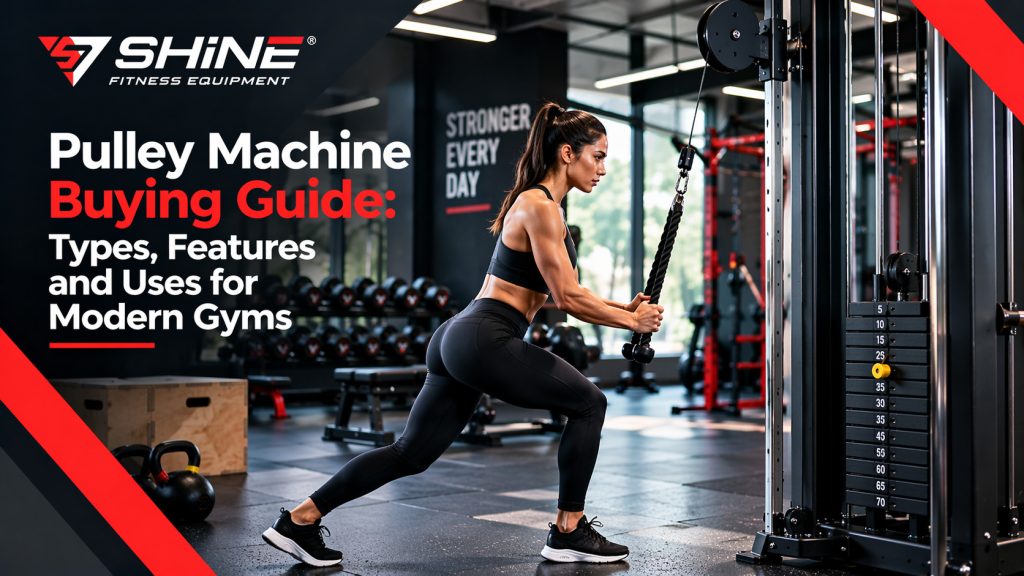
A pulley machine can train almost every muscle group from a single footprint, which is why it sits at the centre of most well-planned strength floors. This guide covers the main types available and the features that separate commercial-grade builds from light-duty ones. It also explains how each type is used and what to check before you place an order for your facility.
Gym owners often treat cable equipment as an afterthought and add it once the racks and benches are in place. That approach usually ends in the wrong configuration, because the right pulley machine depends on member numbers, available floor space and the kind of training your clients actually do.
What Is a Pulley Machine and How Does It Work?
At its core, a pulley machine routes a steel cable from a selectorised weight stack, over one or more wheels, to a handle the user pulls. It works on the same principle as any pulley system: the wheel changes the direction of force. A stack that lifts vertically can therefore deliver resistance from almost any angle.
That change of direction is what makes cable training so valuable. With free weights, gravity always pulls straight down. A cable pulley machine keeps tension on the muscle through the full range of motion, including the stretch and lockout positions where dumbbells lose resistance.
Members get smoother resistance and can change the load quickly with a pin. Trainers get controlled loading, single-arm work and movement patterns that are hard to replicate on fixed-path machines.
Main Types of Pulley Machines for Commercial Gyms
Not every pulley machine serves the same purpose. The configurations below cover most commercial requirements.
Single Cable Pulley Machine
A single cable pulley machine uses one weight stack and one pulley column. It is compact and simple to maintain. It suits smaller floors and personal training studios, and it also works as an overflow station beside busier equipment. By adjusting the pulley height, users can do tricep pushdowns, face pulls, single-arm rows and cable curls.
Dual Pulley Machine
A dual pulley machine uses two independent stacks, so two members can train at once or one member can work both sides together. Long-pull and low-row dual stations belong to this group. They are popular in gyms where back training creates queues during peak hours.
Cable Crossover Station
A crossover is a wide frame with a pulley column on each side, usually joined by a pull-up bar. It is the classic gym pulley machine for chest flyes, crossovers and standing cable work, and it anchors the cable zone in most commercial layouts.
Functional Trainer Machine
A functional trainer machine is a freestanding unit with two columns whose pulleys slide from near the floor to above head height. It suits athletic training, rotational core work and small-group sessions where trainers need quick set-up changes. It is narrower than a full crossover and easier to place along a wall.
Combination Stations
Some facilities choose combination units, such as a lat pulldown paired with a seated row, or a Smith machine with functional trainer columns. These save floor space. However, they can create bottlenecks when one member occupies both functions.
Comparison: Which Pulley Machine Suits Which Gym?
| Factor | Single Cable Pulley | Dual Pulley | Cable Crossover | Functional Trainer |
| Users at once | One | Two, or one bilateral | Two | One or two |
| Footprint | Compact | Moderate | Wide | Moderate |
| Exercise variety | Moderate | Focused, often rows and pulldowns | High | Very high |
| Best suited for | Studios, small gyms | Busy back-training zones | Large commercial floors | PT studios, athletic training |
| Main limitation | Limited simultaneous use | Fixed paths on some models | Needs wall length and ceiling height | Light-duty versions suit lower traffic only |
Use the table as a starting point rather than a rule. A compact neighbourhood gym may get more value from one functional trainer than from a crossover that dominates a wall. A large franchise floor usually needs at least one crossover plus dedicated row and pulldown stations.
Key Features to Check Before Buying a Pulley Machine
Two machines can look identical in a catalogue photograph and behave very differently after a year of daily use. These are the details that matter most.
Build and Mechanical Checklist
- Frame steel and welding: Ask about the steel section and gauge used for the uprights. Heavy-gauge, fully welded frames resist flex when stacks are dropped or users lean on the columns.
- Cable quality: Commercial cables are usually coated steel wire. Check the rated strength and confirm the supplier stocks replacements.
- Pulleys and bearings: Sealed bearings and properly aligned wheels produce the smooth, quiet travel members notice immediately. Rough or noisy movement is often the first sign of a light-duty build.
- Weight stack and guide rods: Look at stack increments, the guide-rod finish and whether bushings can be replaced. Jerky stack movement usually comes from misaligned rods.
- Height adjustment: On single columns and functional trainers, the pop-pin should be easy to operate with one hand and should lock positively.
- Finish: Powder-coated frames hold up better against sweat and chalk than painted ones.
Space and Installation Considerations
Measure the full working area, not just the base. A cable machine for gym use needs clearance for the user, for the arc of the attachment and for people walking past. Crossovers in particular need generous wall length and enough ceiling height for overhead attachments.
Also confirm the floor loading on upper storeys, and check whether the supplier assembles on site. A poorly anchored or misaligned frame affects cable tracking from day one.
Common Uses of a Pulley Machine in Modern Gyms
Cable equipment earns its floor space because it serves several member groups at once.
- General strength members use the pulley machine for isolation work such as flyes, lateral raises, curls and pushdowns after their compound lifts.
- Personal training clients benefit from adjustable resistance angles. Trainers use them to teach movement patterns and correct imbalances one side at a time.
- Athletic and functional training relies on rotational chops, presses and pulls that free weights cannot load easily.
- Beginners and older members often find cable resistance less intimidating than barbells, because the load is guided and easy to change.
The more member groups a single station serves, the stronger the case for a versatile model such as a functional trainer or a full crossover.
How to Choose a Gym Pulley Machine Supplier
The supplier matters as much as the model. A reliable gym pulley machine supplier should be able to explain the specification of each machine, show you how the frame is built and support you after installation.
The first distinction to make is between manufacturers and resellers. A company that fabricates equipment itself can usually adjust heights, upholstery colours or stack weights, and it controls build quality directly. Resellers may offer a wider choice of brands but depend on someone else for parts and modifications.
Before ordering, ask who manufactures the frame and what the warranty covers. Also ask how quickly spare cables ship, whether installation is included, and whether delivery is shown as a separate line in the quote.
Options in the Indian Market
India’s market includes several established names:
- Jerai Fitness is based in Mumbai and has operated since 1994. It is known mainly for heavy-duty strength equipment.
- Viva Fitness positions itself in the mid-to-premium segment with design-led machines.
- International brands such as Life Fitness are available through distributors for facilities with larger budgets.
Each suits a different buyer, so compare specifications, after-sales support and lead times rather than brand recognition alone.
Shine Fitness manufactures its cable range in-house at Chandrala, Gujarat, where it has built gym equipment since 2007. The range includes crossovers, functional trainers, single and dual pulley stations and combination units, with pan-India delivery and on-site installation. As a gym pulley machine supplier that fabricates its own frames, it can also build to an agreed specification when a standard model does not fit the space.
Conclusion
Choosing a pulley machine is really a decision about how your members train and how your floor flows. A single column suits compact spaces, and twin-stack stations ease queues at peak hours. Crossovers anchor a full cable zone, while functional trainers deliver the widest exercise range for their footprint.
Beyond the type, the quality of the frame, cables, bearings and installation decides whether a pulley machine stays smooth and safe after years of daily use. Prioritise those details, plan the layout before ordering, and work with a supplier that can support you with parts and service. A well-chosen gym pulley machine earns its space through versatility and member satisfaction. A poorly chosen cable pulley machine becomes the station everyone avoids.
If you are planning a new strength floor or upgrading an existing one, start by listing your available space, expected footfall and training focus. Then explore the Shine Fitness cable and pulley range or request a quote for a pulley machine specification built around your facility. To understand how these machines hold up under heavy use, read our guide on cable crossover machine durability in busy gyms.
Frequently Asked Questions
What is a pulley machine used for?
A pulley machine trains almost every muscle group with cable resistance, including the chest, back, shoulders, arms, legs and core. Adjustable pulley heights let users perform flyes, rows, pushdowns, curls and rotational movements while keeping constant tension on the muscle through the full range of motion.
What is the difference between a cable pulley machine and a functional trainer machine?
“Cable pulley machine” is a broad term for any cable-and-stack station, including crossovers and single columns. A functional trainer machine is a specific type, with two adjustable columns on a compact frame. It is designed for multi-directional and athletic movements rather than fixed exercise paths.
Is a dual pulley machine better than a single cable pulley machine?
Neither is better in every case. A dual pulley machine lets two people train at once or allows bilateral exercises, which helps busy gyms reduce queues. A single cable pulley machine takes less space and costs less, so it suits studios, smaller gyms or use as an extra station.
How much space does a gym pulley machine need?
It depends on the type. Allow for the machine’s base plus a working zone for the user and the attachment’s arc, and keep a clear walkway behind it. Crossovers need the most wall length. Check the manufacturer’s listed dimensions before finalising a layout rather than relying on estimates.
How often should the cables on a pulley machine be replaced?
Replace a cable as soon as you see fraying, kinks, cracked coating or exposed wire, whatever its age. In busy commercial gyms, staff should inspect cables and pulleys every week. Cable life depends on usage and maintenance, so keep spare cables on hand to avoid downtime.
Which cable machine for gym use suits a small facility?
A functional trainer or a single-column station usually suits a small facility best, because both offer wide exercise variety in a modest footprint. Choose commercial-grade construction if members train daily, and confirm the ceiling height and wall clearance before ordering.
What should I ask a gym pulley machine supplier before buying?
Ask who manufactures the frame, which steel and cable specifications are used and what the warranty covers. Also ask how quickly spare parts ship and whether delivery and installation are included. A supplier that manufactures in-house can usually answer precisely and modify designs if needed.