Enterprise gyms operate in an environment where every equipment decision has measurable consequences. Member retention, injury complaints, equipment downtime, and brand perception are directly shaped by what sits on the gym floor. While multi-function machines are often purchased for their apparent versatility, enterprise operators increasingly recognize that compromise-driven equipment creates hidden costs over time. This reality becomes unavoidable in shoulder training, where misuse, inconsistent movement patterns, and maintenance issues surface quickly at scale. As a result, serious gym owners are re-evaluating their purchasing strategy and shifting toward purpose-built commercial equipment that delivers consistent performance under real-world usage starting with the commercial lateral raise machine.
Enterprise Gyms Do Not Buy Equipment the Way Small Gyms Do
Enterprise gyms operate under conditions that entry-level facilities never face.
- Hundreds or thousands of daily users
- Constant peak-hour congestion
- Wide skill differences among members
- High trainer-to-member ratios
- Strict brand and safety standards
Under these conditions, equipment must work correctly every time, regardless of who uses it.
Multi-function machines are not designed for this reality.
They are designed to offer flexibility, not enforce correct usage.
That difference is exactly where enterprise problems begin.
The Hidden Cost of Multi-Function Equipment in Enterprise Gyms
On paper, multi-function machines appear efficient.
In practice, they introduce risk, inconsistency, and operational drag.
1. User Misuse Becomes the Norm, Not the Exception
Multi-function machines assume user knowledge.
Enterprise gyms serve:
- Beginners
- Casual members
- First-time lifters
- Unsupervised users
When machines require:
- Multiple adjustments
- Angle selection
- Technique awareness
Users skip steps.
Incorrect use becomes routine.
This is not a training issue.
It is a design failure.
2. Shoulder Training Is Where Multi-Function Machines Fail First
Shoulders are the most frequently irritated joint in commercial gyms.
Lateral raises performed incorrectly lead to:
- Chronic shoulder discomfort
- Trap-dominant movement
- Rotator cuff stress
- Reduced training confidence
Multi-function machines provide no protection against poor execution.
Dedicated lateral raise machines do.
3. Maintenance and Downtime Increase Over Time
Multi-function equipment contains:
- More moving parts
- More adjustment rails
- More cables and pulleys
- More wear points
In enterprise usage, this means:
- Higher maintenance frequency
- Increased downtime
- More service calls
- Faster depreciation
Every day a machine is out of service is lost value per square foot.
Why Enterprise Gyms Buy Commercial Lateral Raise Machines
Enterprise gyms do not buy lateral raise machines because they are “nice to have.”
They buy them because they solve repeatable problems.
1. Controlled Movement Fewer Complaints
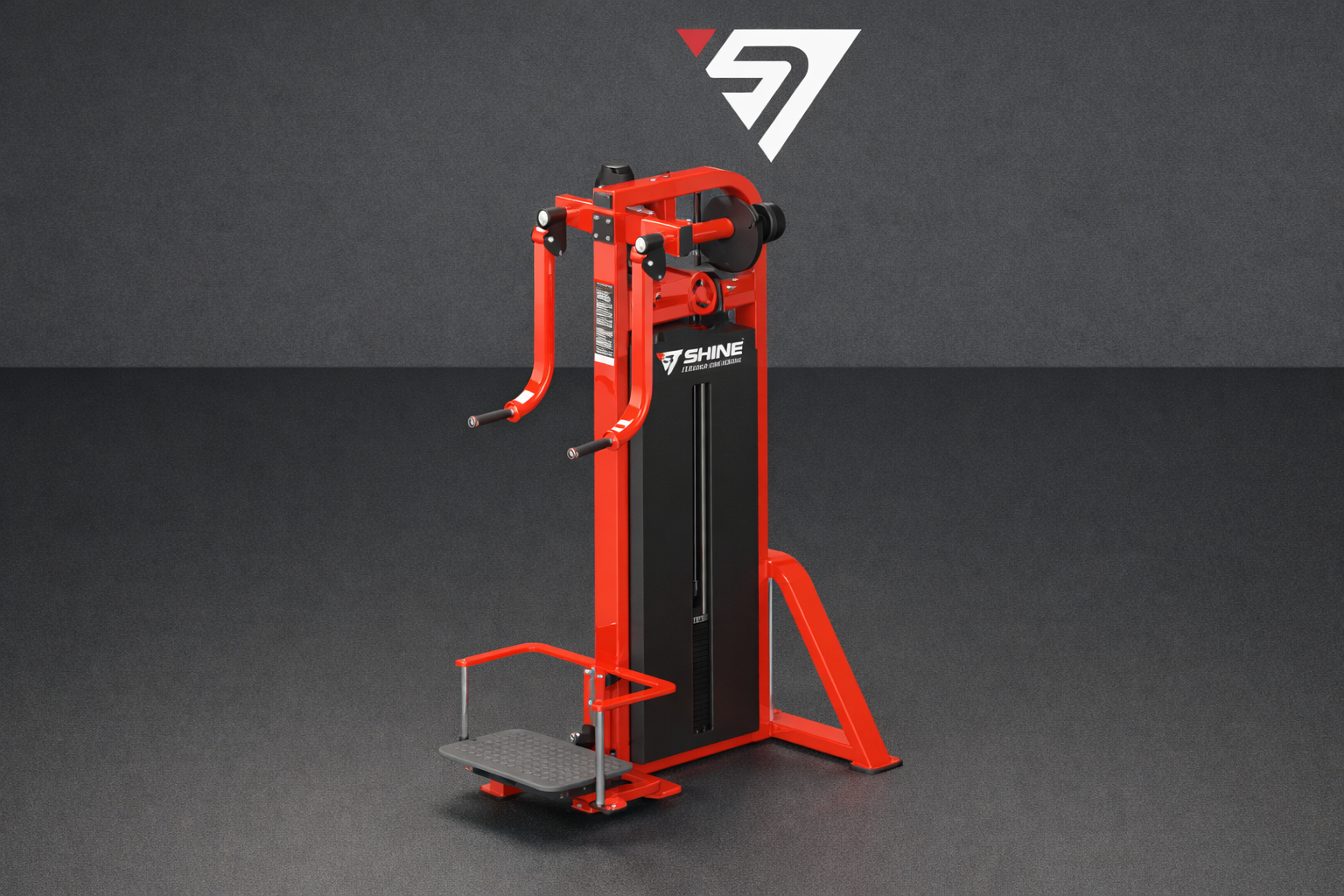
A commercial lateral raise machine guides the user through a fixed, anatomically correct movement path.
This results in:
- Less joint irritation
- Less momentum
- Less misuse
- Fewer shoulder-related complaints
In enterprise gyms, fewer complaints directly correlate with:
- Higher member retention
- Lower refund disputes
- Reduced liability exposure
2. Minimal Adjustment Faster Member Flow
Dedicated lateral raise machines require little to no setup.
This creates:
- Faster user turnover
- Less congestion during peak hours
- More efficient equipment utilization
Multi-function machines slow traffic because users adjust, re-adjust, and often abandon them entirely.
3. Consistent Results Without Trainer Intervention
Enterprise gyms cannot rely on constant coaching.
A lateral raise machine:
- Standardizes execution
- Delivers consistent stimulus
- Reduces the need for correction
Members progress without supervision, which increases satisfaction and confidence.
Enterprise Buyers Think in ROI, Not Purchase Price
The most expensive equipment is not the one with the highest invoice.
It is the one that fails under use.
Long-Term Cost Comparison (Reality-Based)
Multi-function machines:
- Lower upfront cost
- Higher long-term maintenance
- Higher misuse rate
- Shorter commercial lifespan
Commercial lateral raise machines:
- Higher initial investment
- Lower maintenance
- Longer service life
- Higher usage consistency
Over multiple locations, these differences multiply rapidly.
Enterprise gyms buy for years, not months.
Equipment Is a Brand Statement—Whether You Intend It or Not
Members notice equipment quality.
A gym floor filled with purpose-built machines communicates:
- Professionalism
- Serious training standards
- Investment in results
- Long-term commitment
Multi-function machines communicate compromise.
Enterprise brands cannot afford that signal.
Shoulder Training Is Not Optional in Serious Gyms
Shoulder development is a visual marker of training quality.
Members associate:
- Strong shoulders with athleticism
- Balanced delts with professional programming
When shoulder training is neglected—or poorly supported—members feel it.
Dedicated lateral raise machines make shoulder training:
- Visible
- Accessible
- Safe
That matters for retention.
Why Enterprise Gyms Replace Multi-Function Equipment Over Time
Most enterprise gyms do not remove multi-function machines immediately.
They replace them after:
- Increased maintenance
- Member complaints
- Low usage rates
- Injury concerns
By the time replacement happens, the cost has already been paid—just not in one invoice.
Smart buyers skip this step entirely.
The Role of the Manufacturer Matters More Than the Machine
Not all lateral raise machines are built for enterprise use.
Enterprise buyers look for:
- Commercial-grade frames
- Smooth resistance under load
- Long-term mechanical stability
- Consistent manufacturing standards
This is why many enterprise gyms work with specialized manufacturers such as Shine Fitness, where machines are designed specifically for high-traffic, professional environments not catalog versatility.
Enterprise buyers do not want “more features.”
They want fewer failures.
Standardization Across Locations Is a Strategic Advantage
Enterprise gyms operate multiple facilities.
Dedicated machines allow:
- Uniform member experience
- Simplified staff training
- Centralized maintenance
- Predictable procurement
Multi-function machines vary too easily between locations.
Standardization protects brand identity.
When Multi-Function Equipment Is a Strategic Mistake
Multi-function machines fail enterprise gyms when:
- Member volume is high
- Training is unsupervised
- Consistency matters
- Brand perception is critical
Enterprise gyms exist in all four conditions.
The Real Decision Enterprise Buyers Are Making
This purchase is not about lateral raises.
It is about:
- Whether equipment enforces quality or allows error
- Whether maintenance is predictable or constant
- Whether members progress or stagnate
- Whether the brand communicates seriousness or compromise
Enterprise gyms that scale successfully remove variability wherever possible.
Dedicated machines do exactly that.
Final Buyer Statement
Enterprise gyms that rely on multi-function equipment for shoulder training are not saving money—they are deferring problems.
Commercial lateral raise machines:
- Reduce misuse
- Protect joints
- Improve flow
- Increase lifespan
- Strengthen brand perception
That is why serious gyms buy them.
Conclusion
For enterprise gyms, equipment purchases are never isolated decisions. They shape member experience, operational efficiency, injury risk, brand perception, and long-term profitability.
Multi-function equipment promises flexibility, but in high-traffic commercial environments it introduces inconsistency, misuse, higher maintenance, and avoidable risk especially for shoulder training. Those costs rarely appear on an invoice, but they surface over time through complaints, downtime, and reduced member confidence.
Commercial lateral raise machines exist to remove those variables. They standardize movement, protect joints, reduce user error, and perform reliably under constant use. That is why enterprise gyms that scale successfully do not rely on compromise-driven solutions for critical movements.
Buying a commercial lateral raise machine is not about adding another piece of equipment.
It is about enforcing training quality at scale.
Enterprise gyms that prioritize results, safety, and brand standards choose purpose built machines because at this level, compromise is the most expensive option.
Frequently Asked Questions
Yes. In high-traffic gyms, shoulder training performed on multi-function equipment leads to inconsistent use, higher injury risk, and lower member satisfaction. Dedicated machines eliminate these issues.
Because they are not engineered for a fixed shoulder abduction path. Adjustable arms and cables introduce alignment errors that scale into misuse across hundreds of users.
They take less space than the long-term impact of poorly used equipment. Their footprint is justified by higher usage consistency and lower downtime.
No. They are most valuable in mixed-skill environments because they guide beginners safely while still challenging experienced users.
They significantly reduce shoulder strain caused by momentum, poor angles, and overcompensation lowering the risk of complaints and claims.
Yes. Machines with intuitive movement paths and minimal setup see higher adoption than adjustable multi-function stations.
No. They are mechanically simpler than multi-function machines and typically require less maintenance over their lifespan.
Members progress more consistently and experience fewer shoulder issues. Progress and comfort directly influence retention.
No. They complement free weights by providing a controlled option that reduces variability and fatigue-related breakdown.
Yes. They support standardization across facilities, making staff training, maintenance, and brand consistency easier.
Commercial-grade frames, smooth resistance under load, minimal adjustments, and proven durability in high-traffic environments.
When built for commercial environments, yes. This is exactly what they are designed for.
Because maintenance increases, misuse becomes common, and members gravitate toward equipment that feels safer and more effective.
Yes. Multi-function machines can remain for general use, but shoulder training benefits disproportionately from dedicated equipment.
Because specialized manufacturers such as Shine Fitness design machines specifically for high-usage, professional environments where durability and consistency matter more than versatility.