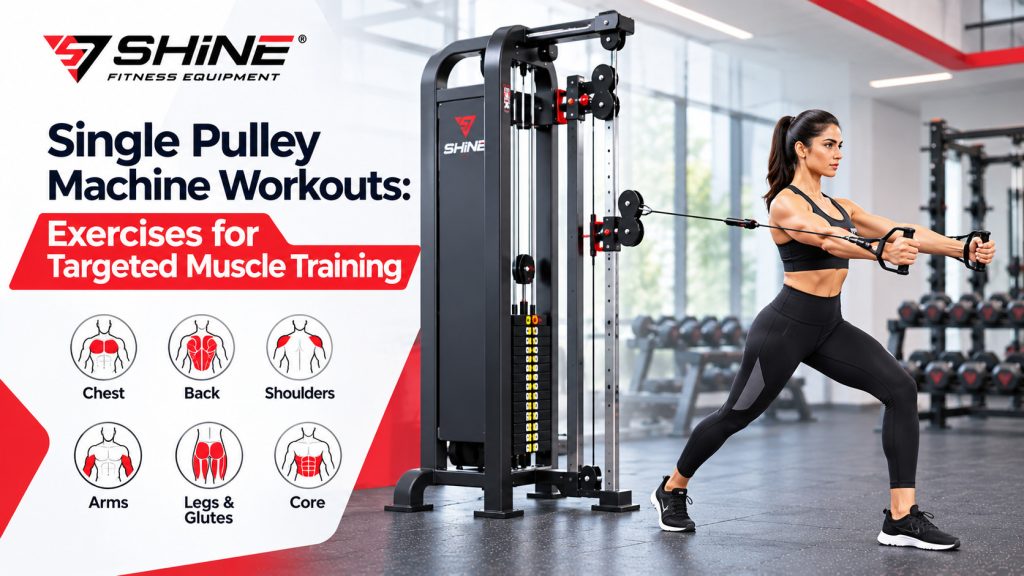
A single pulley machine lets you train almost every muscle group from one station by adjusting the pulley height, the handle and your body position. This guide explains why cable training works, how to set up the machine correctly, and which exercises target the chest, back, shoulders, arms, lower body and core, along with programming tips that support steady, measurable progress.
Why Train on a Single Pulley Machine?
Free weights rely on gravity, so resistance is strongest at certain points of a lift and lighter at others. A cable runs through a pulley, which means the line of pull can be set horizontally, diagonally or from above. This lets you keep tension on a muscle through more of the movement and match resistance to the direction the muscle actually works.
A single pulley machine also makes unilateral training simple. Working one side at a time exposes strength imbalances, involves the core to resist rotation, and allows a fuller range of motion than many fixed machines. For trainers and gym owners, one adjustable cable station can replace several single-purpose machines on a crowded floor.
Cable machine workouts are also easy to scale. Changing the stack weight on a single pulley machine takes seconds, and small adjustments in stance or angle can make the same exercise easier or harder without any extra equipment.
Setting Up the Single Pulley Machine Correctly
Good results depend on the setup more than on the load. Before starting any of the exercises below, check these points:
- Pulley height: set it so the cable pulls directly against the movement you are training, for example high for pulldowns and low for curls and kickbacks.
- Attachment choice: a single handle suits unilateral work, a rope allows the hands to separate at the end of a movement, and an ankle strap is used for hip exercises.
- Distance from the stack: step far enough away that the weights stay lifted between reps, so tension never drops off completely.
- Stance and bracing: a staggered or split stance gives stability, and a braced core prevents the body from twisting to cheat the weight.
Single Pulley Machine Exercises Grouped by Muscle
The following cable machine exercises for different muscle groups can all be performed on a standard single pulley machine. Each one builds on the principle of matching the cable line to the muscle's line of action.
Chest
Single-arm cable chest press: set the pulley at chest height, face away from the stack and press the handle forward in a split stance. Standing cable fly: use a mid or high pulley and sweep the arm across the body with a slight elbow bend. Both are useful single arm cable exercises for balancing strength between the left and right sides.
Back
Single-arm cable row: with the pulley at mid height, pull the handle towards the lower ribs while keeping the torso still. Kneeling single-arm pulldown: set the pulley high, kneel facing the machine and drive the elbow down towards the hip. These movements develop the lats and mid-back with a long stretch at the start of each rep, something a cable handles better than many fixed rows.
Shoulders
Cable lateral raise: stand side-on with the pulley low and raise the arm out to shoulder height. Because the cable crosses the body, it loads the side delts from the bottom of the movement. Face pull: use a rope at upper-chest to head height and pull towards the face, separating the hands. These gym pulley machine workouts support shoulder health as well as size.
Arms
Arm training is where a single pulley machine is especially efficient. Cable biceps curl: use a low pulley and curl the handle while keeping the elbow fixed by your side. Rope triceps push down: use a high pulley and extend the elbows fully. Overhead triceps extension: face away from a low or mid pulley and extend the rope overhead to stretch the long head of the triceps. Single arm cable exercises such as one-handed curls and pushdowns are especially useful for fixing a weaker side.
Lower Body and Glutes
Cable glute kickback: attach an ankle strap at the lowest setting and drive the leg back while keeping the hips square. Cable pull-through: face away from a low pulley with a rope between the legs and hinge at the hips. These cable resistance exercises train hip extension with steady tension and low load on the spine, which makes the cable station valuable for lower-body accessory work.
Core
Core work on cables is effective because the cable can pull from the side, forcing the trunk to resist rotation. Pallof press: stand side-on to a chest-height pulley and press the handle straight out, resisting rotation. Cable wood chopper: pull diagonally from high to low or low to high while rotating through the hips and torso. Kneeling cable crunch: hold a rope from a high pulley and curl the torso down.
| Exercise | Primary muscles | Pulley height | Key cue |
| Single-arm chest press | Chest, front delts, triceps | Chest height | Press forward, not upward |
| Single-arm row | Lats, mid-back | Mid | Keep the torso still |
| Kneeling pulldown | Lats | High | Drive the elbow to the hip |
| Lateral raise | Side delts | Low | Lead with the elbow |
| Rope pushdown | Triceps | High | Elbows stay fixed |
| Glute kickback | Glutes | Low | Hips stay square |
| Pallof press | Core, obliques | Chest height | Resist rotation |
Warming Up on a Single Pulley Machine
A short, targeted warm-up prepares joints and muscles for heavier work. Light face pulls, band-weight external rotations and slow cable rows raise shoulder temperature, while light pull-roughs and kickbacks activate the glutes before lower-body sessions. Because a single pulley machine allows very small load jumps, it is ideal for gradual warm-up sets that build towards working weights without fatiguing the target muscle.
Programming Cable Exercises for Strength Training
Cables are often treated as finishing work, but well-chosen cable exercises for strength training can play a larger role. Rows, pulldowns, presses and pull-roughs respond well to moderate-to-heavy loads with controlled technique, while raises, flies and kickbacks usually suit higher repetitions with a deliberate squeeze.
A practical approach is to pair free-weight compound lifts with targeted cable work. For example, follow barbell squats with cable pull-roughs, or bench presses with single-arm cable presses. The principle of progressive overload still applies: increase load, repetitions or control gradually over time.
Sample Session Structure
- Start with one or two compound movements such as single-arm rows or pulldowns at moderate weight.
- Add two isolation movements, for example lateral raises and rope pushdowns, using controlled tempo.
- Finish with a core anti-rotation exercise such as the Pallof press, performed slowly with a braced trunk.
- Train each side for the same number of repetitions, starting with the weaker side.
Tempo, Range of Motion and Progression
Tempo has a large effect on how cable work feels. A controlled lowering phase of two to three seconds keeps tension on the target muscle and makes lighter loads more productive, while a brief pause at the point of peak contraction improves the mind-muscle connection on raises, flies and kickbacks. Aim to use the full range of motion the joint allows without the plates touching down between reps. When all prescribed repetitions feel smooth and controlled, add a small amount of weight or a few extra repetitions the following week. This simple approach applies to all cable resistance exercises and keeps progress steady without sacrificing technique or joint comfort.
Planned this way, cable machine workouts can form a complete session on their own or support a broader programme, and gym pulley machine workouts fit easily into busy floors where members need quick station changes.
Adapting Single Pulley Machine Workouts by Experience Level
Beginners should spend the first weeks on a single pulley machine learning setup: pulley height, attachment choice and stance. Two or three exercises per muscle group, performed with light loads and slow tempo, are enough to build coordination. Rows, pushdowns, curls and Pallof presses are good starting points because they are easy to learn.
Intermediate lifters can use the station to target weak points, such as an underdeveloped side or lagging rear delts, and to add volume after compound lifts. Advanced lifters often use techniques such as paused reps, slow eccentrics or drop sets, which are easy to perform because changing the pin takes only seconds. At every level, cable training rewards controlled technique more than heavy loading.
Choosing a Single Pulley Machine for Your Gym
For commercial floors, the right single pulley machine should have a smooth, quiet cable path, a wide range of height adjustments, a stable base and durable cables and pulleys. Clear height markings make setup quicker for members, and a well-chosen weight stack lets beginners and experienced lifters perform cable machine exercises for different muscle groups on the same unit. Facilities that want the most variety from one footprint often place two single stations near each other or combine them with a dual-cable crossover. For home gyms, a compact single pulley machine with a wall-mounted or freestanding frame can deliver a full-body workout in very little floor space.
Frequently Asked Questions
What muscles can you train on a single pulley machine?
You can train the chest, back, shoulders, biceps, triceps, glutes, hamstrings and core. Changing the pulley height, attachment and body position changes the line of pull, which lets one machine cover cable machine exercises for different muscle groups, including presses, rows, raises, curls, kickbacks and anti-rotation work.
Are cable machine workouts good for building strength?
Yes. Cable work builds strength, particularly in rows, pulldowns, presses and pull-roughs performed with moderate-to-heavy loads. Cables are most effective when combined with free-weight compound lifts, because they add constant tension and unilateral loading that support overall strength development.
What are the best single arm cable exercises?
Effective single arm cable exercises include the single-arm row, kneeling pulldown, single-arm chest press, lateral raise, one-handed curl and single-arm push down. Training one side at a time helps correct imbalances and requires the core to resist rotation throughout each repetition.
How do I set the pulley height correctly?
Set the pulley so the cable pulls directly against the movement you are training. Use a high setting for pulldowns, pushdowns and crunches, a mid setting for rows and presses, and a low setting for curls, lateral raises, kickbacks and pull-roughs.
Can beginners use a single pulley machine?
Yes. The adjustable weight stack and guided cable path make it beginner-friendly. New users should start with light loads, learn the correct pulley height for each exercise and focus on controlled movement before progressing the weight.
How many cable exercises should I include in a workout?
Most sessions work well with three to six cable exercises, depending on training goals and the other lifts in the programme. Combine one or two compound cable movements with a few isolation exercises and a core movement for balanced coverage.
Are cable resistance exercises safe for the lower back?
Many are, because they allow steady tension with relatively low spinal loading. Pull-throughs, kickbacks and Pallof presses are commonly used for this reason. Anyone with a back injury should get advice from a qualified professional before starting.
Conclusion
A single pulley machine is one of the most versatile stations on any gym floor, whether commercial or home. With the right pulley height, attachment and stance, it trains every major muscle group, supports unilateral work and adds steady tension that complements free weights. Used consistently, this station can drive steady progress for beginners and experienced lifters alike. Prioritise setup and control over load, and build gym pulley machine workouts that pair compound cable movements with targeted isolation and core work.
If you are adding cable stations to a commercial or home facility, consider floor space, user volume and the range of exercises you want to offer. Explore the Shine Fitness cable exercises for strength training equipment range, or contact the team for guidance on the right pulley configuration for your space. To compare single, dual and crossover options before buying, read our pulley machine buying guide.