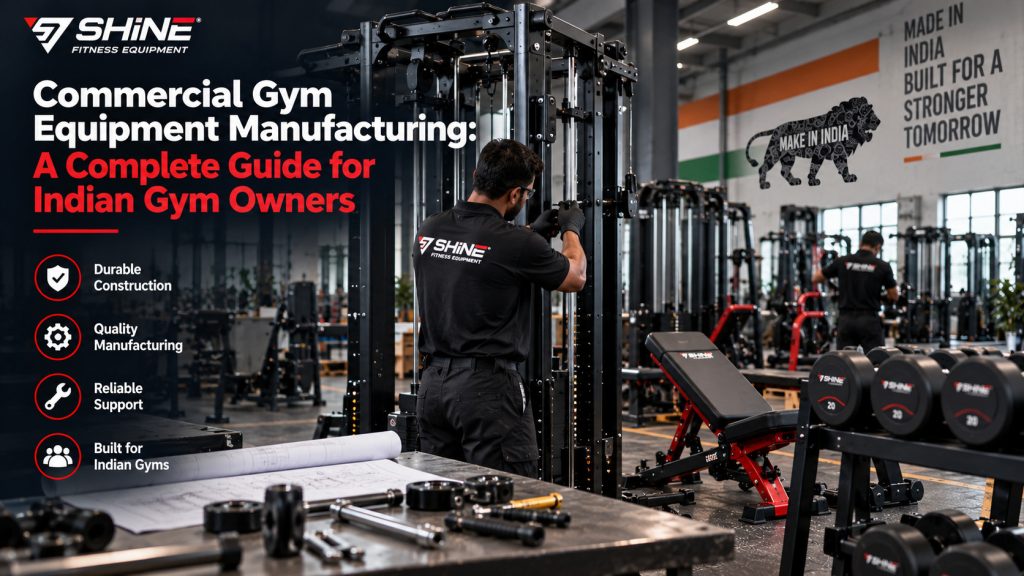
Buying commercial gym equipment is a manufacturing decision before it is a purchasing decision: how a machine is fabricated, welded, finished and supported determines how it performs for the next decade far more than its price at the point of sale. This guide explains what separates genuine commercial-grade manufacturing from light-duty production, which categories of equipment demand the closest attention, and the maintenance routine that protects the investment once machines are on your floor. It is written for gym owners in India who are specifying a new facility or replacing ageing equipment.
Why Commercial Gym Equipment Manufacturing Quality Matters
A machine in a paying facility might be used several hundred times a day, by users of widely varying size and technique, in an environment with constant sweat exposure and, in much of India, high seasonal humidity. Domestic equipment is not engineered for that duty cycle, which is the entire reason commercial gym equipment exists as a separate product class. The distinction is real and it is structural.
Manufacturing quality shows up in four places. Frame construction, heavier-wall tubing, larger sections, and correctly designed load paths that resist deflection and twisting. Welding, continuous, properly dressed welds at stress junctions, rather than short tack welds that fatigue under cyclic loading. Finishing, surface preparation and powder coating that resist corrosion in humid conditions. Component specification, bearings, bushings, cables, pulleys and upholstery chosen for service life rather than lowest unit cost. Any machine worth buying gets all four right, not three of the four.
There is a second reason manufacturing matters for Indian gym owners specifically: proximity. Buying commercial fitness equipment from a domestic manufacturer shortens lead times, simplifies spare-part supply, and makes on-site support practical. An imported machine with a long wait for a replacement cable is an expensive asset standing idle, whereas locally manufactured commercial fitness equipment can usually be supported within days.
What to Look for in a Manufacturer
- In-house fabrication capability. Manufacturers who cut, weld, finish and assemble under one roof control quality at every stage rather than depending on outsourced sub-assemblies.
- Documented quality control. Ask what is inspected, at which stage, and by whom. Raw material sourcing, weld inspection and functional testing should all be defined steps.
- Spare-part availability. Confirm that cables, pads, pins, bushings and rollers are stocked and can be ordered individually years after purchase.
- Track record in commercial settings. Equipment installed in high-traffic facilities and still performing is the most meaningful evidence available.
- After-sales support structure. Installation, commissioning and service response should be defined before you order, not negotiated after a fault.
What Equipment Needs Regular Maintenance
Every piece of commercial gym equipment needs attention, but the type and frequency differ sharply by category. Grouping your inventory this way makes scheduling manageable.
Cardio Equipment
Treadmills, cross-trainers, bikes and rowers combine mechanical wear with electronics, which makes them the most maintenance-intensive category. Belts need tensioning and lubrication to the manufacturer’s interval; decks wear and eventually need replacement; consoles and sensors need connection checks; and drive components need periodic professional inspection. Because electrical work is involved, the boundary between in-house tasks and technician work is strict. Cardio units should always be on a scheduled professional service contract, and they are the one category where in-house work is genuinely limited.
Strength Equipment
Selectorised machines, lat pulldowns, cable crossovers, leg machines, chest presses, are mechanically simpler but take heavy repeated loading. The wear items are predictable: cables fray, pulleys develop bearing noise, guide rods collect dust, upholstery tears, and fasteners loosen. Routine inspection catches nearly all of it. Because these faults are visible before they become failures, disciplined gym equipment maintenance here delivers a better return than in any other category of commercial gym equipment.
Free Weights and Benches
The lowest-maintenance group, but not maintenance-free. Barbells need sleeve cleaning and knurl care; plates and dumbbells need checking for loose collars, cracked rubber and worn urethane; racks need fastener checks and J-cup liner inspection; and benches need pad and mechanism attention. Storage discipline matters as much as servicing here, commercial fitness equipment left lying on the floor gets damaged and damages flooring in turn.
| Category | Main Wear Points | Typical Check Frequency | In-House or Technician |
| Cardio | Belts, decks, electronics, drive components | Daily visual, monthly detailed | Technician for all electrical work |
| Selectorised strength | Cables, pulleys, guide rods, upholstery | Weekly function, monthly detailed | Mostly in-house |
| Plate-loaded | Bushings, linkages, weight horns, pads | Monthly | Mostly in-house |
| Racks and benches | Fasteners, liners, upholstery, feet | Monthly | In-house |
| Free weights | Collars, rubber, knurling, storage racks | Weekly | In-house |
Daily and Routine Maintenance Tasks
A maintenance programme succeeds or fails on whether it is written down and assigned. Vague intentions do not survive a busy floor, and gym equipment maintenance is no exception. The gym equipment maintenance structure below works for most commercial facilities in India and can be adapted to your traffic levels.
Daily Tasks
- Wipe down every contact surface and upholstery panel with an appropriate cleaner.
- Visually inspect cables, handles, grips and pads on all strength machines.
- Check that all cardio units power up and that consoles respond correctly.
- Return loose weights, collars and attachments to their storage positions.
- Log any fault reported by members or staff, with machine name, time and symptom.
Weekly and Monthly Tasks
- Weekly. Run every adjustment mechanism through its full range. Check guide rods for smooth travel. Inspect treadmill belt alignment and tension.
- Monthly. Torque-check fasteners across all strength machines and racks. Inspect every cable end to end, including swage fittings. Clean and lubricate to manufacturer specification. Check rubber feet and weight-stack bumpers.
- Quarterly. Inspect frames and welds for cracks or corrosion, deep clean, audit the service log and reorder consumable spares.
- Annually. Arrange professional servicing for cardio equipment and any unit still under warranty.
Working from a written gym equipment maintenance checklist rather than memory is what turns this from a good intention into a routine. Assign each block of the gym equipment maintenance checklist to a named role, record completion, and review the log monthly. The broader discipline of preventive maintenance is well established across industries for exactly this reason: scheduled attention costs a fraction of unplanned failure.
How Maintenance Extends Commercial Gym Equipment Life
The financial case is straightforward. A commercial gym equipment frame, if properly manufactured, will outlast its consumable components many times over. Cables, pads, bushings, bearings and rollers are designed to be replaced. When they are replaced on schedule, the frame keeps working. When they are not, a worn component damages the parts around it, a scored pulley chews through cables, a loose fastener elongates its mounting hole, a torn pad lets moisture into the frame.
There are four practical benefits worth being explicit about:
- Lower total cost of ownership. Replacing consumables is a small recurring cost. Replacing machines is a capital event.
- Less downtime and better member experience. Out-of-order signs are one of the most common complaints in gym reviews, and they are almost entirely preventable.
- Improved safety and reduced liability. Cable and fastener failures under load are the faults most likely to cause injury, and both are detected by routine inspection.
- Protected warranty and resale value. Documented gym equipment repair and servicing history supports warranty claims and materially improves what used machines fetch.
Good commercial gym maintenance also changes your relationship with your supplier. A facility that keeps records can point to a pattern when a component fails early, which makes warranty conversations factual rather than adversarial. The same records justify commercial gym equipment replacement decisions to investors or partners, and they make a gym equipment maintenance checklist auditable rather than decorative.
Common Mistakes Indian Gym Owners Make
- Buying on price alone. A light-duty machine in a commercial setting fails in months rather than years, and the saving disappears with the first replacement.
- Ignoring humidity and ventilation. Coastal and monsoon-season conditions accelerate corrosion. Ventilation and dehumidification protect equipment as well as members.
- Deferring small repairs. A single frayed cable becomes a safety incident. Same-week gym equipment repair should be the standard.
- No spare-part stock. Keeping cables, pads, pins, grips and feet on hand converts a three-week outage into a same-day fix.
- Skipping installation checks. Levelling, floor protection and correct assembly at commissioning prevent a surprising share of later faults.
Arranging gym equipment repair through the original manufacturer, where possible, keeps parts correct and warranties intact. Third-party commercial gym equipment servicing and generic parts can be cheaper in the short term, but substituted components change load paths in ways that are not visible from outside the machine. Regular commercial gym equipment servicing by people familiar with the design is the safer route.
Frequently Asked Questions
What makes equipment commercial grade rather than home grade?
Commercial gym equipment means heavier frame construction, higher load ratings, continuous welds, corrosion-resistant finishing, and components specified for continuous daily use. Home equipment is lighter and built for occasional use, not for a paying membership.
How often should commercial gym equipment be serviced?
A commercial gym maintenance routine needs daily cleaning and visual checks, weekly function checks, monthly fastener and cable inspections, quarterly frame inspection, and annual professional servicing for cardio units. High-traffic gyms should shorten these intervals.
Is it better to buy Indian-made or imported gym equipment?
For commercial fitness equipment, domestic manufacturing usually offers shorter lead times, easier spare-part supply and more practical on-site support. Evaluate build quality, warranty terms and service response rather than origin alone when comparing suppliers.
How long does commercial gym equipment last?
A well-manufactured frame lasts many years with correct maintenance. Consumables such as cables, upholstery, bushings and bearings wear sooner and are replaced periodically, which is why spare-part availability affects real lifespan.
What should be on a gym equipment maintenance checklist?
Daily cleaning and visual inspection, weekly mechanism and belt checks, monthly fastener torque and full cable inspection, quarterly frame and weld inspection, and annual professional cardio servicing, all recorded against each machine.
How much space is needed for commercial equipment?
Plan clearance for entry, exit, spotting and weight handling around every machine, not just its footprint. Aisle width and equipment spacing affect safety and peak-hour capacity more than the total number of machines.
Can maintenance be handled in-house?
Much routine commercial gym maintenance can be handled by trained staff: cleaning, fastener checks, cable inspection, pad replacement and basic adjustments. Electrical work, frame repairs and load-bearing assemblies require a qualified technician or the manufacturer.
Conclusion
For an Indian gym owner, commercial gym equipment is best understood as a long-term asset whose value is set at two points: the manufacturing quality you buy, and the maintenance discipline you apply afterwards. Frame construction, weld integrity, finishing and component specification decide how a machine ages; a written maintenance routine, a small spare-part stock and a clear line between in-house and technician work decide how much of that potential lifespan you actually realise. Get both right and commercial gym equipment costs become predictable rather than disruptive. Prioritise manufacturers who fabricate in-house, document their quality control, and can supply parts years after installation.
If you are planning a new facility or replacing ageing machines, start by auditing your current floor, recording each unit’s condition, and mapping your peak-hour usage against available space. Explore the Shine Fitness product range or contact the team for guidance on specification, installation and servicing for your facility.