A back pulldown machine is a staple of every serious gym floor. It lets members build a wider, stronger back through a controlled vertical pull, and it scales from a first-time user pulling 10 kg to an advanced lifter moving 100 kg or more. This 2026 guide covers how the machine works, the muscles it trains, the specifications that separate a durable unit from a weak one, when it is not the right purchase and how to choose the right model for your facility.
What Is a Back Pulldown Machine and How Does It Work?
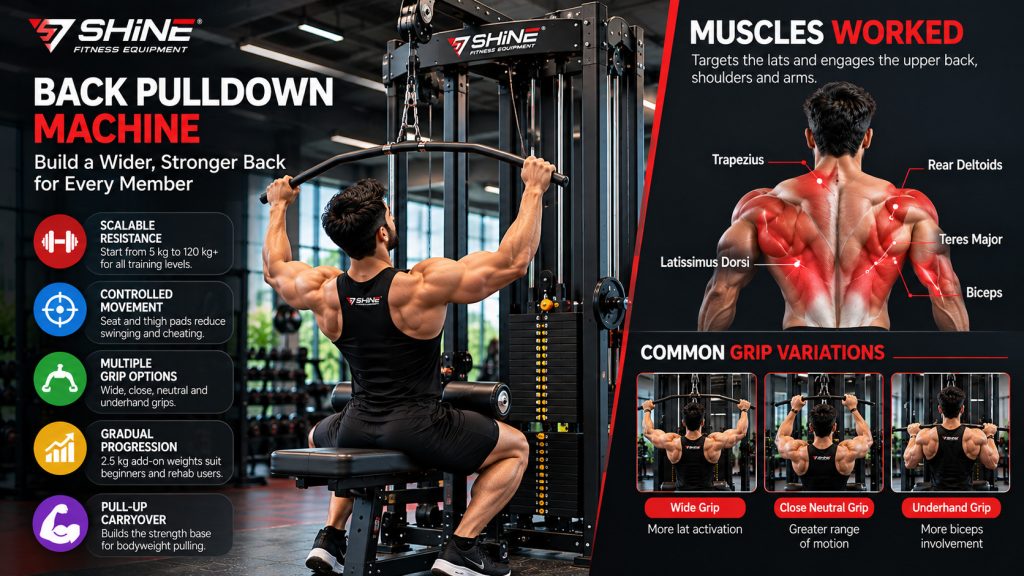
A lat pulldown station has five core parts: a seat, a pair of thigh pads, a high pulley mounted roughly 2.1 - 2.3 m above the floor, a cable, and a long bar, typically 120–150 cm wide. The user sits beneath the pulley, grips the bar and pulls it down towards the upper chest, then lets it return under control. Resistance comes from a selectorised weight stack or, on plate-loaded designs, from weight plates on lever arms.
The movement mirrors a pull-up, but the load can be set well below bodyweight. A 70 kg member who cannot yet do one pull-up can start at 25–30 kg and build from there. That makes the pulldown one of the most accessible ways to develop vertical pulling strength. The thigh pads lock the user in place, so the back does the work rather than momentum or body swing.
On a selectorised unit, the cable runs over two to four pulleys from the bar to the stack. Each extra pulley adds a little friction, which is why pulley quality has a direct effect on how smooth the pull feels in the first and last 10 cm of the movement.
Benefits for Back Training
These benefits explain why a lat pulldown machine for gym floors remains one of the most requested strength stations:
- Scalable resistance: stacks start at 5 kg, so beginners can train long before they manage a pull-up.
- Controlled movement: the fixed seat and thigh pads reduce swinging and cheating.
- Grip variety: wide, close, neutral and underhand grips shift the emphasis between muscles.
- Gradual progression: 2.5 kg add-on weights suit older members and people returning from injury.
- Pull-up carryover: 8–12 weeks of consistent pulldown training builds the strength base for bodyweight pulling.
For a gym, a pulldown also has a practical advantage: it is intuitive, so members use it confidently without supervision. A typical set of 10–12 reps takes under a minute, which means a single station can serve 15–20 members in a busy one-hour window. That makes it one of the highest-usage pieces of commercial fitness equipment on the floor.
What Muscles Does the Lat Pulldown Work?
The main target is the latissimus dorsi, the large, fan-shaped muscle responsible for shoulder extension and adduction. It runs from the lower spine and pelvis to the upper arm, making it the widest muscle of the upper body. Research examining the lat pulldown has also measured activity in the latissimus dorsi and teres major during the exercise.
Supporting muscles include:
- Teres major: works closely with the lats during every pull.
- Rhomboids and middle trapezius: draw the shoulder blades together and down.
- Rear deltoids: assist, particularly with wider grips.
- Biceps and forearms: bend the elbow and hold the bar securely.
Grip choice shifts the emphasis. A wide overhand grip, about 1.5 times shoulder width, is commonly used to target the lats and upper back. A close neutral grip allows a longer range of motion and more elbow flexor involvement. An underhand grip at shoulder width brings the biceps in further. A well-built station with three or four attachment options lets members use all of these variations without leaving the machine.
For most members, 3–4 sets of 8–12 reps, twice a week, is a sound starting point for back development. Coaches often pair the pulldown with a horizontal row so the back is trained in both planes.
Key Features to Look For
When evaluating commercial gym equipment, the specifications below separate a reliable pulldown from one that wears out within two or three years:
- Frame and steel: look for 2.5–3 mm wall-thickness steel tube, commonly in 50 × 100 mm or 60 × 120 mm sections, with continuous welds rather than spot welds. This prevents flex at heavy loads.
- Cable and pulleys: a 5–6 mm high-tensile, nylon-coated steel cable and sealed-bearing pulleys of roughly 110–120 mm diameter give smooth, quiet travel.
- Weight stack: 70–100 kg suits most commercial floors; strength-focused gyms often need 100–120 kg. Increments of 5 kg, with a 2.5 kg add-on, help beginners progress.
- Adjustable seat and thigh pads: at least 5–6 adjustment positions so users from roughly 150 cm to 195 cm tall stay secure.
- Upholstery: 40–50 mm high-density foam and tear-resistant PU or PVC covering built for 10+ hours of daily use.
- Attachments: a long bar, a close-grip V-handle and a row handle if the unit includes a low pulley.
- Stack shroud: a full or partial guard around the weight stack, which keeps fingers clear and is expected on commercial floors.
Some models combine the pulldown with a low row station. These dual-function units let two exercises share one frame, which suits floors under 100 m².
| Type | Resistance | Best For | Consideration |
| Selectorised lat pulldown | Weight stack with a selector pin (70–120 kg) | Commercial gyms and all member levels | Stack size sets the maximum load |
| Plate-loaded lat pulldown | Plates on lever arms | Strength-focused gyms | Needs plate storage within 2–3 m |
| Pulldown with low row | Shared stack with high and low pulleys | Space-limited floors | Usually one user at a time |
As with all commercial gym equipment, choose the type that matches how your members actually train rather than the one with the longest feature list.
How to Choose the Right Back Pulldown Machine for Your Gym
Choosing the right unit means balancing member needs, available space and budget. Work through the five steps below in order.
Assess Your Members
High-traffic gyms with 300+ active members need robust commercial fitness equipment with heavier stacks, and many place two pulldown stations to avoid queues at peak hours. Studios, hotels and corporate gyms with under 100 daily users can usually rely on a single combination unit.
Check Space and Ceiling Height
A typical selectorised pulldown has a footprint of about 1.2 m × 1.6–1.8 m and stands 2.1–2.3 m tall. Allow a ceiling height of at least 2.6–2.7 m so the top pulley and frame have clearance and tall users can stand safely. The ISO 20957 fitness equipment standard recommends a free training area of at least 0.6 m around stationary equipment, so plan for that space behind and beside the seat.
Compare Selectorised and Plate-Loaded Designs
Selectorised units adjust between users in under five seconds with a pin change, which matters on busy floors. Plate-loaded designs offer a different, more natural feel, suit heavy strength training and have fewer cables to maintain, but members must load and unload plates.
Understand the Lat Pulldown Machine Price
The lat pulldown machine price varies with frame gauge, stack weight, pulley quality, attachments and whether a row station is included. Compare quotes on specification rather than headline cost. A cheaper machine with a 4 mm cable or thin steel often needs a replacement cable within 12–18 months, and the repair costs and downtime quickly erase the initial saving. Ask each supplier for the steel thickness, cable diameter and stack weight in writing so you compare like with like.
Choose a Reliable Gym Equipment Supplier
Work with a gym equipment supplier that offers delivery, installation, warranty and spare parts. Buying directly from a manufacturer such as Shine Fitness, which builds its lat pulldown range in-house at Chandrala, Gujarat, means clear specifications and direct after-sales support. If you are looking for a back pulldown machine for sale, compare at least three models side by side, including single-pulley and double-pulley rowing versions.
Setup and Maintenance Checklist
Buying the right unit is half the job; keeping it running is the other half. A simple schedule keeps a pulldown station in service for 10 years or more:
- Daily: wipe down the seat, thigh pads and grips, and check that the selector pin seats fully.
- Weekly: inspect the cable along its full length for fraying, kinks or a cracked coating.
- Monthly: check pulley bearings for noise, tighten frame bolts and wipe the guide rods.
- Every 6 months: lubricate guide rods with a silicone-based lubricant and check cable tension.
- Replace immediately: any cable showing broken strands. Never wait for the next service.
Fix the machine to the floor if the manufacturer recommends it, and place it on a rubber floor at least 10–15 mm thick to protect both the frame and the floor.
When a Pulldown Machine Is Not the Right Buy
A pulldown is not the right purchase for every facility. Skip it, or choose a different option, in these situations:
- Your ceiling is under 2.5 m. A standard high pulley will not fit safely. A low-row machine or a functional trainer with an adjustable pulley is a better choice.
- You already own a functional trainer or cable crossover. If it has a high pulley and lat bar attachment, a dedicated pulldown adds limited value for a small studio.
- Your gym focuses on bodyweight or CrossFit-style training. A pull-up rig with assistance bands may serve your members better and cost less.
- You are equipping a home gym on a tight budget. A commercial-grade unit is overbuilt for one or two users; a lighter home model or a pull-up bar is more sensible.
- You cannot commit to basic maintenance. A cable machine that is never inspected becomes a safety risk. If no one will check the cable weekly, choose a plate-loaded design instead.
Being honest about these limits prevents you from spending on floor space and budget that a different machine would use better.
Frequently Asked Questions About Back Pulldown Machines
What is a back pulldown machine used for?
It is used to train vertical pulling strength, mainly targeting the latissimus dorsi along with the teres major, rhomboids, rear deltoids and biceps. It builds back width and strength and helps members progress towards unassisted pull-ups.
Is a lat pulldown better than pull-ups?
Neither is strictly better. Pull-ups use bodyweight and demand more core control, while a lat pulldown allows loads from 5 kg upwards with precise adjustment. Most programmes use both, with pulldowns especially useful for beginners and high-volume back training.
How do I choose a lat pulldown machine for gym use?
Look for 2.5–3 mm steel tubing, sealed-bearing pulleys, a 5–6 mm high-tensile cable, adjustable thigh pads and a 70–120 kg weight stack. A lat pulldown machine for gym floors should also include at least three attachments and come with clear warranty and spare-part support.
What affects the lat pulldown machine price?
The lat pulldown machine price depends on frame construction, stack weight, cable and pulley quality, upholstery, attachments and whether a low row is included. Custom sizes, colours and branding can also affect the quote, so always compare detailed specifications.
Where can I buy a lat pulldown in India?
You can find a back pulldown machine for sale through manufacturers, authorised dealers and equipment suppliers. Buying directly from an Indian manufacturer usually means clearer pricing, faster spares and on-site installation. Request an itemised quote before ordering.
Is the lat pulldown suitable for beginners?
With coaching on posture and grip, new members can build back strength over 8–12 weeks before moving on to pull-ups or heavier pulling variations. To learn more about correct form, read our lat pulldown machine exercise guide with form tips.
How much ceiling height does a lat pulldown need?
Most commercial units stand 2.1–2.3 m tall, so plan for a ceiling of at least 2.6–2.7 m, plus 0.6 m of free space around the machine.
What should I check before buying from a gym equipment supplier?
Confirm where the equipment is made, the warranty terms, spare-part availability, delivery timelines and whether installation is included. A reliable gym equipment supplier should provide written specifications and references from gyms where its machines are already installed.
Conclusion
A back pulldown machine is essential for building back strength, and it serves members at every level, from beginners working towards their first pull-up to experienced lifters chasing back width. Focus on 2.5–3 mm steel, sealed-bearing pulleys, a 5–6 mm cable and the right stack size, and choose a lat pulldown machine for gym use that fits your space and member profile. Durable commercial gym equipment like this repays its cost through years of daily use.
If you are comparing options, list your floor space, ceiling height, member numbers and preferred type, then compare quotes on specification. Whether you need a single back pulldown machine for sale or a full range of commercial fitness equipment, explore the Shine Fitness lat pulldown range or request a quote for a recommendation tailored to your gym.