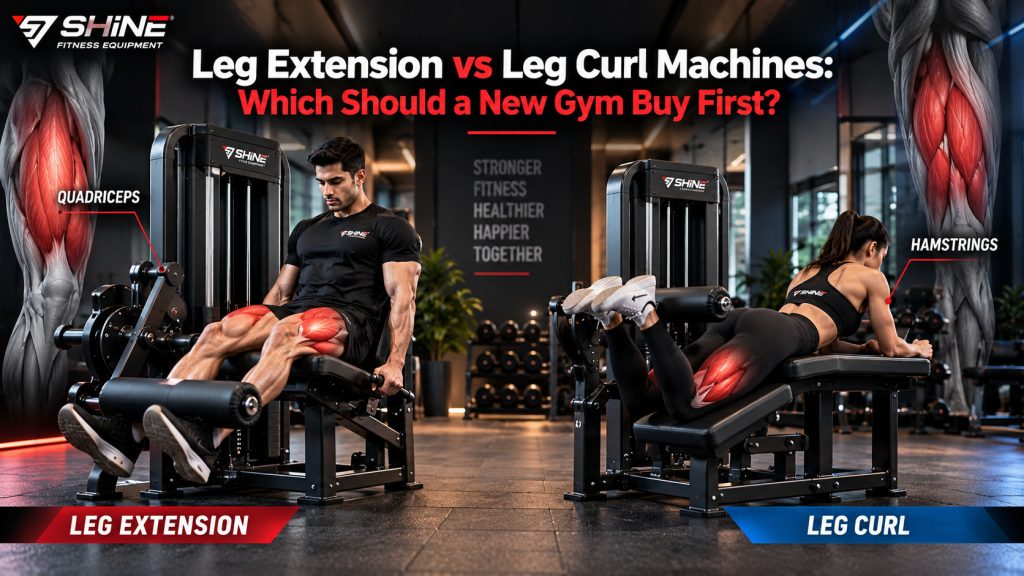
The short answer to leg extension vs leg curl is that they train opposite sides of the thigh through opposite joint actions: the extension machine straightens the knee and loads the quadriceps, while the curl machine bends the knee and loads the hamstrings. The two units look similar on a gym floor and occupy similar footprints, and they are often bought together, but they are not interchangeable, and using one does not cover what the other does. This guide explains the mechanics of each machine, the muscles involved, when each one earns its place in a training programme, and what gym owners should weigh up before buying either or both.
Leg Extension vs Leg Curl: What Each Machine Trains
Both machines isolate a single joint. That is the defining feature of the pair and the reason they exist alongside compound equipment like squat racks and leg presses. Understanding the movement pattern makes the distinction obvious, whether you frame it as leg curl vs leg extension or as a quad vs hamstring machine choice.
The Leg Extension Machine
On a leg extension, the user sits upright with the shin behind a padded roller and straightens the knee against resistance. The hip stays fixed, so the load has nowhere to go except the front of the thigh. Because the lever arm is long and the range of motion is controlled, the machine allows precise loading of the quadriceps without demanding balance, grip strength, or spinal loading. This is why it remains a staple in rehabilitation settings as well as bodybuilding, and why any serious leg extension vs leg curl discussion starts with joint mechanics rather than muscle names.
The Leg Curl Machine
A leg curl reverses the action. The user bends the knee, lying prone, seated, or standing depending on the variant, and pulls the roller towards the glutes. Resistance now falls on the back of the thigh. Seated versions place the hip in flexion, which lengthens the hamstrings before the movement begins; prone and standing versions keep the hip closer to neutral. That hip position changes the emphasis slightly, which is worth knowing when you compare the two machines seriously. It is also the detail most often missed in a casual leg extension vs leg curl comparison.
Muscles Worked Compared
This is where the comparison becomes practical. The leg extension muscles are the four heads of the quadriceps: rectus femoris, vastus lateralis, vastus medialis, and vastus intermedius. Three of those cross only the knee. The rectus femoris also crosses the hip, which is why it contributes less when the hip is already flexed in a seated position.
The leg curl muscles are the hamstring group, biceps femoris, semitendinosus, and semimembranosus, supported by the gastrocnemius at the calf and the popliteus at the knee. Most of the hamstring group crosses both the hip and the knee, which explains why hamstring training responds to both knee-flexion work and hip-hinge work such as deadlifts. In muscular terms, then, the quad vs hamstring machine question is really the leg extension vs leg curl question stated another way. If you want an anatomical reference, the quadriceps femoris muscle group is well documented.
| Factor | Leg Extension | Leg Curl |
| Joint action | Knee extension | Knee flexion |
| Primary muscles | Quadriceps (four heads) | Hamstrings (three heads) |
| Secondary involvement | Minimal | Calf and popliteus assist |
| Hip position | Seated, hip flexed | Seated, prone, or standing |
| Common training goal | Quad size, knee-tracking control | Hamstring balance, posterior strength |
| Typical placement | Beside other seated selectorised units | Beside the extension or as a combo unit |
| Suits beginners | Yes, low skill requirement | Yes, low skill requirement |
Reading the table side by side makes the difference leg extension leg curl creates in a programme clear: one machine builds the pushing side of the knee, the other builds the pulling side. A floor that offers only one leaves half the joint undertrained, and the leg extension muscles end up developed out of proportion to the leg curl muscles.
When to Use Each in a Workout
The leg curl vs leg extension decision inside a workout depends on the goal of the session, not on preference. Both are accessory movements. Neither should replace squats, leg presses, or hinges as the main driver of lower-body strength, so leg extension vs leg curl is rarely an either-or decision for a well-built programme.
Situations That Favour the Leg Extension
- Quad-focused hypertrophy work. Isolation lets a lifter accumulate volume on the quadriceps after heavier compound sets have already fatigued the hips and lower back.
- Controlled loading after knee injury. Physiotherapists commonly use open-chain knee extension because load, range, and speed can all be limited precisely. Any such use should be supervised by a qualified clinician.
- Pre-exhaust and finishing sets. Light, higher-repetition extension work at the end of a leg day adds stimulus without adding spinal fatigue.
- Teaching knee control. New members often learn to feel quadriceps engagement more easily on a fixed machine than under a barbell.
Situations That Favour the Leg Curl
- Correcting front-to-back imbalance. Most general-population trainees do far more knee-extension work through daily movement and squatting than knee flexion, so the leg curl muscles lag behind.
- Supporting sprint and change-of-direction athletes. Knee flexion strength is a recognised component of hamstring conditioning programmes.
- Adding posterior volume without lower-back load. Unlike Romanian deadlifts, curls do not tax the spinal erectors, so they fit late in a session.
- Working around limited hip mobility. A member who cannot hinge well can still train the hamstrings productively.
Programming both in the same session is normal. A common approach is to pair them, one set of each, alternating, which keeps the member at a single station and halves the equipment queue during peak hours, and it is the most common way the leg curl vs leg extension pairing is used in practice. When gym owners weigh up leg extension vs leg curl for a member-experience point of view, that pairing behaviour matters as much as the anatomy.
Buying Both for a Commercial Gym
For a facility, this stops being an anatomy question and becomes a floor-planning question. Treated as a quad vs hamstring machine pair, two separate selectorised units give you two stations that can run in parallel. A combination unit gives you one station in roughly the footprint of one machine. Neither is universally correct.
This is the point at which leg extension vs leg curl becomes a question about throughput. Facilities with a narrow strength area or a mixed-use studio often choose the combo. High-traffic commercial gyms with a dedicated lower-body zone usually prefer separate units, because throughput during evening peak decides how crowded the floor feels. Judging leg extension vs leg curl purely on price ignores this, and the cost of member frustration is harder to measure than the cost of steel.
Key Factors to Consider Before You Buy
- Frame construction and weld quality. Lower-body machines take heavy, repeated loading. Frame gauge and weld integrity determine how the unit ages, far more than cosmetic finish does.
- Adjustability range. Back pad, roller position, and start-angle adjustment decide whether a 5-foot member and a 6-foot-3 member can both use the machine safely.
- Weight stack increments. Smaller increments matter more on isolation machines than on compound ones, because the working muscle is small and jumps feel large.
- Pad and roller quality. Upholstery and roller foam are the first components to wear on any leg machine. Ask whether replacements are available separately.
- Service access. Cable, pulley, and bearing replacement should be possible without dismantling the frame. This determines long-term downtime.
Among leg day machines, these two are also among the easiest for new members to approach unsupervised, which is a genuine retention advantage. A beginner who feels competent on day one is more likely to return in week six.
Common Mistakes Gym Owners Make
- Settling the leg extension vs leg curl question by buying only the extension because it is the more familiar machine, and leaving the posterior chain to free weights alone.
- Placing the two units at opposite ends of the floor, which discourages pairing and increases congestion.
- Choosing light-duty units for a commercial setting, where daily usage cycles are many times higher than in a home gym.
- Overlooking spare-part availability, which turns a small failure into weeks of a machine standing idle.
Having leg machines compared honestly at the planning stage, footprint, traffic, member profile, servicing, produces better decisions than comparing specification sheets alone. The leg extension vs leg curl choice should follow your floor plan, not fight it.
Frequently Asked Questions
Is the leg extension or leg curl better for building legs?
Neither is better; they train opposite muscle groups. The leg extension muscles are the quadriceps and the leg curl muscles are the hamstrings. A balanced lower-body programme includes both, usually alongside compound movements such as squats or leg presses.
Can I train hamstrings without a leg curl machine?
Yes. Romanian deadlifts, glute-ham raises, Nordic curls, and hip thrusts all train the hamstrings. A curl machine adds knee-flexion loading specifically, which hinge movements do not fully replicate, so many programmes include both.
Are leg extensions bad for the knees?
For most healthy people, no. Leg extensions are widely used in both training and rehabilitation. Discomfort usually relates to excessive load, end-range strain, or existing injury. Anyone with knee pain should consult a qualified physiotherapist before loading the joint.
What is the main difference between a leg extension and a leg curl?
In leg extension vs leg curl terms, the extension straightens the knee against resistance and loads the quadriceps. The leg curl bends the knee against resistance and loads the hamstrings. The joint action is reversed, and so is the muscle group trained. That is the whole difference leg extension leg curl work creates.
Should a commercial gym buy a combo machine or two separate units?
Combo units save floor space and cost less than buying each quad vs hamstring machine separately. Separate units allow two members to train at once, which matters at peak hours. Space availability and expected footfall should decide the choice.
Which machine should come first in a workout?
Either can come first, but both are usually placed after compound lifts. Some lifters use extensions as a pre-exhaust before squats. Curls are commonly placed late in a session because they add little spinal fatigue.
How much space does each machine need?
Both are compact compared with racks or leg presses, but each needs clearance for entry, exit, and the weight stack. Always plan walkway space around the unit rather than only its stated footprint.
Conclusion
The leg extension vs leg curl comparison resolves cleanly once you look at the joint rather than the machine: one extends the knee and loads the quadriceps, the other flexes the knee and loads the hamstrings. For an individual lifter, that means both belong in a complete programme rather than competing for the same slot, and the leg extension vs leg curl debate largely disappears once both are on the floor. For a gym owner, it means the real decision is about space, traffic, build quality, and serviceability, the anatomy simply tells you that skipping one side of the joint is not an option. Plan the pair together, position them near each other, and specify equipment rated for continuous commercial use.
If you are planning or upgrading a lower-body training zone, map your available floor area and expected peak-hour usage before finalising your machine list. Browse the Shine Fitness strength equipment range or contact the team for guidance based on your facility size and member profile.