Choosing an Indian gym equipment manufacturer over an imported or reseller-led supply chain can simplify almost every stage of a commercial gym project, from specification to servicing. This article sets out seven practical reasons, shows how to evaluate the machines you will rely on most, and explains what to check before you commit to an order.
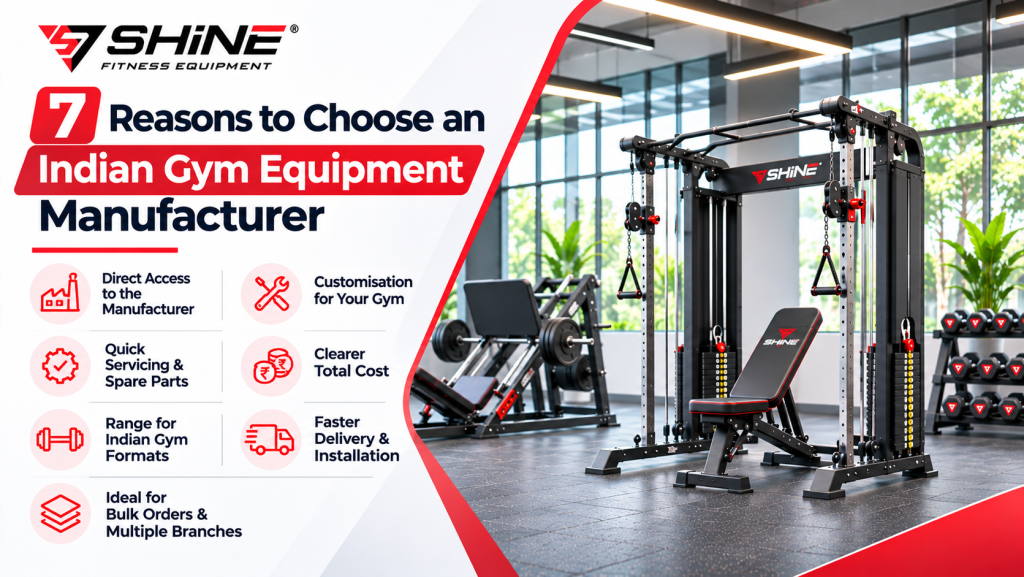
1. Direct Access to the People Who Build the Machine
When you buy from a manufacturer, you can ask about frame dimensions, tube sizes, welding, coating and bearings, and get answers from the team that produces them. With a reseller, those questions often go through a second party. For a facility that will run machines for many hours each day, that direct line to technical detail is valuable.
2. Customisation for Your Floor Plan and Brand
Commercial gyms are rarely identical. A manufacturer can often adjust colours, upholstery, dimensions and station combinations to suit your room and branding. Customisation is not guaranteed by every supplier, so ask early which modifications are possible and whether they affect lead time.
3. Easier Servicing and Spare Parts
A machine that cannot be repaired quickly becomes a dead zone on your floor. A domestic manufacturer typically ships spares within the country and can send a technician more readily than an overseas supplier. Ask each supplier about response times, spares lists and service coverage in your city before ordering.
4. Clearer Total Cost
Imported equipment adds freight, customs, currency movement and sometimes long lead times. Domestic supply tends to make costs easier to predict, and GST treatment is straightforward to put in the quotation. Compare itemised quotes rather than headline prices, and include installation and freight in every comparison.
5. A Range Built Around Indian Gym Formats
Indian commercial gyms range from compact neighbourhood studios to multi-floor clubs, and a local manufacturer is used to supplying across that range. Whether you need a full strength floor or a handful of key stations, the process of choosing, quoting and installing is usually quicker when the supplier is familiar with typical room sizes and member profiles.
6. Faster Delivery and Installation
Domestic production and logistics often shorten the time between order and opening day. Confirm delivery windows in writing, ask who installs the equipment, and request a handover covering cleaning, lubrication and basic inspection routines for your staff.
7. Scope for Bulk Orders and Repeat Business
Multi-branch operators and large gyms benefit from consistent specifications across locations. A manufacturer can quote for bulk gym equipment suppliers type requirements, keep the same finishes across branches and often offer a more flexible approach for later orders.
Quick Reasons Summary
- Direct technical answers from the people who build the machines.
- Options for customisation of finish, dimensions and station layout.
- Local spares and service coverage.
- Fewer cost surprises from freight and customs.
- Practical experience with Indian gym room sizes.
- Shorter lead times in many cases.
- Consistency across multiple branches.
Key Machines to Evaluate
A strong commercial floor usually has a core of versatile strength machines. Here are the main categories to compare across suppliers.
Functional Trainer Machine
A functional trainer machine uses adjustable cable pulleys and lets members train in many planes of movement. It is a flexible station that serves beginners and advanced users. Check pulley quality, cable specification, stack size and smoothness of adjustment. Gamma Fitness lists functional trainer and Smith machine combinations in its online range, and Cosco lists functional trainers with stated stack weights, which shows how common the format is across the Indian market.
Smith Machine
A Smith machine guides the bar on fixed rails, which makes heavy pressing and squatting more controlled for many users. Examine the rail alignment, safety catches and bar glide. Combined units with a half rack or power rack save space, but verify that each function is built to the same standard.
Multi Gym Machine
A multi gym machine places several exercise stations around a central stack. It is a space-efficient choice for smaller gyms and boutique studios. Confirm the number of stations, simultaneous users supported and stack arrangement.
Leg Press Machine
A leg press machine loads the quadriceps, glutes and hamstrings with the lower back supported. Compare 45-degree plate-loaded designs and seated selectorised options, and check seat adjustment, safety stops and footplate size.
Chest Press Machine
A chest press machine gives guided pressing for members who are not yet comfortable with a barbell. Look at handle path, seat range and stack smoothness, because these determine comfort for different body sizes.
| Machine | Main Use | Best Suited For |
| Functional trainer | Cable-based, multi-angle training | Mixed-ability gyms, personal training |
| Smith machine | Guided barbell work | Gyms wanting controlled heavy lifts |
| Multi gym | Several stations on one frame | Compact studios, limited space |
| Leg press | Lower-body strength | Strength floors, rehab-friendly zones |
| Chest press | Guided upper-body pressing | Beginners and general members |
How to Buy Gym Equipment in India Without Costly Mistakes
If you plan to buy gym equipment in India, a structured process will protect your budget.
- Define member profile and goals before choosing machines.
- Measure the room and mark walkways, exits and power points.
- Request itemised quotations with model, dimensions, finish and warranty.
- Test samples where possible.
- Verify service and spares in writing.
- Plan phased delivery if you are opening in stages.
Mistakes to Avoid
- Choosing the cheapest machine without checking frame and finish.
- Buying more stations than the room can comfortably hold.
- Ignoring the service network.
- Skipping installation scope in the quotation.
What to Ask an Indian Gym Equipment Manufacturer Before You Commit
Once you shortlist an Indian gym equipment manufacturer, move from brochures to specifics. A reliable Indian gym equipment manufacturer will answer technical questions plainly and put its answers in writing.
Specification Questions
- Which machines in the range are designed for commercial duty, and how does the Indian gym equipment manufacturer define that?
- What stack weights, cable ratings and frame sections are used on each functional trainer machine and leg press machine?
- Are the Smith machine rails and the chest press machine handles built to the same standard as the frame?
Commercial Questions
- What are the lead times if you order several machines together from bulk gym equipment suppliers like this?
- Does the Indian gym equipment manufacturer quote freight, installation and GST separately?
- Can the Indian gym equipment manufacturer match finishes across a second branch later?
Visiting the Workshop
Where possible, visit the Indian gym equipment manufacturer’s facility or showroom. Watching welding, coating and assembly gives you far more information than a photo gallery. If a visit is not possible, request a video walkthrough of a machine similar to the one you plan to order, and ask a bulk gym equipment suppliers contact to explain how orders are packed and dispatched.
Why This Matters for Long-Term Cost
Each question above protects you from a cost that appears after installation, such as repeated repairs or mismatched finishes. An Indian gym equipment manufacturer who is comfortable with scrutiny usually has little to hide. Treat evasive answers as a reason to look elsewhere.
Making the Final Decision
When you compare offers, give extra weight to the Indian gym equipment manufacturer that answers questions openly and documents warranty terms. Ask each Indian gym equipment manufacturer for references from gyms of a similar size, and call at least one. The right Indian gym equipment manufacturer will welcome that check.
Frequently Asked Questions
Why choose an Indian gym equipment manufacturer?
An Indian manufacturer offers direct technical answers, local spares and service, customisation options, predictable costs and shorter delivery times. These advantages tend to matter most for commercial gyms that need dependable equipment and quick support after installation.
What equipment does a commercial gym need first?
Start with a mix of cardio machines, a functional trainer, selectorised strength machines, a Smith machine or rack, a leg press and free weights. The final list depends on member profile, room size and budget, so plan from the floor layout outward.
Are manufacturers better than traders for bulk orders?
For bulk orders, manufacturers usually offer better control over specification, finish consistency and spares. Traders can supply stock quickly but may have limited influence over build quality. Ask both for written warranty and service terms before deciding.
How do I check gym equipment quality before buying?
Inspect frame thickness, welds, coating, pulleys, cables and padding. Test stability and smoothness in person if you can, and request a specification sheet. Ask about warranty terms and how quickly spare parts can be dispatched.
Which is better for a small gym: multi gym or separate machines?
A multi gym machine is often better for small spaces because it combines several stations in one footprint. Separate machines give more simultaneous capacity and comfort, so the right choice depends on room size and expected peak-time traffic.
How should I plan to buy gym equipment in India?
Define your member profile, measure the room, request itemised quotations, test samples and verify service support. Include installation, freight and GST in every comparison, and avoid choosing purely on price.
What should a bulk quotation include?
A bulk quotation should list each model, quantity, dimensions, finish, warranty, freight, installation, GST and delivery schedule. Itemised quotes make it simple to compare suppliers and prevent hidden costs appearing later.
Conclusion
An Indian gym equipment manufacturer gives commercial gyms direct technical access, customisation, local servicing and clearer costs, all of which reduce risk over the lifetime of the equipment. Judge each supplier on build quality, specification detail, warranty and support, not on headline price alone, and plan the layout before selecting machines. For more background on common training machines, see this overview of weight training equipment.
If you are planning a commercial gym setup, review your available space, equipment requirements and expected usage before selecting individual machines. Explore the relevant Shine Fitness equipment range or contact the team for guidance based on your facility requirements. To see what sets a manufacturer apart, read our guide on why Shine Fitness leads the pack of gym machines manufacturers in India.