
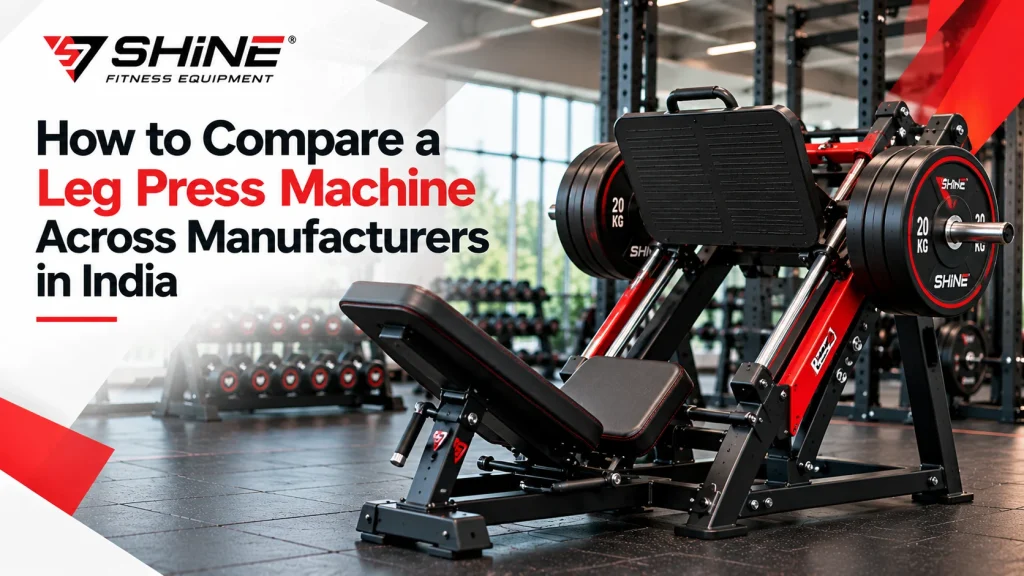
Buying a leg press machine is a major purchase for any gym, and quotes from different makers can look alike while hiding real gaps in build, movement and value. This guide shows how to compare one across manufacturers in India — the formats, the specs that matter, and the signals that separate a 10-year machine from a 10-month one.
The main types of leg press machines
Before comparing brands, it helps to know which type you are actually comparing, because each suits a different space and training style. The leg press itself is a compound lower-body movement — a triple-extension exercise that drives the ankles, knees and hips together — but the machine built around it comes in a few distinct formats.
The most common is the 45-degree press, where the sled travels on an inclined rail set at roughly 45°. It allows heavy loading, often 400 kg or more in plates, and a long range of motion, which is why a 45 degree leg press machine is a staple on serious strength floors. The horizontal or seated version keeps the user upright and the movement level, takes up less vertical space, and is usually easier for beginners and rehab settings.
A hack squat sits in the same family and loads the legs through a guided squat pattern rather than a press. Knowing which format fits your members and your floor is the first step, because comparing an inclined unit directly against a seated one on price alone misses the point — they do different jobs.
Which specifications actually matter in a leg press machine?
When you line up quotes, judge each unit on the details that affect strength, safety and lifespan — not just the headline price. Five specifications carry most of the weight:
- Frame and steel gauge — commercial frames are typically built from 2–3 mm wall steel or 50–75 mm box section, fully welded. Heavier, thicker steel resists flex under load and is the main driver of longevity.
- Load capacity — confirm the rated maximum. Commercial units commonly range from 400 kg to 1,000 kg; aim for 20–30% headroom above what your strongest members will ever load.
- Sled and rail movement — smooth, well-bearinged travel with no play is what makes the press feel safe and consistent rep after rep. Linear bearings usually outlast nylon rollers.
- Footplate size and angle — a plate of around 50 × 60 cm suits different foot positions and body sizes, broadening who can train on it comfortably.
- Safety stops and locks — reliable, easy-to-reach catches are essential on any press where the user sits under a loaded sled.
These are the points where good and poor leg press equipment genuinely diverge. Two machines can share a footprint and a look while differing sharply on steel thickness and bearing quality, so insist on real figures before comparing anything on cost.
45-degree, seated and hack compared
Choosing between formats is easier when you see them side by side. The table below compares the three on the factors that affect suitability and value. Capacity and footprint figures are typical commercial ranges in 2026; exact numbers vary by manufacturer and quote.
| Factor | 45-degree leg press | Horizontal / seated | Hack squat |
| Loading style | Plate-loaded sled | Plate or selectorised | Guided squat |
| Typical load capacity | 450–1,000 kg | 300–600 kg | 400–700 kg |
| Footprint (approx.) | 2.2–2.5 m long | 1.7–2.0 m long | ~1.9 m long |
| Vertical space needed | More | Less | Moderate |
| Ease for beginners | Moderate | Easier | Moderate |
| Best suited for | Strength-focused floors | Studios, rehab, general | Squat-pattern training |
There is no single best format — only the best fit for your space and members. A strength-led commercial floor often prioritises an inclined press, while a compact studio of under 100 m² may prefer a seated unit. Decide the format first, then compare within that type across different manufacturers.
Build-quality signals to compare
Once the format is set, the real comparison is build quality, and this is where manufacturers differ most. A commercial leg press machine that will take 50 or more sessions a week must be judged on construction, not finish alone. Seven signals are worth checking in person:
- Weld quality — clean, even welds at stress points signal careful fabrication; rough or inconsistent welds are a warning sign.
- Bearing and roller quality — the sled should glide without wobble or noise, which depends on good bearings and straight guide rails.
- Upholstery and padding — dense foam of 40 mm or more, well stitched, holds up far better than thin padding under constant use.
- Powder-coat finish — an even coat protects the steel and resists wear from plates and sweat for years rather than months.
- Stability under load — the machine should feel planted, with zero rocking, when loaded to its rated maximum.
- Total machine weight — commercial units often weigh 150–350 kg; a very light frame for its class usually means thinner steel.
- Moving-part count — fewer wear points means fewer things to service over a 10-year life.
These signals matter more on a heavily used floor than on a lightly used one, because high traffic exposes every shortcut. Comparing them properly is what lets you choose a unit that stays safe and smooth for a decade rather than a season.
How do you compare the manufacturer, not just the machine?
Two identical-looking units from different makers are rarely equal, which is why the leg press machine manufacturer behind the quote deserves as much scrutiny as the product itself. The maker determines steel quality, welding consistency, component grade and the support you receive afterward.
When comparing, ask each maker the same five questions: What steel gauge is used? Is the frame fully welded in-house? What is the rated load capacity, and how is it tested? What warranty covers the frame versus the moving parts? What spare-parts and service support come with it? Consistent, specific answers are a good sign; vague ones are not. A typical commercial warranty runs 5–10 years on the frame and 1–2 years on wear parts, so treat anything far below that as a red flag.
Buying from an established gym equipment manufacturer in India that produces its own equipment also means factory-direct pricing and direct servicing, rather than a reseller's margin and a longer support chain. This is also where customisation enters the comparison: a genuine manufacturer can often adjust footplate size, seat position or finish so the unit fits your members and your brand — something a trader simply cannot offer.
When a leg press machine is the wrong buy
An honest comparison includes knowing when not to buy at all. A leg press machine is not the right first purchase in every situation, and recommending it anyway helps no one:
- Your floor is under 50 m² and tight on ceiling height. A 45-degree unit needs 2.2–2.5 m of length plus clearance for the sled and the user's entry. If space is that limited, a seated unit or a well-chosen free-weight rack may serve more members per square metre.
- Your members mostly want functional or sport-specific training. The movement is guided and fixed-path, so it builds quads and glutes well but does little for balance or core stability. A squat rack may fit those goals better.
- Your weekly traffic is very low. If the unit will see only a handful of sessions a week, paying for 1,000 kg of commercial-grade capacity is money better spent elsewhere in the gym.
- The budget forces a trade on safety. If the only affordable option skips proper catches, stops and a stable base, walk away. A cheaper frame that compromises on safety is never the right buy.
If any of these describe your gym, pause and reconsider the format — or the purchase itself — before comparing quotes.
Comparing cost of ownership, not just the sticker
The cheapest quote and the cheapest machine to own are rarely the same thing, so a fair comparison looks past the purchase price to the full 10-year cost. Three factors decide it:
- Maintenance schedule — a commercial unit needs bearings, bolts and upholstery checked every 6–12 months. Frames with fewer moving parts cost less in labour over their life.
- Spare-parts availability — a bearing or cable will eventually fail. A maker that stocks parts locally can turn a multi-day repair into a same-week fix; an importer with no stock may leave a machine idle for weeks, costing far more than the part itself.
- Resale and lifespan — a well-built frame holds value and can run 10–15 years, so its cost per year is often lower than a budget unit replaced after 3–4.
Ask each manufacturer how parts are stocked and serviced before you compare prices. A unit that is 15% cheaper to buy but twice as expensive to keep running is not the saving it appears to be.
Common mistakes when comparing
Most comparison errors come from looking at the wrong things. Avoid these when you weigh up any option:
- Comparing price before specification — a quote that is 15–20% cheaper means nothing until you know the steel gauge, load rating and component quality behind it.
- Ignoring the format — judging a 45-degree unit against a seated one on cost alone compares two machines built for different jobs.
- Overlooking safety features — catches, stops and a stable base are not optional on a loaded press; never trade them away for a cheaper frame.
- Forgetting footprint and clearance — a unit that fits the budget but not the floor plan creates problems after delivery.
- Discounting after-sales support — a cheaper machine with no spare-parts network becomes costly the first time a bearing or cable fails.
The thread running through these mistakes is judging equipment on its sticker instead of its substance. Compare on build, safety and support, and the right choice usually becomes clear.
Frequently Asked Questions
What should I look for when comparing leg press machines?
Compare on build quality, load capacity, sled movement, safety stops and footplate design, then on price. Judge each unit on steel gauge, welding and smoothness of travel, since those decide how safe and durable it is over 10 or more years of use.
Is a 45-degree leg press better than a seated one?
Neither is simply better — they suit different needs. An inclined press allows heavier loading, often 450–1,000 kg, and a longer range, while a seated unit saves space and is easier for beginners. Choose based on your members, training style and available floor.
What load capacity should a commercial leg press machine have?
A commercial unit should offer 20–30% headroom above what your strongest members will load, so it never works at its limit. Many commercial models rate from 400 kg to 1,000 kg, so confirm the tested capacity with the manufacturer before buying.
How much space does a leg press machine need?
Plan for the full footprint plus clearance for the sled's travel and the user's entry and exit. A 45-degree unit generally needs 2.2–2.5 m of length against roughly 1.7–2.0 m for a seated one, so check installed dimensions against your floor plan first.
Does the manufacturer really affect quality?
Yes, substantially. The same design built by a careful maker and a careless one perform very differently. Steel, welding, bearings and finish all depend on the manufacturer, which is why comparing the maker matters as much as comparing the product.
Is a plate-loaded or selectorised leg press equipment?
Plate-loaded presses allow very heavy loading and are common on strength floors, while selectorised units adjust in seconds and are easier for new users. The better choice depends on your members' strength levels and how fast they need to change loads.
How long does a good leg press machine last?
A well-built unit from a reputable gym equipment manufacturer in India can last 10 years or more with routine maintenance of bearings, bolts and upholstery. Longevity depends on build quality, which is why construction should outweigh price in any comparison.
Conclusion
Comparing these machines well is about substance over surface. Settle on the right format for your space and members, then weigh each option on steel gauge, load capacity, sled movement, safety and finish — and give the manufacturer behind it equal scrutiny. A unit judged this way, on build and support rather than headline price, is the one that stays safe and smooth long after a cheaper alternative has worn out.
The practical step is simple: decide your format, write down the specifications that matter, and ask each manufacturer the same questions before you compare quotes. If you are planning a strength floor, review your space and load requirements, then explore the Shine Fitness range or request a quote to match the right machine to how your gym will actually train.


