The bench press vs machine chest press debate comes down to one practical question: do you need a free-weight lift that builds stability and whole-body tension, or a guided movement that lets you push the chest hard with less risk? Both build muscle when they are programmed well. This guide explains how each exercise works, which muscles it loads, where each one fits for different goals, and what gym owners should consider when selecting commercial chest workout equipment for a busy training floor.
Bench Press vs Machine Chest Press: What Is the Difference?
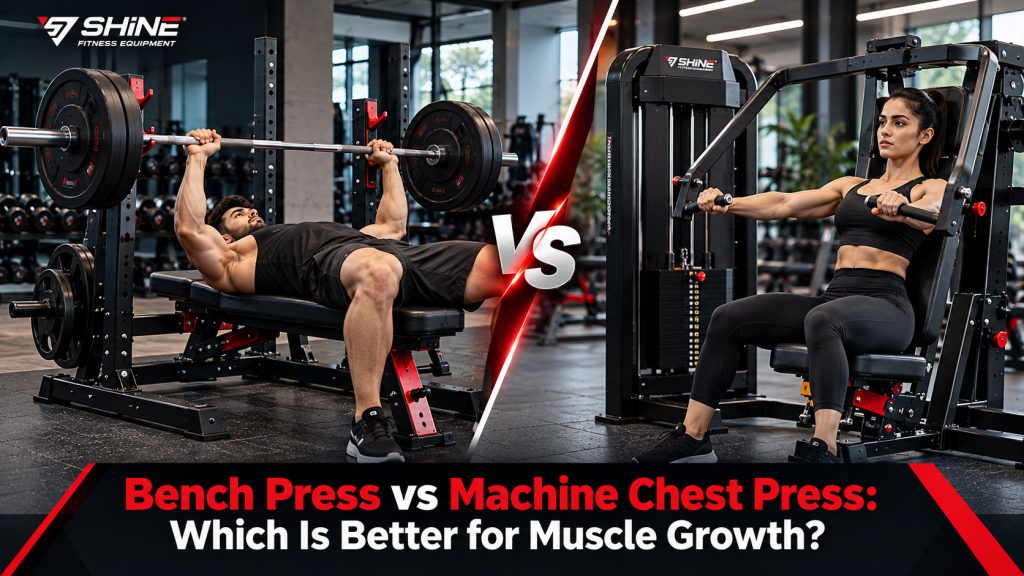
The bench press is a free-weight exercise. You lie on a flat bench, lower a barbell to the mid-chest and press it back up. Nothing guides the bar, so the chest, shoulders, triceps and the small stabilising muscles around the shoulder joint all work together to control its path.
A chest press machine moves the load along a fixed track. You sit upright or slightly reclined, grip the handles and press forward against a weight stack or a plate-loaded lever. The machine controls the path, so less effort goes into balance and more goes directly into pushing.
Put simply, the key difference in bench press vs machine chest press is who controls the movement: you, or the machine. That single distinction shapes how each exercise feels, how safely it can be loaded and which members it suits best.
| Factor | Bench Press | Machine Chest Press |
| Movement path | Free, controlled by the lifter | Fixed, guided by the machine |
| Stabiliser demand | High | Low |
| Spotter needed for heavy sets | Usually yes | Rarely |
| Learning curve | Moderate to steep | Short |
| Loading method | Barbell and plates | Weight stack or plate-loaded arms |
| Best suited for | Strength and athletic carryover | Hypertrophy volume, beginners and controlled training |
Bench Press vs Machine Chest Press for Muscle Growth
Muscle growth depends mainly on mechanical tension, sufficient training volume and sets taken reasonably close to failure. Both exercises can deliver all three, which is why the bench press vs machine chest press question has no single winner for hypertrophy.
The machine has an edge in one area: you can push sets closer to failure without a spotter. When the seat and handles are set correctly, fatigue in the stabilising muscles is less likely to end a set before the chest has been properly worked.
The bench press has its own advantage. Heavier loads and the need to control a free bar recruit more muscle across the upper body, and progress on the barbell is easy to measure over months. In practice, the bench press vs machine chest press comparison for hypertrophy is much closer than most lifters expect.
What Drives Chest Hypertrophy
- Progressive overload: adding weight, repetitions or sets over time, whichever tool you use.
- Proximity to failure: finishing most working sets within one to three repetitions of failure.
- Full range of motion: a deep, controlled stretch at the bottom of every rep rather than short, bouncing reps.
- Consistent weekly volume: a steady number of hard chest sets each week, adjusted to recovery.
Bench Press for Chest Strength and Muscle Development
The barbell bench remains the benchmark upper-body strength lift in gyms, powerlifting and athletic programmes. The main bench press benefits include:
- Whole-body tension: the legs, upper back and core create a stable base for pressing heavy loads.
- Measurable strength: a barbell makes progress easy to track, from light warm-ups to heavy single repetitions.
- Shoulder stability: controlling a free bar trains the rotator cuff and the muscles around the shoulder blades.
- Efficient use of space: one bench, one bar and a set of plates can serve many lifters across the day.
Those bench press benefits only appear with sound bench press technique. Keep the shoulder blades pulled back and down, plant the feet, stack the wrists over the elbows and lower the bar to the lower chest before pressing up and slightly back. Poor bench press technique, such as flared elbows or bouncing the bar off the chest, is a common cause of shoulder irritation.
For gym owners, a solid bench setup means a stable, well-padded bench with secure uprights and enough surrounding space for loading plates safely.
Machine Chest Press for Controlled Chest Training
A chest press machine suits lifters who want to focus on the chest without managing balance. The key machine chest press benefits include:
- Safer failure: you can stop a rep and let the handles return without being pinned under a bar.
- Faster learning: beginners can train productively in their very first sessions.
- Quick load changes: moving a selector pin takes seconds, which makes drop sets simple.
- Joint-friendly paths: many designs follow a converging arc that suits the natural movement of the shoulder.
Those machine chest press benefits also help older members and people returning from injury, and they are valuable in busy gyms where trainers cannot spot every member. Seat height matters: the handles should line up with the mid-chest, not the collarbones, so the load stays on the pectorals rather than the front of the shoulders.
Bench Press vs Machine Chest Press: Which Is Better for Different Goals?
The better choice depends on what the member is training for. Here is how the bench press vs machine chest press decision usually plays out in practice.
Beginners
Start with the machine to learn the pressing pattern and build base strength, then introduce the barbell with light loads once form is consistent.
Strength and Powerlifting
The bench press is essential because it is the lift being tested. Machines work well as accessory volume after the main barbell work.
Bodybuilding and Hypertrophy
Use both. Heavy barbell work early in the session can be followed by machine sets taken close to failure.
Rehabilitation and Older Members
The guided path and adjustable range of a chest press machine generally make it the safer starting point, ideally under qualified supervision.
Bench Press vs Machine Chest Press: Stability, Safety and Technique
Safety is where the bench press vs machine chest press comparison differs most. A free bar can drift or stall, so heavy benching needs a spotter, safety arms or a rack with catch bars. A machine removes most of that risk, although it can still cause strain if the seat is set incorrectly or the weight is jerked.
Common mistakes to avoid on both exercises:
- Lifting the hips off the bench to force out a final repetition.
- Setting the machine seat too high, which shifts the load onto the front shoulders.
- Cutting the range of motion short to lift heavier weights.
- Ignoring worn cables, loose upholstery or damaged bench pads.
The last point is an equipment issue, and it is the main reason well-built commercial gym equipment matters for safety as much as for durability.
Can You Use Bench Press and Machine Chest Press Together?
Yes, and most well-designed programmes do. Framing the topic as bench press vs machine chest press can be misleading, because the two exercises complement each other. A practical session might open with three or four heavy barbell sets, then move to the machine for higher-repetition sets where the lifter can safely train close to failure. On lighter days, the machine can carry most of the chest volume while the bench is used for technique practice.
This combination also spreads demand across the gym floor, which matters during peak hours when every bench is taken.
How to Choose the Right Chest Training Equipment for Your Gym
For a facility, the question shifts from which exercise is better to which mix of equipment serves your members. Settling the bench press vs machine chest press question at facility level usually means offering both. Consider:
- Member profile: beginners and older members need more machines, while strength-focused gyms need more benches and racks.
- Floor space and flow: machines take a fixed footprint, while benches need clear space for loading plates.
- Build quality: heavy-gauge steel, stable welds, durable upholstery and smooth pulleys.
- Service and spares: a local gym equipment manufacturer can supply parts and adjustments faster than an overseas supplier.
Most commercial facilities benefit from flat, incline and Olympic benches alongside at least one chest press machine and a pec fly station. Buying directly from a gym equipment manufacturer such as Shine Fitness, which builds its range in-house at Chandrala, Gujarat, also makes it easier to discuss specifications and finishes for the whole floor.
Frequently Asked Questions About Bench Press and Machine Chest Press
Is the machine chest press as good as the bench press for building muscle?
Yes, for pure muscle growth a machine chest press can be just as effective when sets are taken close to failure with enough weekly volume. The bench press offers more strength carryover and stabiliser work, so many lifters use both for complete chest development.
Which is safer, bench press or machine chest press?
The machine chest press is generally safer because the handles follow a fixed path and you can stop a rep without being trapped under a bar. The bench press is safe with good bench press technique, a spotter or safety arms, and sensible loading.
Should beginners start with the bench press or a machine?
Most beginners benefit from starting on a machine to learn the pressing pattern and build base strength. Once they can control the movement, adding a light barbell bench press helps them develop stability, coordination and the full range of bench press benefits over time.
Can I do bench press and machine chest press in the same workout?
Yes. A common approach is heavy barbell sets first, while you are fresh, followed by machine sets in a higher repetition range. This pairing combines strength work with safe, high-effort hypertrophy volume and is one of the most practical ways to train the chest.
What muscles does the machine chest press work?
The machine chest press mainly works the pectoralis major, with the front deltoids and triceps assisting. Because the machine manages balance, stabiliser activity is lower than on the bench press, which is one of the key machine chest press benefits for isolating the chest.
What chest equipment should a commercial gym have?
This mix of commercial chest workout equipment covers beginners, strength lifters and bodybuilders, and reduces queues during peak hours. To learn more about choosing benches, read our guide on the top commercial gym bench types for modern gyms.
How do I choose a reliable gym equipment manufacturer?
Check frame thickness, weld quality, upholstery, warranty terms and whether spare parts are available locally. Ask for a written specification for every machine, and prefer a gym equipment manufacturer that builds its equipment in-house rather than rebadging imported stock.
Conclusion
The bench press vs machine chest press choice is not about picking a single winner. The bench press builds measurable strength, stability and full upper-body control, while the machine chest press lets members train the chest hard, safely and with less technical demand. For most lifters, the best results come from combining both.
For gym owners, understanding bench press vs machine chest press leads to an equally practical takeaway: a floor that offers both options serves every member, from first-timers to competitive lifters. Durable commercial gym equipment and a well-planned range of commercial chest workout equipment keep both stations busy, safe and reliable for years.
If you are planning or upgrading a chest training zone, map out your member mix and available floor space first. Explore the Shine Fitness bench and strength range, or request a quote for a specification based on your facility's requirements.