The pendulum squat is a plate-loaded leg machine that guides your body along a curved path, letting you train your legs hard with less demand on balance and lower-back stability than a free barbell squat. This article explains how the movement works, which muscles it targets, where it fits in a leg programme, what its limitations are, and what gym owners should look for when choosing one for a training floor.
What Is a Pendulum Squat Machine?
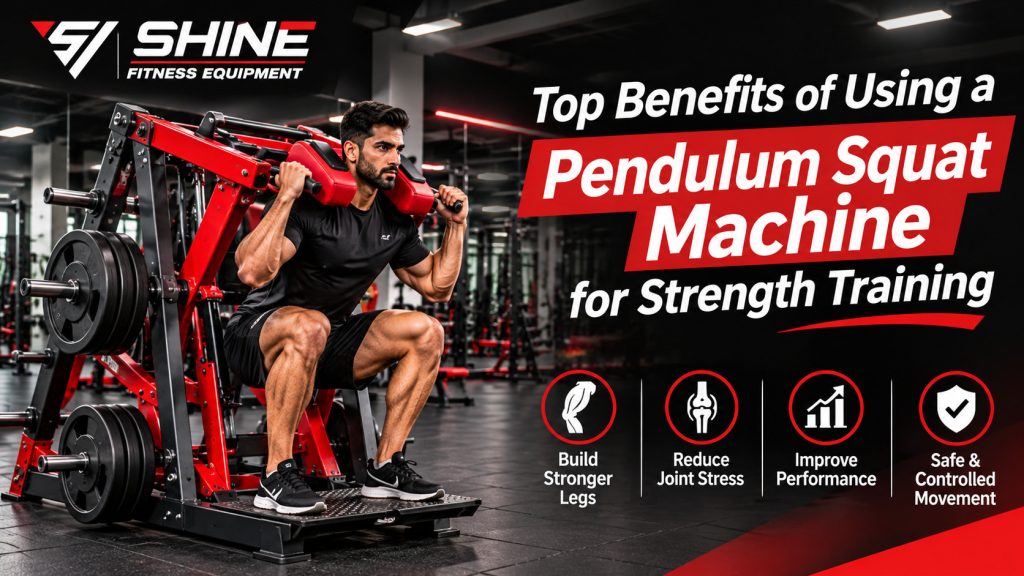
A pendulum squat machine uses a lever arm that pivots from a fixed point, much like the swing of a pendulum. The lifter stands on a footplate, places the shoulders under padded supports, and squats while the arm carries the load through an arc rather than a straight vertical line.
This arc is the defining feature. In a barbell squat, the lifter must control the bar path, balance and trunk position at once. In a pendulum squat, the machine controls the path, so the lifter can concentrate on pushing through the legs. Most designs let you adjust stance position and, in some cases, pad height, which changes how the movement feels for different body proportions.
Because the machine is plate-loaded, resistance is set by adding weight plates. This suits commercial gyms that already stock plates for other leg and strength stations, and it gives lifters a wide, progressive load range.
How the Pendulum Squat Exercise Works
The pendulum squat exercise follows a controlled descent and drive. As you lower, the hips and knees bend while the machine arm rotates through its arc. As you press up, the knees and hips extend and the arm returns to its starting position.
Setup and Technique
A sound setup makes the biggest difference to results and comfort:
- Adjust the pads or stance so the shoulders sit securely beneath the supports.
- Place the feet on the platform at a width that feels natural for your hips.
- Brace the trunk, release the safety handles as designed, and lower under control.
- Descend to a depth your mobility allows, keeping the heels grounded.
- Drive upward without bouncing at the bottom, and stop before the knees lock aggressively.
Foot position changes the emphasis. A lower, narrower stance generally shifts more demand toward the knee extensors, while a higher, wider stance tends to involve more hip extension. Experiment gradually and keep the movement pain-free.
Pendulum Squat Muscles Worked
Understanding pendulum squat muscles worked helps you place the machine correctly in a programme. The primary mover is the quadriceps group at the front of the thigh, which extends the knee. The glutes work to extend the hip, particularly at deeper positions, and the adductors assist from the inner thigh.
The hamstrings play a supporting role at the hip, and the calves contribute as stabilisers. The trunk muscles still brace, though the machine reduces the stabilising demand compared with a free barbell. For a deeper anatomical background on the front-thigh muscles, see this overview of the quadriceps femoris.
Muscle Involvement at a Glance
- Quadriceps: primary driver of knee extension, especially with a lower, narrower stance.
- Glutes: contribute to hip extension, with greater involvement at deeper depth.
- Adductors: assist stability and hip extension, particularly with a wider stance.
- Hamstrings and calves: supporting roles that help control movement and stabilise joints.
- Trunk muscles: brace throughout the lift, though demand is lower than in a free squat.
Pendulum Squat Benefits for Strength Training
The main pendulum squat benefits come from combining heavy leg loading with a guided movement path. These advantages are practical rather than magical, and they are most valuable when the machine is used within a balanced programme.
Benefits of the Pendulum Squat Machine
The benefits of the pendulum squat machine fall into several categories:
- Guided movement path: the arc reduces the balance demand, so lifters can focus effort on the legs.
- Lower spinal loading demands: because the shoulders and trunk are supported, many lifters find it easier on the lower back than a heavy barbell squat, although individual tolerance varies.
- Progressive overload: adding plates lets lifters increase resistance gradually and track progress clearly.
- Safer high-effort sets: safety handles and a fixed path make training close to failure more manageable than with an unsupported bar.
- Accessible for many experience levels: newer lifters can learn leg-driving mechanics without mastering a barbell squat first.
For facility owners, the key benefits of pendulum squat machine training include added variety in a leg area that might otherwise rely on a rack and a leg press.
Pendulum Squat for Quadriceps Development
Many lifters choose the pendulum squat for quadriceps training because the arc and supported torso allow deep knee flexion with a strong focus on the thighs. When the stance is placed lower and the heels stay grounded, the front thigh does much of the work.
A few practical principles apply. Use a full, controlled range of motion that your joints tolerate, and avoid bouncing out of the bottom position. Moderate to high repetition ranges often suit machine-based work, since the stable setup allows lifters to push close to failure with good form. For a complementary movement, pair this exercise with single-joint work such as the leg extension and curl machines found in a strength equipment range.
Pendulum Squat for Leg Strength Programming
Using the pendulum squat for leg strength works best when it supports, rather than replaces, other lower-body movements. It can be a main lift for lifters who find barbell squats uncomfortable, or an accessory that adds volume after heavy compound work.
A simple approach is to treat the pendulum squat exercise as a quad-focused strength builder. Start with a weight that allows controlled repetitions, then increase load or repetitions gradually over several weeks. Combine it with hip hinges, lunges or a squat rack for free-weight variety so the legs are trained through different movement patterns.
Programming Tips
- Place it early in a leg session if you want it to be the main strength driver.
- Place it after a barbell squat if you want a pendulum squat for quadriceps volume without more spinal loading.
- Increase load only when you can complete repetitions with consistent depth and control.
- Rest adequately between sets to maintain quality on heavy work.
Pendulum Squat vs Other Leg Machines
This movement is one of several machine-based leg options. The comparison below uses qualitative differences only.
| Factor | Pendulum squat | Barbell back squat | Hack squat | Leg press |
| Movement path | Curved arc guided by lever | Free path controlled by lifter | Fixed, angled path | Fixed path pushing a sled away |
| Balance demand | Low | High | Low | Very low |
| Trunk stabilisation | Reduced | High | Reduced | Minimal |
| Typical emphasis | Quadriceps, glutes | Whole lower body and trunk | Quadriceps | Quadriceps, glutes |
| Space and set-up | Dedicated machine with plates | Rack, bar and plates | Dedicated machine with plates | Dedicated machine with plates |
| Best suited for | Quad-focused strength and hypertrophy | General strength and athletic development | Quad-focused training | High-volume or rehab-friendly loading |
No single option is best for everyone. A well-equipped facility usually offers several so members can match the exercise to their goals and comfort.
Limitations and Mistakes to Avoid
The machine is effective, but understanding its limits prevents poor choices.
- Treating it as a complete replacement for all free-weight squatting, which also trains balance and full-body coordination.
- Using an excessively heavy load that shortens the range of motion.
- Placing the feet in a position that causes knee or hip discomfort rather than adjusting the stance.
- Bouncing out of the bottom position instead of controlling the turnaround.
- Ignoring individual limitations, such as joint pain, and failing to seek professional guidance when needed.
Lifters with existing injuries or medical conditions should consult a qualified professional before adding any new loaded exercise.
What Gym Owners Should Look For
If you are adding this machine to a commercial floor, weigh the pendulum squat benefits against your floor space, then focus on construction and usability. Look for a stable base, smooth pivot hardware, adjustable pads and clear safety handles. Confirm the footplate size and grip surface, and check that plate-loading is straightforward and secure.
Think about floor space and plate storage too. The machine needs room to load and unload plates safely, plus clearance around it for members to enter and exit. Ask the supplier about finish, installation support and spare-part availability, since heavily used leg machines face constant stress.
Frequently Asked Questions
What is a pendulum squat?
A pendulum squat is a plate-loaded machine exercise in which the lifter squats while a pivoting lever arm moves the load through a curved path. The guided arc reduces balance demands and lets lifters focus on driving through the legs with controlled resistance.
What muscles does the pendulum squat work?
The pendulum squat muscles worked are mainly the quadriceps, with the glutes and adductors assisting. Hamstrings and calves help stabilise, and the trunk braces throughout. Foot position changes the emphasis, with a lower, narrower stance generally increasing quadriceps involvement.
Is the pendulum squat better than a barbell squat?
Neither is universally better. The machine offers guided movement and lower balance demands, which suits quad-focused work. The barbell squat trains balance, coordination and trunk stability more broadly. Many lifters use both depending on goals and joint comfort.
Is the pendulum squat good for beginners?
Yes, many beginners find it approachable because the machine controls the movement path. They can learn leg-driving mechanics with a lighter load. Proper setup, controlled depth and gradual progression remain important, and a trainer can help check technique.
How deep should I squat on a pendulum machine?
Squat to a depth you can control with heels grounded and no joint pain. A fuller range often increases quadriceps and glute involvement, but depth should reflect your mobility. Avoid forcing extra range or bouncing out of the bottom position.
How often should I use the pendulum squat?
Most lifters include it once or twice a week within a leg programme, depending on total training volume and recovery. Increase load gradually and monitor how your legs and joints respond before adding more sessions or sets.
Can the pendulum squat replace the leg press or hack squat?
It can replace them in a programme, but each machine feels different. It follows a curved path, the hack squat uses an angled fixed path, and the leg press pushes a sled. Variety may help lifters train different strengths and positions.
Conclusion
The pendulum squat earns its place in a modern strength programme because it combines heavy leg loading with a guided, controlled movement path. It suits quad-focused training, supports progressive overload through plates, and gives lifters of many levels a comfortable way to build lower-body strength. Its limits are equally clear: it complements, rather than replaces, free-weight squatting, so pair a pendulum squat for leg strength with other lifts. Good technique still matters. For gym owners, it adds variety and quality to a leg area when it is well built and properly installed.
If you are planning a leg training area, review your available space, member needs and expected usage before selecting individual machines. Explore the relevant Shine Fitness plate-loaded range or request a quote for guidance based on your facility requirements. To see how it compares with other squat-pattern equipment, read our Smith machines vs free-weight power racks guide.