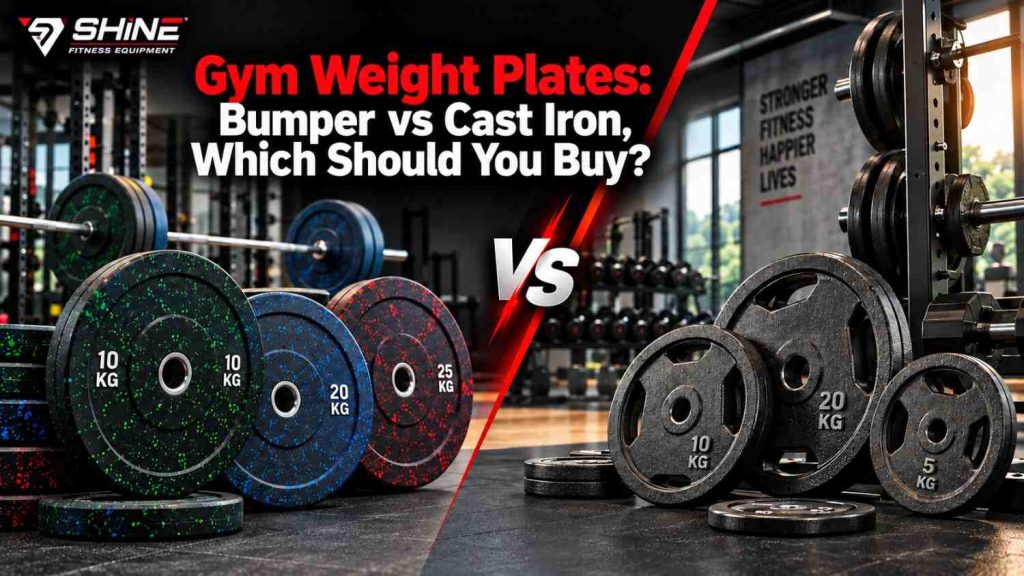
Choosing gym weight plates looks simple until you compare two sets at similar prices and find one lasts a decade while the other chips, rusts and drifts out of tolerance within a year. This guide explains how each plate type is built, where bumper and cast iron designs genuinely differ, what bore size and weight tolerance mean in practice, and how to match a set to the way your gym trains. You will also learn what drives cost and which specifications are worth insisting on.
What Gym Weight Plates Have to Withstand
Gym weight plates spend their life being loaded, unloaded, stacked, dragged and occasionally dropped. In a commercial setting hundreds of people handle them with no thought for the flooring, and that environment punishes weak material choices quickly.
Three properties decide whether a set holds up. Impact tolerance: what happens when a loaded bar returns to the floor. Dimensional accuracy: whether the bore fits the bar cleanly and the stated mass matches the real one. Surface durability: whether the finish survives contact with racks and other plates.
Buyers focus on the third because it is visible in photographs. In practice the first two decide whether your gym weight plates still perform correctly after two years, and they are the hardest to judge from a listing.
The Three Main Types of Gym Weight Plates
Most gym weight plates fall into three construction families. Each solves a different problem, and buying the wrong family for your training style is the most common and most expensive mistake.
Cast Iron Plates
Traditional cast iron plates are machined or cast solid iron with a painted, enamelled or bare finish. They are thin for their mass, which matters on a heavily loaded bar, and cheapest per kilogram.
Their limitation is impact. Dropping loaded iron gym weight plates damages the plate and the floor, and bare iron surface-rusts in humid conditions. They suit powerlifting, machine loading and strength work where the bar is set down rather than released.
Bumper Plates
Bumper plates use a dense rubber body around a steel or brass insert hub. They are built to be dropped from overhead, which makes them essential for Olympic weightlifting and most CrossFit-style programming.
All bumpers share the same diameter regardless of mass, so the bar sits at a consistent height whether loaded to 20 kg or 180 kg. The trade-off is thickness: heavy loads take up considerably more sleeve length than the equivalent in iron, and the rubber is more expensive per kilogram.
Rubber-Coated and Urethane Plates
Rubber-coated plates wrap a cast iron core in a bonded rubber shell. They protect floors and racks, run quieter than bare iron and resist corrosion, while staying thinner than a full bumper. Urethane versions use a tougher, colour-stable coating at higher cost.
These rubber plates are not built for repeated overhead drops. They are the practical middle option for commercial gym weight plates on general floors where noise, floor protection and appearance matter but Olympic lifting is not the primary activity.
Comparison Table: Bumper vs Cast Iron vs Rubber-Coated
| Factor | Cast Iron | Bumper | Rubber-Coated |
| Core construction | Solid iron | Dense rubber with steel hub | Iron core, bonded rubber shell |
| Drop tolerance | Low; control the descent | High; designed for drops | Moderate; occasional drops only |
| Thickness per kg | Thinnest | Thickest | Between the two |
| Floor and rack protection | Poor | Good | Good |
| Noise | Loudest | Quietest | Quiet |
| Corrosion resistance | Low unless coated | High | High |
| Cost per kg | Lowest | Highest | Middle |
| Best suited for | Powerlifting, machine loading | Olympic lifting, CrossFit | Mixed commercial floors |
No single column wins. Most commercial weight plates inventories draw on two of these families: bumpers for a dedicated lifting platform, and iron or rubber-coated plates for racks, benches and plate-loaded stations.
Olympic Versus Standard Bore
Bore size is the specification most often overlooked on gym weight plates, and getting it wrong makes an entire set unusable. Olympic weight plates have a 50 mm centre hole and fit Olympic bars and most commercial plate-loaded machines. Standard plates use a smaller bore, typically around 25 to 28 mm, and fit lighter domestic bars only.
Commercial facilities should specify Olympic weight plates throughout. It is the accepted standard for bars, racks and plate-loaded equipment, so a single plate inventory serves every station on the floor. Mixing bore sizes creates storage confusion and leaves members holding plates that will not fit the nearest bar.
Check the hub as well as the hole. Olympic weight plates with a steel-lined or machined hub keep their fit for years, while unlined holes in soft material widen and rattle on the sleeve. For a general technical overview of plate standards, the Wikipedia article on weight plates is a useful neutral reference.
Key Factors to Check Before Buying
- Weight tolerance. Ask for the tolerance your gym weight plates are held to, usually expressed as a percentage of nominal mass. Tighter tolerance matters most for competition and for progressive overload at low increments.
- Bore finish. A machined or steel-lined bore slides on and off cleanly. Rough, unlined bores scratch bar sleeves and loosen over time.
- Hub bonding on rubber plates. The hub-to-rubber joint is the usual failure point. Ask how the insert is bonded and whether replacements are available.
- Flatness. Plates that do not sit flat wobble on the sleeve, rock on storage pegs and wear unevenly.
- Finish quality. Powder coat or e-coat over prepared iron resists chipping and sweat far better than a single layer of paint.
- Increment coverage. A usable set needs fractional plates as well as heavy ones, or progression stalls at the smallest available jump.
Matching Plates to How Your Facility Trains
- Powerlifting and general strength gyms. Cast iron or rubber-coated plates in a full increment range, paired with solid racks and benches. Impact tolerance matters less than thinness and cost per kilogram.
- Olympic lifting and functional training. Bumper plates on a dedicated platform, since dropping loaded bars is part of the programme rather than an accident.
- Mixed commercial gyms. Rubber-coated plates across the main floor for noise and floor protection, with a bumper set on one platform.
- Hotel, corporate and residential gyms. Rubber-coated commercial weight plates in a limited range, because noise transmission and floor damage are the dominant concerns.
- Machine-heavy facilities. Standardise on Olympic bore so the same commercial weight plates serve every plate-loaded station without duplication.
What Actually Drives Weight Plates Price
The weight plates price you are quoted reflects raw material mass, machining, finishing and freight, and those four factors explain nearly every difference between two apparently similar quotations. Rubber and urethane cost more per kilogram than iron, which is why bumpers sit at the top of the range.
Machining is the hidden variable. Tighter tolerance and a properly finished bore need more process steps, and a supplier quoting well below market usually loosens one of them. For weight plates India buyers, freight matters more than expected: plates are dense, so a low unit price with high delivery cost often ends up dearer.
When comparing any weight plates price, compare cost per kilogram at a stated tolerance rather than headline set prices. Two sets described identically can differ substantially once tolerance and finish are held constant. The weight plates India market now spans imported competition-grade sets and domestically produced commercial ranges, so ask which category a quotation refers to. Most weight plates India suppliers quote iron and rubber-coated ranges as separate lines, so confirm you are comparing like with like.
Storage and Maintenance
- Store plates off the floor. Vertical pegs or horizontal trees keep plates dry, protect edges and remove trip hazards. Dedicated storage extends usable life more than any other single measure.
- Separate the families. Keeping bumper and iron plates on different storage prevents chipping and makes loading faster during busy periods.
- Inspect hubs quarterly. Check rubber plates for early separation at the insert and retire any plate showing movement.
- Control humidity on bare iron. Wipe down and lightly oil exposed iron in humid climates; surface rust spreads faster than most operators expect.
Good storage also protects the equipment around your gym weight plates. Loose plates on the floor damage flooring, bar sleeves and machine frames, and cause a large share of avoidable member injuries.
Conclusion
The right gym weight plates depend on how the bar leaves your hands. If loaded bars are dropped, bumpers are not optional. If lifting is controlled and floor space is tight, cast iron gives you the most weight in the least sleeve length. If your priority is a quiet, durable, floor-friendly commercial gym floor, rubber-coated plates sit sensibly between the two. Standardise on Olympic bore, insist on a stated weight tolerance and a properly finished bore, and budget for dedicated storage from the outset that last decision protects your investment more than any other.
If you are planning or expanding a facility, work out your bar count, platform requirements and plate storage capacity before finalising quantities, since storage and plate-loaded stations determine how a set is actually used day to day. Explore the Shine Fitness plate storage and plate-loaded equipment range for the racks and stations that hold and use those plates.
Frequently Asked Questions
Are bumper plates better than cast iron plates?
Neither is better in general. Bumpers are essential where loaded bars are dropped from height, while iron gym weight plates are thinner and cheaper per kilogram for controlled lifting and machine loading.
What bore size should I buy for a commercial gym?
Specify 50 mm Olympic bore throughout. It matches Olympic bars, racks and virtually all commercial plate-loaded machines, so one plate inventory serves every station on the floor.
Can I drop rubber-coated plates?
Only occasionally and from low height. Rubber-coated plates protect floors and reduce noise, but the iron core and bonded shell are not engineered for the repeated overhead drops that bumpers absorb.
How accurate should gym weight plates be?
Commercial training plates are typically supplied within a small percentage tolerance of nominal mass, while competition plates are held far tighter. Ask for the figure in writing rather than assuming a standard.
How long do gym weight plates last?
Well-finished plates that are stored properly commonly last well over a decade. Failures usually come from hub separation on rubber plates, chipped coatings on iron, or damage caused by leaving plates on the floor.
What increments should a complete set include?
Cover the full range from fractional plates through to the heaviest denomination you expect to load. Missing small increments is the most common gap, and it prevents members from progressing in manageable steps.
Do I need different plates for machines and barbells?
Not if you standardise on Olympic bore. The same gym weight plates then load barbells, plate-loaded machines and racks, which simplifies both purchasing and storage.