
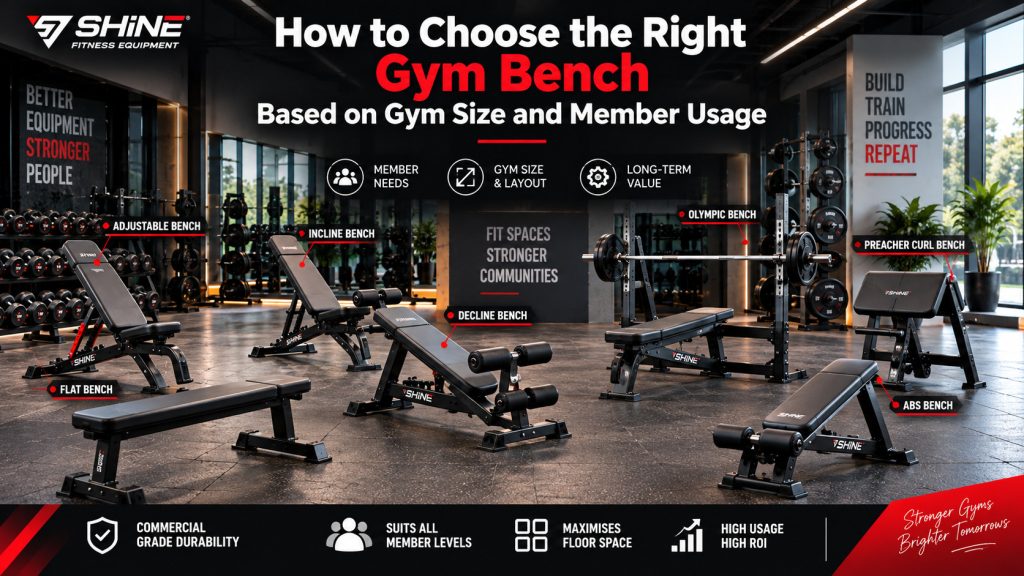
Choosing the right gym bench mix is one of the least glamorous and most consequential decisions in a commercial fitness setup, because benches are used in more exercises than any other single piece of equipment on the floor. This guide covers the ten bench formats that earn their space in a commercial facility, what separates commercial construction from light-duty construction, and how to work out how many units your floor actually needs. By the end you will be able to build a bench list based on your member profile rather than on a supplier’s catalogue order.
Types of the Best Gym Benches
A bench is not one product. The category covers fixed-angle platforms, multi-position units, Olympic stations with integrated uprights, and specialised isolation benches. The ten formats below cover almost every requirement a general-purpose commercial gym will encounter.
Flat Bench
The flat bench is the reference point for the whole category. It supports dumbbell pressing, rows, step-ups, hip thrusts, and dozens of accessory movements. A good flat bench sits at a pad height that lets an average user plant both feet firmly, and its frame does not shift laterally under an offset load. Most facilities underestimate demand here, the flat gym bench is usually the busiest unit on the floor.
The dual-axis flat bench is a variant worth knowing. Its frame geometry improves stability and reduces the tendency to rock during heavy single-arm work, which makes it a sensible upgrade in a free-weight-heavy facility.
Adjustable Bench
The adjustable, or utility, bench is the most versatile piece of workout bench equipment you can buy. A multi-position back pad covers flat, incline, and in many cases decline positions from a single footprint. In small studios this is the single highest-return purchase, because one unit replaces three fixed benches and reduces the total workout bench equipment budget considerably.
Two variants deserve separate mention. The super adjustable bench extends the angle range and adds seat adjustment, which matters for shorter members who slide down the pad on steep inclines, and it is the most requested gym bench machine feature in mixed-ability facilities. The new adjustable bench format typically offers a faster ladder or pop-pin adjustment mechanism, which reduces the time members spend fiddling between sets, a small detail that becomes visible during peak hours.
Incline and Abs Bench
Dedicated incline benches remain a useful fitness bench format in busy facilities even when adjustable units are present, simply because they remove adjustment time and hold their angle permanently. Paired with them, the abs bench covers crunches, sit-ups, and decline core work, and it is often the fitness bench that sees the most beginner traffic in a gym.
As a fitness bench for general members, it is also easy to use without instruction. The decline bench completes the angle set for pressing, while the Olympic decline bench adds integrated uprights so a loaded barbell can be racked directly.
Olympic and Specialist Benches
- Olympic flat bench. A flat pad with barbell uprights, sized for a standard Olympic bar. This is the classic commercial gym bench for barbell pressing and needs clear space behind it for a spotter.
- Olympic multi-purpose bench. Combines flat, incline, and decline pressing with uprights in one station, which saves considerable floor area in mid-sized gyms.
- Preacher curl bench. An angled pad that fixes the upper arm and isolates the biceps, removing the swing that limits standing curls.
- Standing preacher curl bench. The same isolation principle in a standing position, with a smaller footprint and quicker entry and exit.
- Utility bench. A compact flat-to-incline unit designed to be moved around the floor as needed, rather than occupying a fixed station. It is the most flexible piece of exercise bench equipment in the list.
Together these ten formats represent the practical range of weight bench types used across commercial facilities. Few gyms need all ten of these weight bench types, but nearly every gym needs a considered subset. Deciding which weight bench types to stock is the first step in planning the free-weight floor.
| Bench Type | Primary Use | Footprint | Best Suited For |
| Flat bench | Dumbbell press, rows, hip thrusts | Small | Every facility, in multiples |
| Adjustable bench | Flat, incline and decline in one unit | Small | Studios and space-limited floors |
| Incline bench | Upper-chest pressing | Small | Busy free-weight zones |
| Abs bench | Core and decline sit-ups | Small | Beginner and general fitness areas |
| Olympic flat bench | Barbell bench press | Large | Strength-focused gyms |
| Olympic decline bench | Declined barbell pressing | Large | Full strength setups |
| Multi-purpose Olympic | All barbell press angles | Large | Mid-sized commercial gyms |
| Preacher curl bench | Isolated biceps work | Small | Bodybuilding-oriented floors |
| Standing preacher bench | Isolated biceps, standing | Very small | High-traffic accessory zones |
| Utility bench | Portable flat and incline work | Very small | Functional and class areas |
What to Look for in a Commercial Bench
The gap between a home-use bench and a commercial one is not always visible in a photograph. It shows up in duty cycle. A home unit might see a few sessions a week; a commercial unit may be loaded, unloaded, sat on, dragged, and knocked into hundreds of times a day. That difference drives every specification that matters when you evaluate a gym bench machine for a paying membership, and it is the reason a commercial gym bench costs more than a visually similar domestic unit.
Load Rating and Frame Gauge
Load rating should account for the user’s bodyweight plus the total weight being lifted, not just the barbell. Heavier-wall steel tubing and larger cross-sections resist deflection and twisting better than thin-wall alternatives, which is why commercial frames are visibly bulkier than domestic ones. Ask any supplier for the rated capacity of each bench and the basis of that rating, rather than accepting a headline number in isolation.
Weld quality matters as much as material. Continuous, well-dressed welds at stress junctions, where the uprights meet the base, and where the back pad bracket meets the frame, are the points that fail first under repeated loading. Powder-coated finishes protect against the humidity and sweat exposure that are unavoidable in Indian gym environments.
Upholstery and Stability
- Pad density. Foam that is too soft compresses under load and reduces stability; foam that is too firm becomes uncomfortable during long sets. Commercial units aim for a firm, supportive middle ground.
- Cover material. Sweat-resistant, easily wiped vinyl or synthetic leather extends service life. Stitching quality determines where the first tear appears.
- Base footprint and feet. Wide, rubber-footed bases resist tipping and protect flooring. Feet should be replaceable.
- Adjustment mechanism. Ladder, pop-pin, and pneumatic systems each have trade-offs in speed, durability, and cost. Whatever the design, it should lock positively with no play.
- Gap between seat and back pad. A smaller gap improves comfort on incline work and is a mark of better design.
A further practical point: replacement upholstery should be available separately. Pads wear long before frames do, and a facility that can re-upholster rather than replace protects its investment in workout bench equipment. When comparing exercise bench equipment from different suppliers, spare-part availability is worth asking about before the order, not after.
How Many Benches a Gym Needs
There is no universal formula for how much bench capacity a floor needs, but there is a usable method. Count your peak-hour occupancy, estimate what proportion of members will be in the free-weight and machine zones at that time, and work backwards. A bench that is occupied continuously during peak hours is a bottleneck regardless of how good it is.
Practical Planning Guidelines
- Weight the mix towards flat and adjustable units. These cover the widest range of exercises and see the highest turnover.
- Add Olympic stations according to your strength-training demand. A gym whose members mainly do barbell work needs more; a general-fitness club needs fewer.
- Treat specialist benches as accessory capacity. One preacher station is usually sufficient in a mid-sized gym.
- Plan working space, not just footprint. Each station needs clearance for entry, exit, spotting, and dumbbell handling.
- Keep one or two portable utility benches spare. This exercise bench equipment absorbs overflow demand and supports class or functional sessions.
Placement matters as much as quantity. Every gym bench belongs near the dumbbell racks it serves, with enough aisle width that a member walking past does not force a lifter to break position. Facilities that treat bench equipment gym layout as an afterthought usually end up rearranging within the first year. Reviewing established training equipment standards, including general guidance on weight training practice, helps set realistic expectations for how members will actually use the space.
Frequently Asked Questions
What is the best gym bench type for a commercial gym?
The adjustable gym bench offers the widest exercise coverage from one footprint, making it the most valuable single purchase. Most commercial gyms then add multiple flat benches and at least one Olympic station to handle barbell pressing demand.
How many benches does a commercial gym need?
There is no fixed ratio. Base the number on peak-hour occupancy and the proportion of members using free weights. Flat and adjustable benches should form the majority, with Olympic and specialist units added according to actual demand.
What is the difference between a commercial and a home bench?
A commercial gym bench is built for continuous daily use, with heavier frames, higher load ratings, denser upholstery, and replaceable components. Home bench equipment gym owners sometimes buy by mistake is lighter, cheaper, and not designed for the duty cycle of a paying membership.
Is a flat bench or an adjustable bench better?
An adjustable bench covers more exercises, but a flat bench is more stable and faster to use. Most commercial floors need both: several flat benches for high-turnover pressing work, plus adjustable units for incline and decline variations.
What should I check before buying a gym bench?
Check the load rating, frame construction and weld quality, pad density, adjustment mechanism, base stability, and the availability of replacement upholstery for any bench equipment gym buyers are quoted. Confirm the footprint including the clearance needed around the unit.
How long does a commercial gym bench last?
With correct use and routine maintenance, a well-built commercial frame lasts many years. Upholstery and adjustment hardware wear sooner and are normally replaced periodically, which is why spare-part availability affects total cost of ownership.
Do preacher curl benches justify the floor space?
In bodybuilding-focused and general commercial gyms, yes, they isolate the biceps in a way free-weight curls cannot. Standing versions deliver similar benefit in a smaller footprint where space is constrained.
Conclusion
Building a bench list is an exercise in matching formats to demand. Among the weight bench types available, flat and adjustable units carry the bulk of the load in almost every facility; Olympic stations serve barbell-focused members; preacher and abs units add depth once the basics are covered. Above all, specification matters more than variety, a smaller number of properly constructed commercial units will outlast and outperform a larger number of light-duty ones. When you evaluate any gym bench, look at frame construction, load rating, upholstery quality, and how easily worn parts can be replaced, then plan placement around the dumbbell and barbell zones those benches actually serve.
If you are specifying benches for a new gym or upgrading an ageing free-weight area, start by measuring your peak-hour usage and available floor space. Explore the Shine Fitness bench range or contact the team to discuss a bench mix suited to your facility size and membership profile.

